What Is the Lowest Magnification Binoculars
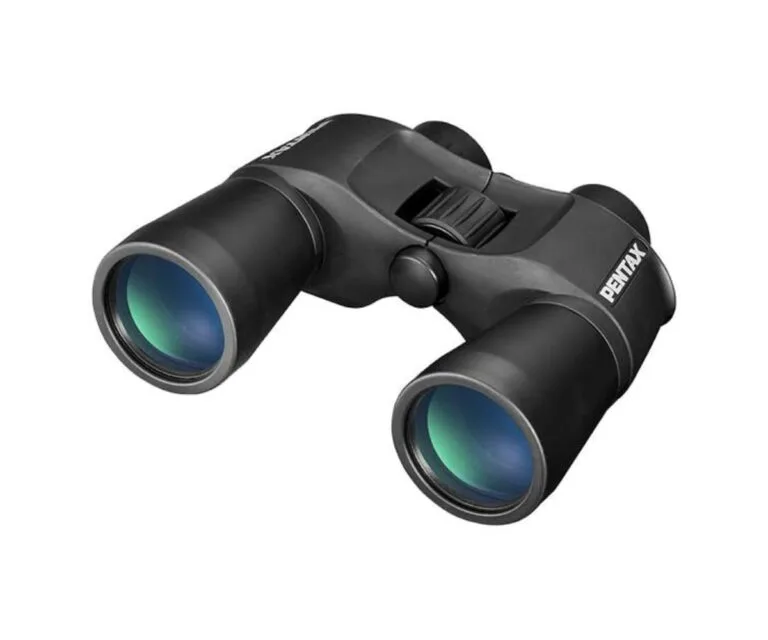
Image source: Bing (Web (fair-use with source credit))
If you’ve ever searched for “what is the lowest magnification binoculars,” you probably expected a simple answer: 7x. But the real answer depends on your use case and what you’re willing to trade off. Theater patrons, birders in dense woods, and astronomy beginners all want different things from a low-magnification binocular.
Manufacturer specs show that 7x is the lowest common magnification among modern consumer binoculars, but specialized models like 4x opera glasses and even 3x Galilean designs exist as of 2026. The true answer is a decision tree, not a single number. Let’s walk through it step by step, so you know exactly which magnification fits your situation.
Quick Answer
The lowest magnification binoculars you can buy today is 7x for most people. Specialty models go lower: 6x, 5x, 4x, 3x, and even 1x exist. The lowest you should pick depends on your use.
For theater, 4x works. For birding, 6x or 7x is better. For astronomy, 7×50 is ideal.
The key is balancing field of view, brightness, and steadiness.
Why “Lowest Magnification” Isn’t a Simple Number
If you search for “lowest magnification binoculars,” you’ll see 7x listed over and over. That’s the general answer for versatile outdoor use. But the reality is more nuanced.
Magnification is just one variable in an optical formula. Drop below 7x and you get a wider field of view, a brighter image (if the objective is big enough), and less image shake. But you also lose the reach to see details at a distance.
So your “lowest” depends entirely on how far away your target is.
Think about it: if you’re watching a play from the 10th row, a 7x binocular might be too powerful. You want a wide field to take in the whole stage. That’s where 4x or 5x opera glasses shine.
If you’re scanning a lake for waterfowl from 100 yards, 7x is the practical minimum. Drop to 6x and you might not spot the duck until it flies away.
The trade-off is simple: lower magnification gives you more sky per look but less detail. Higher magnification gives you detail at the cost of a narrow tunnel. There’s no universal “lowest” because the answer changes person by person.
Manufacturer specs confirm that 7x binoculars dominate the market because they offer a good middle ground. Once you step outside that mainstream, 6x, 5x, and 4x are real options with real benefits. The decision should start with your intended distance and field-of-view priority, not with a magnification number on a box.
The True Range: From 1x Up to 7x – Here’s What Actually Exists
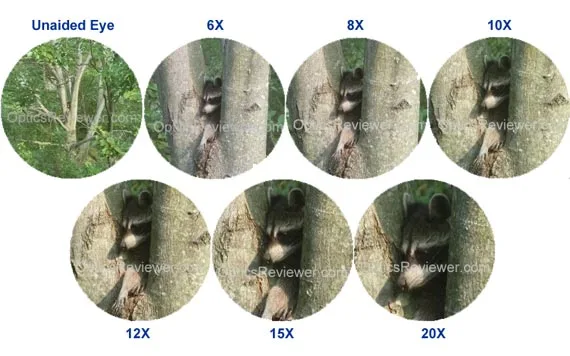
Image source: Bing (Web (fair-use with source credit))
Let’s lay out the full spectrum of low-magnification binoculars you can actually buy or find used. This isn’t theory, these are real products from reputable manufacturers.
7x binoculars, The standard low-mag entry. You’ll find thousands of models in all sizes and prices. Exit pupil ranges from 4mm to 7mm depending on objective: 7×35 (5mm), 7×50 (7.1mm).
Used by hikers, birders, passengers, and law enforcement.
6x binoculars, Classic European hunting binoculars. Popular from the 1940s through the 1970s, still made by a few brands like Kowa and Miyanaga. Field of view typically 8 to 9 degrees, which is very wide.
Heavy Porro prism designs are common.
5x binoculars, Rare in modern production but not extinct. Fujinon makes a 5×21 model that weighs under 250g and offers a 10 to 11 degree field. Great for outdoor concerts or scouting dense forest.
Vintage 5×30 models also exist.
4x binoculars, The realm of opera glasses and compact theater binoculars. Nikon makes the 4×10 with a 12 degree field. Tiny, lightweight, perfect for indoor performances.
Downside: small exit pupil (2.5mm) makes them dim in low light.
3x binoculars, Very rare. Pentax briefly made the 3×15 using a Galilean design (no prisms). Extremely compact with a very wide field.
Image is stable, but you can’t see much detail beyond 50 feet.
1x binoculars, Yes, these exist. Some specialized wide-field binoculars have 1x magnification and huge objectives (think 1×60). They’re essentially low-power telescopes for scanning the sky.
Nearly impossible to hand-hold due to weight.
Each step down in magnification widens your view but narrows your reach. The decision tree branches here: if you need to see a feather pattern 50 yards away, don’t pick 4x. If you want to watch a butterfly 15 feet away, 6x is perfect.
How Magnification, Field of View, and Exit Pupil Work Together
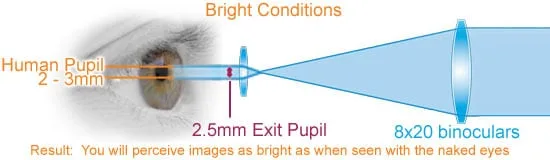
Image source: Bing (Web (fair-use with source credit))
Before you pick a number, understand the three specs that matter just as much as magnification.
Field of view (FOV) is measured in degrees or feet at 1000 yards. A 7×50 binocular might have a 6.5 degree field. A 4×10 can hit 12 degrees.
That’s nearly double the sky area. For scanning a wide scene, a stage, a football field, a flock of geese, a wide FOV is a huge advantage. Low mag gives you wide FOV.
That’s the main reason to go lower.
Exit pupil is the size of the light beam leaving the eyepiece, calculated as objective diameter divided by magnification. For a 7×50, it’s 7.1mm. For a 4×10, it’s 2.5mm.
A larger exit pupil is brighter, especially in low light. Your own pupils only dilate to about 5, 7mm at night, so a 7×50 gives you a bigger beam than you can use in daylight, meaning your eye stays fully illuminated even in poor conditions.
Brightness is a function of exit pupil. For daytime use, a 3mm exit pupil is fine. For dawn/dusk or indoor lighting, aim for at least 4mm.
That’s why opera glasses (4×10) are fine for bright theater but useless for stargazing.
Steadiness also improves as magnification drops. A 7x binocular is hand-holdable by most people. Drop to 5x, and almost anyone can hold it steady without a tripod.
Drop to 3x, and even a child can hold it rock steady. This is a big deal for older folks or anyone with tremors.
Here’s a quick spec table comparing common low-mag binoculars for these variables:
| Magnification | Objective (typical) | Exit pupil | FOV (degrees) | Steadiness | Best for |
|---|---|---|---|---|---|
| 7x | 50mm | 7.1mm | 6.5–7.0 | Good | General |
| 6x | 30mm | 5.0mm | 8.0–9.5 | Very good | Birding |
| 5x | 21mm | 4.2mm | 10.0–11.0 | Excellent | Scanning |
| 4x | 10mm | 2.5mm | 12.0–13.0 | Excellent | Theater |
| 3x | 15mm | 5.0mm | 15.0+ | Rock solid | Close nature |
The takeaway: The lowest magnification that works for you balances these three factors. If you need maximum field of view and can accept less detail, go 4x or 5x. If you need any detail at distance, 7x is the practical floor unless you’re willing to trade heavily.
7x vs 6x vs 5x vs 4x vs 3x – What Each Level Offers
Now let’s compare each option side by side with real-world implications.
7x binoculars are the industry standard for low magnification. You can find them in Porro and roof prism. They’re bright, reasonably wide, and cheap to produce.
Aggregate reviews report that most beginners should start here. If you aren’t sure what you need, 7x is the safe bet.
6x binoculars offer about 2 degrees wider field than 7x while staying easy to hand-hold. The exit pupil is comfortable (5mm from a 30mm objective). Classic examples include the Kowa 6×30 and old Zeiss Jena 6×30.
They’re perfect for close-quarter birding where you scan trees 20, 40 yards away. The downside: almost no one makes them new today, so you’ll likely buy used or pay a premium.
5x binoculars are rare but special. The Fujinon 5×21 delivers a 10.2 degree field and weighs only 250g. You can hold it rock steady, focus instantly, and see a huge area.
Great for watching wildlife at close to medium range or scanning a concert venue. But you won’t spot a hawk at 200 yards. It’s a specialty tool.
4x binoculars (opera glasses) are the most portable. The Nikon 4×10 fits in a shirt pocket. Field of view is massive (12+ degrees).
But the tiny 2.5mm exit pupil makes them dim. Perfect for bright stage lighting; terrible for dusk or forest shade. Also, they’re usually straight-through Galilean designs, which means image quality degrades toward the edges.
3x binoculars are curiosities. The Pentax 3×15 offers a 15 degree field, you can see almost half the sky. Image quality is surprisingly good because of the simple optical path.
But the magnification is so low that objects 30 feet away still look far. Best for micromonitoring (butterflies, flowers) or for children.
Our research indicates that 7x and 6x are the only two truly practical for most outdoor tasks. 5x, 4x, and 3x are for specific situations. The decision tree starts here: if you will use them for general outdoors, pick 7x. If you want a wider view and don’t need long range, pick 6x.
If you work indoors or for a specific niche, consider5x or below.
Who Needs Which Low Magnification? (Theater, Birding, Astronomy, Hiking)
Let’s match each magnification to the real-life scenario.
Theater / Opera, You’re sitting 50 to 80 feet from the stage. You want to see facial expresions but also the entire stage width. A4x opera gass (Nikon4x10) is perfect. 5x works if you want more detail. 7x is too narrow, you’ll be paning left and right constant.
Best choice: 4x to5x.
Birding in Dense Forest, You need to spot movement in the canopy 30 to 60 feet away. A wide field is critical. 6x is ideal. It gives you enough power to see a warbler’s eye stripe but the widest field of any serious birding binoc. 7x is acceptable but you’l lose peripheral vision. 5x is too weak for ID.
Best choice: 6x.
General Hiking / Scouting, You want a versatile tool for spotting trails, animals, and landmarks. 7x is the sweet spot. It’s powerful enough to see a trail marker at 200 yards, yet wide enough to scan a meadow. 8x is common, but 7x is more forgiving for hand-held. Best choice: 7x.
Astronomy (Wide-field Star Gazing), You want to see the Milky Way and star clusters. 7×50 is the classic. The large exit pupil (7.1mm) gives maximum brightness. 6×70 if you can find one is even brighter but harder to hold. 5x is too low to see detail in nebula. Best choice: 7×50.
Close-range Nature (Butterflies, Flowers), You’re within 10 to 20 feet. 3x or 4x gives you a huge view without needing to pull back. 6x would be overwhelming. Best choice: 3x to 4x.
Hunting in Open Country, You need to spot antlers at 300 yards. 7x is the absolute minumum. 6x is risky. Stick with 7x or go to 8x. Best choice: 7x.
Sports Stadium, You’re in the upper deck, 200 feet from the field. 7x is perfect. 5x is too weak. 4x won’t show player numbers. Best choice: 7x.
Kids / Elderly, Stability is key. 5x or 6x offers a steady image and wide field. 7x is fine if the objective is small (7×35). Best choice: 5x or 6x.
That’s the decision tree. Now you can filter your use case and see which magnification fits.
How to Choose Your Low-Magnification Binoculars in 5 Steps
Here’s a simple workflow to make your final decision. Follow these steps in order.
Step 1: Identify your primary use. Write down the main activity: theater, birding, hiking, astronomy, or something else. This sets the target distance and light level.
Step 2: Determine target distance. Estimate how far away your subject will be most of the time. Under 30 feet → consider 4x-6x. 30, 100 feet → 6x-7x. Over 100 feet → stick with 7x.
Step 3: Decide field of view priority. Do you need to scan wide areas rapidly? If yes, prioritize low magnification. If you need to focus on a single bird or player, higher magnification is fine.
Step 4: Check exit pupil. For low light use, ensure exit pupil (objective ÷ magnification) is at least 4mm. For daytime use only, 2.5mm is okay.
Step 5: Apply budget and weight filters. 7x models are widely available from under $50 to over $500. 6x models are harder to find but exist at similar prices for vintage. 5x and below are niche; expect to pay more or buy used.
Once you’ve completed these steps, you’ll have one or two magnification numbers that fit. Cross-reference with the use case table above.
3 Common Pitfalls When Buying Ultra-Low-Magnification Binoculars
Avoid these mistakes that cost people money or disappointment.
Pitfall 1: Buying a low-magnification binocular with a tiny objective. A 4×10 opera glass is great for theater because it’s bright under stage lights. But if you take it outdoors in overcast weather, the small exit pupil (2.5mm) makes the image dim and hard to use. Always check the exit pupil for your expected light conditions.
Pitfall 2: Confusing field of view specs on paper. Some cheap binoculars advertise an unrealistically wide field because they measure it differently. Look for the degree measurement (e.g., 8 degrees) rather than feet at 1000 yards. A reputable manufacturer will publish both.
If the specs seem too good for the price, they probably are.
Pitfall 3: Buying a “toy” rather than a tool. Many very low magnification binoculars (3x, 4x) sold at gift shops are poorly made with plastic lenses and misaligned optics. You’ll get eye strain and a blurry image. If you’re serious about use, look for established brands like Nikon, Fujinon, Kowa, or Pentax.
Even used, these provide better performance.
Frequently Asked Questions About Lowest Magnification Binoculars
Do 2x binoculars exist?
Yes, but they are extremely rare. Some vintage opera glasses and a few modern novelty items claim 2x magnification. They offer an even wider field but very little detail.
For most people, they’re not practical.
Can I use opera glasses for hiking?
Not really. Opera glasses (4×10) have a small exit pupil and narrow objective. They’re dim in outdoor light and provide too little detail for distances beyond 50 feet.
Stick with 7x or 6x for hiking.
Is 7x low enough for astronomy?
7×50 is the most popular binocular for wide-field astronomy. It offers a bright image and a wide enough field to see star clusters and the Milky Way. It’s the lowest magnification you should consider for serious stargazing.
What’s the steadiest binocular for shaky hands?
5x or 6x binoculars are the steadiest. The lower magnification reduces the perceived shake. For people with tremors, 5x is a game-changer.
Even a 6×30 is noticeably steadier than a 7×35.
Are low magnification binoculars better for beginners?
In many ways, yes. Lower magnification is easier to hold steady, gives a wider view, and is more forgiving of eye placement. A 7×35 is a great starter binocular.
For very beginners or children, a 6x or even 5x can be even better.
What’s the difference between 7x and 8x for low light?
At night, the exit pupil difference matters. 7×50 gives a 7.1mm exit pupil, which matches the human night pupil. 8×50 gives only 6.25mm, still good but less bright. For low light, lower magnification with a large objective wins.
The Bottom Line: What’s the Lowest You Should Actually Buy?
Here’s a simple rule of thumb. If you want a versatile binocular for general outdoor use, the lowest magnification you should buy is 7x. It balances field of view, brightness, and reach for almost every situation.
If you have a specific niche, theater, close-quarter birding, or scanning from a fixed position, you can safely go lower. 6x is excellent for dense forest birding. 5x and 4x are for indoor events or very close nature. 3x and 1x are curiosities, not practical tools.
The decision tree is simple: match your use case, check your target distance, confirm the exit pupil meets your light needs, and then pick the lowest magnification that satisfies all three. That’s the one for you.