What Is the Best Field of View for Binoculars
There's a lot of debate about what is the best field of view for binoculars, and most advice you'll find is too vague. The truth is that the "best" field of view depends entirely on what you're doing with the binoculars. A birdwatcher and a stargazer need totally different numbers.
Picking the wrong one makes your binoculars feel like looking through a soda straw.
Field of view (FOV) is measured in degrees or in feet at 1,000 yards. As of 2026, most mid-range binoculars offer a real FOV between 5.5 and 8.5 degrees. The real question is which end of that range fits your use case.
Here's how to figure it out.
Quick Answer
The best field of view for binoculars depends on your use case. For birdwatching, choose a wide FOV of 380 to 420 feet at 1,000 yards. For stargazing, a narrower FOV of 280 to 330 feet gives better detail.
For general use, aim for 330 to 370 feet. The apparent FOV matters more than the real FOV. Wide apparent FOV of 60 degrees or more gives an immersive feel.
Image source: Bing (Web (fair-use with source credit))
Why There's No Single "Best" Field of View
You might expect a simple number like "7.5 degrees is best." But optics don't work that way. Field of view is always a trade-off with other specs. You can't get a huge FOV and high magnification at the same time.
Not without spending a fortune or accepting edge distortion.
Here's the fundamental trade-off. Higher magnification magnifies the image, but it also magnifies hand shake and narrows the FOV. Lower magnification gives you a wider view but less detail at distance.
The objective lens size also matters. A 42mm lens collects more light than a 32mm lens, but the FOV is often slightly narrower on larger objectives due to optical design constraints.
The third factor is apparent field of view. This is the angle you see through the eyepiece. It's calculated by multiplying the real FOV by the magnification.
A real FOV of 7 degrees through an 8x binocular gives you an apparent FOV of 56 degrees. That's standard. A premium binocular with the same magnification might have a 7.5 degree real FOV and use specialized eyepiece design to push the apparent FOV to 65 degrees or more.
That feels like looking through a big window instead of a tunnel.
So the "best" FOV is the one that balances these factors for your specific activity. There is no universal number. The decision tree is simple.
Match the FOV to your primary use. Accept the trade-offs that come with it.
The Two Numbers That Actually Matter: Real FOV vs. Apparent FOV
Most people only look at the real field of view. That's the number printed on the box. It tells you how wide the actual scene is at 1,000 yards.
For example, a binocular might say "367 feet at 1,000 yards" or "7 degrees." Both mean the same thing.
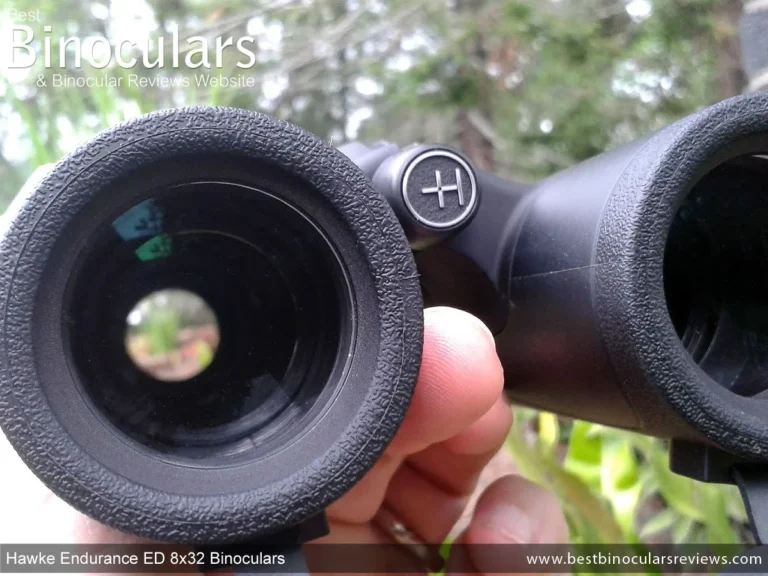
But the real FOV is only half the story. The apparent field of view is what your eyes actually experience. Two binoculars can have the same real FOV but feel completely different due to magnification.
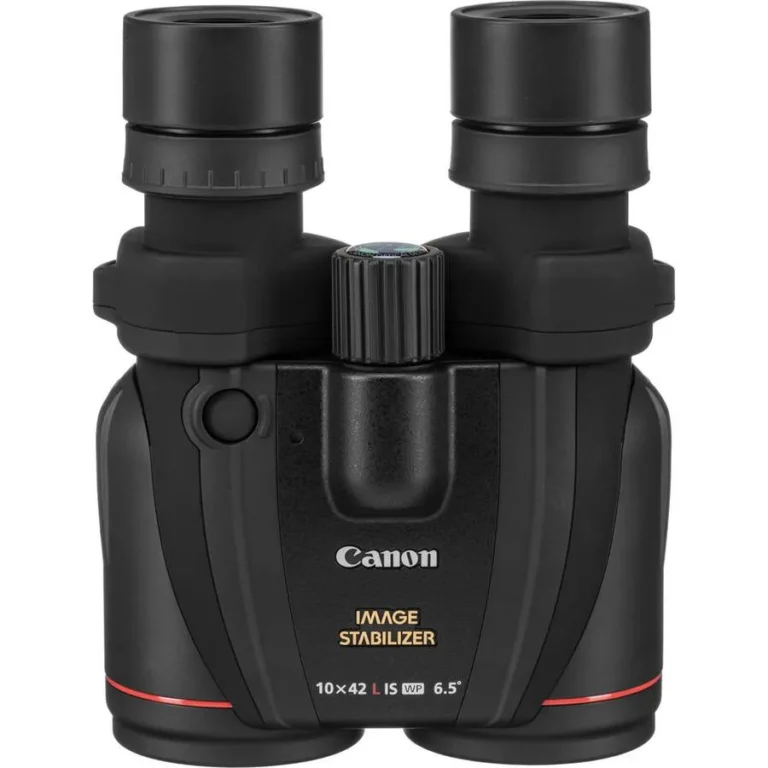
A 10x binocular with a 6.5 degree real FOV gives you a 65 degree apparent FOV. That feels wide and immersive. An 8x binocular with the same 6.5 degree real FOV gives you only a 52 degree apparent FOV.
That feels like looking through a tube.
The industry standard for apparent FOV is defined by ISO 14132-1:2002. This standard provides a formula for calculating true apparent FOV. It accounts for optical distortion and gives a slightly lower number than simple multiplication.
For our purposes, the simple multiplication gives you a good ballpark.
Image source: Bing (Web (fair-use with source credit))
Here's a quick reference for how apparent FOV feels:
| Apparent FOV | User Experience | Common Examples |
|---|---|---|
| Under 50 degrees | Narrow, tunnel-like | Some compact 10×25 models |
| 50 to 60 degrees | Standard, comfortable | Most 8×42 and 10×42 models |
| 60 to 65 degrees | Wide, immersive | Premium mid-range models |
| 65 to 70 degrees | Very wide, cinematic | High-end birding binoculars |
| Over 70 degrees | Ultra-wide, panoramic | Specialty astronomy models |
When you're comparing binoculars, always check both numbers. A 10×42 with a 6.3 degree real FOV and a 63 degree apparent FOV is a much better experience than a 10×42 with a 5.8 degree real FOV and a 58 degree apparent FOV. The difference is noticeable within seconds of looking through them.
The Decision Tree: What's Your Main Use?
Let's walk through the most common use cases. Choose the one that fits you best.
For Birdwatching
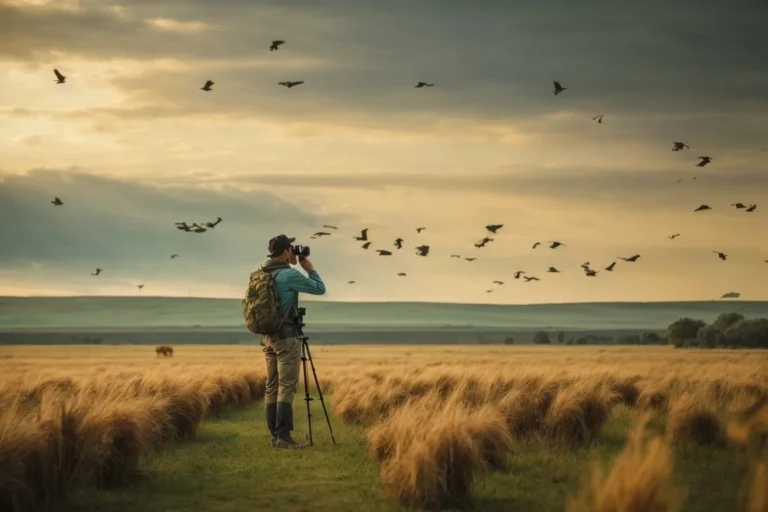
If you're tracking birds through dense trees or following fast-moving flocks, you want a wide field of view. The ideal range is 380 to 420 feet at 1,000 yards. That's about 7.2 to 8.0 degrees.
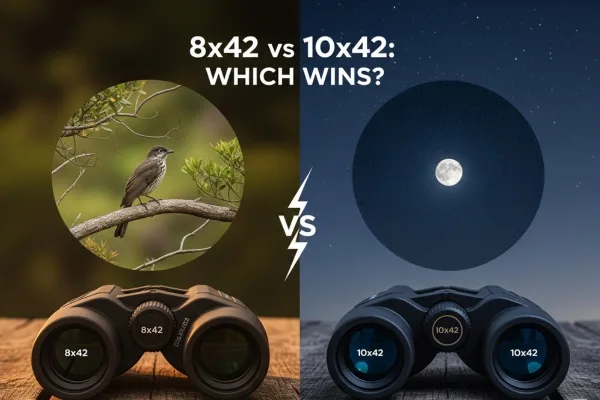
You want an 8x or 8.5x magnification. The 8×42 is the classic birding spec because it gives you a good balance of brightness, stability, and wide FOV.
Manufacturer specs for the 8×42 class typically show FOV from 330 to 420 feet. Premium models hit 420 feet or more. That extra width makes a real difference when a warbler is flitting through branches.
You can find the bird quickly and keep it in view as it moves.
For Hunting
Hunting is a different game. If you're sitting in a blind or stand, you have time to scan slowly. A narrower FOV of 300 to 350 feet at 1,000 yards is fine.
You often want 10x magnification to see detail at longer ranges. The 10×42 is the standard hunting binocular.
But if you're hunting in thick brush or walking through woods, you need a wider FOV. A 7x or 8x with a 380 to 400 foot FOV lets you catch movement and see the whole scene. The trade-off is that you lose some detail at distance.
For Stargazing
Astronomy is a unique case. You want high magnification, typically 10x to 15x, and a large objective lens like 50mm or 56mm. The FOV will be narrow, around 280 to 330 feet.
That's fine. You're looking at a small patch of sky in detail. The wider FOV on a 7×50 is nice for sweeping the Milky Way, but you'll see more detail with a 10×50 or 12×50.
The exit pupil is critical here. A 10×50 gives a 5mm exit pupil, which is ideal for dark skies. The narrow FOV is a feature, not a bug.
It reduces the amount of sky glow you see and helps you focus on deep sky objects.
For General Use and Travel
If you want one binocular for everything, aim for a 330 to 370 foot FOV. That's roughly 6.3 to 7.0 degrees. An 8×32 or 8×42 is a good all-rounder.
You get a wide enough view for casual birding and enough magnification for general sightseeing. You won't be the best at any single activity, but you'll be good enough for most.
For Sports and Concerts
This is the one case where you might want a narrower FOV with high magnification. A 10×25 or 8×25 compact binocular gives you a 290 to 330 foot FOV. That's fine because you're watching a single field or stage.
The compact size matters more than the widest view.
The Three Biggest Mistakes People Make When Choosing FOV
Mistake 1: Only Looking at the Real FOV Number
The most common mistake is picking a binocular based on the real FOV alone. A 7×35 with a 450 foot FOV sounds incredible. But the apparent FOV is only 56 degrees.
That's standard. Meanwhile, a 10×42 with a 350 foot FOV has a 65 degree apparent FOV and feels much more immersive. Always calculate the apparent FOV.
Mistake 2: Ignoring the Exit Pupil
The exit pupil is the beam of light that comes out of the eyepiece. It's the objective lens diameter divided by the magnification. A 42mm objective at 8x gives a 5.25mm exit pupil.
A 42mm at 10x gives a 4.2mm exit pupil. In bright daylight, your pupils are about 3mm, so both work fine. But in low light, your pupils dilate to 5 to 7mm.
A 4.2mm exit pupil won't fill your pupil, so the image looks dimmer.
A wider FOV often comes with a larger exit pupil, but not always. Check both numbers. If you need low-light performance, prioritize a 5mm or larger exit pupil.
That means lower magnification or larger objective. A 7×50 gives a 7.1mm exit pupil and a wide FOV, but it's heavy.
Mistake 3: Choosing a FOV That's Too Wide for the Budget
Wide FOV binoculars are harder to make well. They require more complex eyepiece designs and precision glass. A cheap wide-angle binocular will have distortion, chromatic aberration, and soft edges.
The extra field width is useless if the edges are blurry.
If your budget is under $200, stick with a standard FOV around 330 to 360 feet. You'll get sharper images and better build quality. Don't chase the widest number.
As you move up to $300 to $500, you can start looking at wider FOV models with better edge-to-edge sharpness.
A buyer sees a 10×50 with a 400 foot FOV for $80. It sounds amazing. But the optics are poor, and the edges are so blurry that you naturally look only through the center.
The effective FOV is much narrower than the spec sheet claims.
How to Check a Binocular's FOV Before You Buy
You can't always look through a binocular before buying it. But you can still get a good sense of the FOV from the specs. Here's exactly what to check.
Read the Spec Sheet Correctly
Every binocular lists its field of view on the box or product page. It will be in one of three formats. Feet at 1,000 yards.
Meters at 1,000 meters. Or degrees. All three describe the same thing.
Use this conversion to compare. One degree equals about 52.5 feet at 1,000 yards. So a 7 degree binocular is roughly 367 feet at 1,000 yards.
Write down the real FOV and the magnification. Then multiply them to get the apparent FOV. A 7 degree real FOV with 8x magnification gives you a 56 degree apparent FOV.
That's standard. A 7.5 degree real FOV with 10x gives you a 75 degree apparent FOV. That's excellent.
Look for the ISO Apparent FOV Number
Some premium binocular manufacturers now list the ISO apparent FOV on their spec sheets. This is the most accurate number because it accounts for optical distortion. The ISO method gives a slightly lower number than simple multiplication.
If the ISO apparent FOV is 62 degrees or higher, you're getting a genuinely wide view.
Check Close Focus Distance
A wide FOV binocular often has a longer close focus distance. That's a trade-off. If you want to look at butterflies or flowers at 6 feet, a wide FOV might not focus that close.
Check the close focus spec. For birding, you want 6 to 8 feet. For general use, 10 to 15 feet is fine.
Read Between the Lines on Cheap Models
Budget binoculars often exaggerate their FOV. A cheap 10×50 might claim a 400 foot FOV. But the edge distortion is so bad that the effective usable FOV is much narrower.
The center is sharp, but the outer 30 percent is a blurry mess. Your eyes naturally focus on the center, so you don't actually use the full width.
Manufacturer specs are usually accurate for premium brands. For budget brands, reduce the claimed FOV by about 10 to 15 percent in your expectation.
The Trade-Off Table: FOV, Magnification, and Brightness Compared
Here's the reality of binocular design. You can pick two of the following three: wide FOV, high magnification, or large objective lens. You can't have all three at a reasonable price and weight.
The table below shows the trade-offs for common configurations.
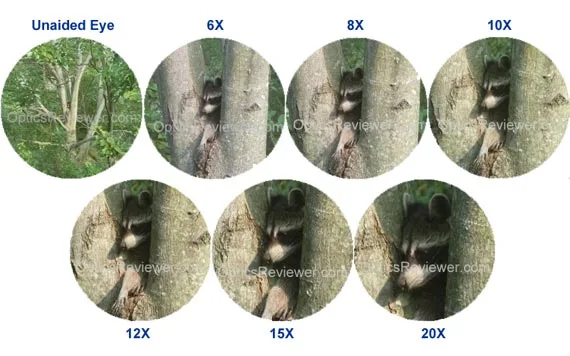
Image source: Bing (Web (fair-use with source credit))
| Configuration | Typical FOV (ft @ 1000 yds) | Apparent FOV | Exit Pupil | Best For |
|---|---|---|---|---|
| 7×35 | 420 to 450 | 51 to 56 degrees | 5.0mm | Wide field, casual use |
| 8×32 | 380 to 420 | 56 to 62 degrees | 4.0mm | Travel, general use, birding |
| 8×42 | 330 to 420 | 51 to 62 degrees | 5.25mm | Birding, general use, low light |
| 10×42 | 300 to 370 | 56 to 65 degrees | 4.2mm | Hunting, detail at distance |
| 10×50 | 280 to 340 | 55 to 63 degrees | 5.0mm | Stargazing, low light, detail |
| 12×50 | 280 to 320 | 57 to 63 degrees | 4.2mm | Long-range, stargazing, tripod use |
| 15×56 | 230 to 280 | 50 to 57 degrees | 3.7mm | Long-range, astronomy, tripod needed |
The key takeaway is that the 8×42 gives you the widest range of FOV options. You can find models from 330 to 420 feet. The 10×42 is narrower but gives you more reach.
The 7×35 is the widest option but has lower magnification and smaller objective.
If you want the widest apparent FOV, look for a 10x binocular with a 6.5 to 7.0 degree real FOV. That gives you a 65 to 70 degree apparent FOV. That's rare and expensive.
Most 10x binoculars have a 5.5 to 6.0 degree real FOV, which gives a 55 to 60 degree apparent FOV. That's still good.
The Straightforward Decision Guide
Here's a simple decision tree. Answer these questions in order.
Step 1: What's Your Primary Activity?
If you said birding, go with an 8×42 with a 380 to 420 foot FOV. If you said hunting, go with a 10×42 with a 340 to 370 foot FOV. If you said stargazing, go with a 10×50 or 12×50 with a 280 to 330 foot FOV.
If you said general use, go with an 8×32 or 8×42 with a 330 to 370 foot FOV.
Step 2: What's Your Budget?
Under $200, stick with standard FOV models. Don't chase wide angles. Over $200, you can start looking at wider FOV options.
Over $500, you can get premium wide-angle models with excellent edge sharpness.
Step 3: Do You Wear Glasses?
If you wear glasses, you need long eye relief, at least 15 to 18mm. A wide FOV binocular with long eye relief is harder to find. Check the eye relief spec.
The best glasses-friendly binoculars have a 17 to 20mm eye relief and a 60 degree apparent FOV.
Step 4: Do You Need Low-Light Performance?
If you're hunting at dawn or dusk, or stargazing, prioritize a large exit pupil. That means a 7×50, 8×56, or 10×50. The FOV will be narrower, but the brightness is more important.
Step 5: Try Before You Buy
Nothing beats looking through the actual binocular. Find a local store with a good selection. Look at a distant sign or bird feeder.
Move your eyes around the edges. If the edges are blurry, the FOV is not as useful as the spec sheet suggests. If the whole view is sharp, you've found a good one.
Frequently Asked Questions
What is a good field of view for binoculars?
A good field of view for general use is 330 to 370 feet at 1,000 yards. For birding, aim for 380 to 420 feet. For stargazing, 280 to 330 feet is acceptable.
The apparent FOV should be at least 55 degrees for a comfortable view.
Is a wider field of view always better?
No. A wider FOV makes it easier to find and track subjects, but it often comes with edge distortion, lower magnification, or higher cost. For stargazing, a narrow FOV gives better detail.
The best FOV is the one that matches your use case.
How do I calculate field of view on binoculars?
Field of view is listed in degrees or feet at 1,000 yards. Multiply the degree FOV by 52.5 to get feet at 1,000 yards. Multiply the real FOV by the magnification to get the apparent FOV.
For example, a 7 degree FOV with 8x gives a 56 degree apparent FOV.
What is the difference between real FOV and apparent FOV?
Real FOV is the actual width of the scene you see. Apparent FOV is the angle of the image that enters your eye, calculated by multiplying real FOV by magnification. Apparent FOV determines how immersive the view feels.
A wide apparent FOV of 60 degrees or more feels like looking through a window.
Do I need a wide FOV for birding?
Yes. Birding is the most demanding use case for FOV. Birds move quickly and unpredictably.
A wide FOV of 380 to 420 feet at 1,000 yards helps you find and track them. An 8×42 binocular is the standard choice for birding because it balances FOV, brightness, and stability.
Can I get a wide FOV with high magnification?
Rarely. High magnification narrows the FOV by design. A 10x binocular has a narrower FOV than an 8x binocular with the same objective lens.
Some premium 10x models achieve a 6.5 to 7.0 degree real FOV, giving a 65 to 70 degree apparent FOV, but they are expensive.