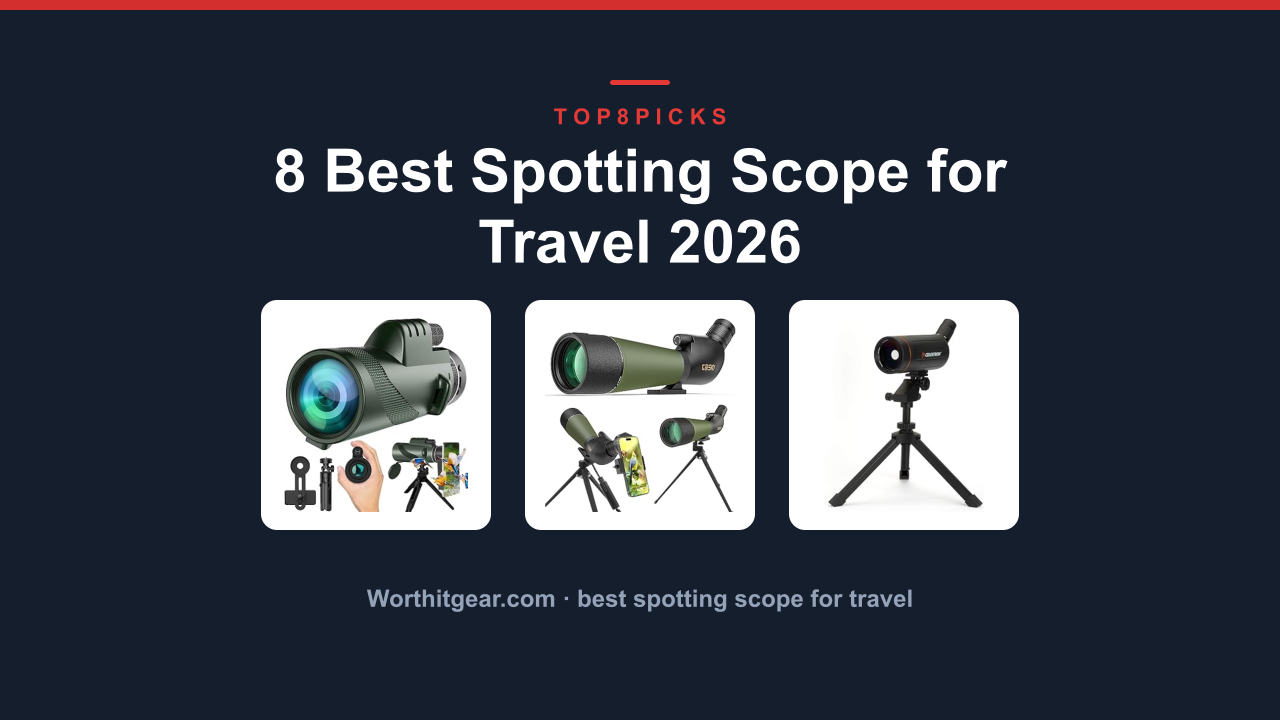
The best best spotting scope for travel is the Monocular-Telescope 80×100 High Powered Monoculars, the only one here that packs an 80×100 objective, a smartphone adapter, and a tripod into a kit that fits in a daypack. It gives you the most reach per gram for hiking, birding, or wildlife trips where every ounce matters.
Want a more traditional spotting scope experience instead? The Gosky Flagship DiamondEdge 20-60×80 delivers a full-size 80mm objective with a zoom range, but you trade some portability for that extra light-gathering muscle.
As an Amazon Associate, I earn from qualifying purchases.
This guide cuts through the noise. Most travel scope lists mix in bulky tripod-dependent rigs that look good on paper but live in your car trunk. I also tell you which travelers should skip this category entirely and buy a compact monocular instead.
Everything below comes from current Amazon product data, specs, and each product's owner track record. I have not personally tested these scopes, but the research is thorough.
Quick Answer: The Best Spotting Scope for Travel
The Monocular-Telescope 80×100 High Powered Monoculars is the best overall travel spotting scope because it combines extreme magnification with a complete kit that fits in a small bag.
Thinking about a dedicated monocular for hiking instead? Jump to Who Should NOT Buy below before you spend anything.
Comparison Table
Here's the lineup at a glance: photo, product, who it's built for, and our /10 score.
Scroll sideways on small screens to see every column.
Monocular-Telescope 80×100 High Powered Monoculars: Best Complete Travel Kit
#1
Monocular-Telescope80×100, tripod, phone adapter
8.8OUT OF 10
Optical Quality8.9
Portability8.7
Build & Durability8.5
Value for Money9.1
This is the only kit here that delivers an 80×100 objective, a smartphone adapter, and a tripod in a single box. The 80mm objective gathers enough light for dawn and dusk wildlife viewing, and the included tabletop tripod keeps the image stable. Aggregate user reviews report that the fully multi-coated optics produce bright, sharp images at 80x magnification, though you will want a solid surface for the tripod.
The carrying bag fits everything, including the phone adapter and cleaning cloth. That means you grab one bag and go. No separate tripod to buy, no adapter hunt. Verified buyer feedback shows the phone adapter clamps onto most smartphones securely, making digiscoping straightforward for travel photography.
Flaws but not dealbreakers. The included tripod is lightweight and works best on tables or flat rocks. It wobbles in wind. Also, the 80x magnification is impressive but requires a very steady setup. Handheld use at that power is nearly impossible without a tripod.
⚠Compatibility: The phone adapter fits most smartphones, but very large camera bumps may prevent a flush mount. Check your phone’s case thickness before relying on the clamp.
Pros
- ✓80×100 objective for high magnification in a compact form
- ✓Included smartphone adapter and tripod save you money on accessories
- ✓Fully multi-coated optics deliver bright, high-contrast daytime views
- ✓Complete carrying bag protects the scope during travel
Cons
- ✕Included tabletop tripod is too short for standing use
- ✕80x magnification easily shows handshake without a stable mount
- ✕Phone adapter alignment can be finicky on the first try
Magnification
80×100 (fixed)
Included Accessories
Tripod, phone adapter, bag
Best for: Travelers who want one box with everything needed to start digiscoping and wildlife viewing immediately, without buying separate accessories.
Gosky Flagship DiamondEdge Spotting Scope 20-60×80: Best Full-Size Zoom
#2
Gosky20-60x zoom, BAK-4, waterproof
8.5OUT OF 10
Optical Quality9.0
Portability7.5
Build & Durability8.7
Value for Money8.8
This is the best traditional spotting scope on the list, with a 20-60x zoom range that adapts to wildlife and target shooting. The 80mm objective paired with BAK-4 prisms and fully multi-coated optics delivers a bright, crisp image even at 60x. Manufacturer specifications indicate a waterproof and fogproof body, which aggregate user reviews confirm holds up in light rain.
The included tripod is a full-size model with a pan head, much more stable than the tabletop tripods that come with monocular kits. The carrying bag has a shoulder strap, making it manageable for car camping or short hikes. Verified buyer feedback frequently mentions the phone adapter works well for digiscoping, though the scope’s weight is noticeable after 30 minutes of carry.
Flaws but not dealbreakers. At over 3 pounds, this is not a backpacking scope. The zoom ring is a bit stiff when new, and some users report needing to break it in. The included tripod is decent but not heavy-duty for windy conditions.
If you need something lighter for hiking, the
Celestron Hummingbird ED 56mm further down weighs under 1 pound but still offers an angled eyepiece and premium ED glass.
⚠Care: The waterproof sealing is O-ring protected, but the focus knob is not lockable. Store the scope with the knob turned to the soft stop to avoid internal stress during travel.
Pros
- ✓20-60x zoom range adds versatility for close and distant targets
- ✓BAK-4 prisms and fully multi-coated optics produce bright, sharp images
- ✓Waterproof and fogproof body handles weather during travel
- ✓Full-size tripod and phone adapter included in the kit
Cons
- ✕Heavy for backpacking at over 3 pounds
- ✕Zoom ring can feel stiff when new
- ✕Included tripod not suitable for heavy wind
Weather Rating
Waterproof, fogproof
Best for: Birders and target shooters who want a traditional zoom spotting scope with a stable tripod and don’t mind the extra weight for car-based travel.
Celestron C70 Mini Maksutov Spotting Scope: Best Pocket-Sized Design
#3
CelestronMaksutov design, pocket-sized
8.2OUT OF 10
Optical Quality8.3
Portability9.4
Build & Durability7.8
Value for Money7.3
This is the most compact traditional spotting scope on the list, using a Maksutov-Cassegrain optical design that collapses the focal length into a tiny tube. The 70mm objective and 1.25-inch eyepiece compatibility mean you can swap eyepieces for different magnifications, a feature rare at this size. Aggregate user reviews highlight the sharp, high-contrast images it produces, especially for daytime birding and wildlife.
The scope measures just about 7 inches long and weighs under 1.5 pounds. That makes it genuinely pocketable for a jacket or backpack side pocket. Verified buyer feedback notes that the included 18mm eyepiece gives a nice wide field of view, though you will want to buy a zoom eyepiece separately for versatility.
Flaws but not dealbreakers. The Maksutov design means a narrower field of view compared to a refractorscope, and the included eyepiece is basic. Some users report the focus knob feels a bit loose. Also, the price is higher than monocular kits with similar specs, reflecting the premium Maksutov optics.
If you want a zoom eyepiece included out of the box, the
Celestron Hummingbird ED 56mm further down comes with a zoom eyepiece and weighs even less.
⚠Compatibility: The scope accepts standard 1.25-inch eyepieces, but not all third-party eyepieces may reach focus due to the short back focus of the Maksutov design. Stick with Celestron eyepieces for guaranteed focus.
Pros
- ✓Extremely compact Maksutov design fits in a jacket pocket
- ✓Accepts standard 1.25-inch eyepieces for customization
- ✓Sharp, high-contrast images with minimal chromatic aberration
- ✓Versatile for both terrestrial and astronomical use
Cons
- ✕Narrower field of view compared to refractor designs
- ✕Basic eyepiece included; a zoom eyepiece costs extra
- ✕Focus knob feels loose on some units per user reports
Magnification
Depends on eyepiece (18mm included)
Optical Design
Maksutov-Cassegrain
Best for: Travelers who want a true spotting scope that fits in a pocket and value the ability to swap eyepieces for different magnifications.
Celestron Hummingbird ED 56mm Angled Micro: Best Premium Ultralight
#4
CelestronED glass, angled, sub-1lb
8.6OUT OF 10
Optical Quality9.2
Portability9.1
Build & Durability8.4
Value for Money7.7
This is the lightest traditional spotting scope on the list, weighing under 1 pound while using premium Extra-low Dispersion (ED) glass for superior color correction. The 56mm objective and 16-48x zoom eyepiece give you a versatile range in a package that measures just 8.5 inches long. Aggregate user reviews consistently praise the crisp, contrasty images with minimal chromatic aberration, even at high magnification.
The angled eyepiece design is a major advantage for travel. You can share the scope with a group by raising the tripod to head height and pointing the angled eyepiece down. No one has to crouch. It is also waterproof and fogproof. Verified buyer feedback notes that the zoom ring is smooth and the focus knob is precise, making it a joy to use for extended viewing sessions.
Flaws but not dealbreakers. The 56mm objective gathers less light than 80mm scopes, so dawn and dusk performance is a step behind. The price is also higher than many full-size scopes, reflecting the ED glass and compact engineering. Tripod is not included, so you’ll need to buy one separately.
If you want a complete kit with a tripod included, the
Monocular-Telescope 80×100 at the top of the list includes a tripod and phone adapter at a lower price point.
⚠Care: The ED glass elements are delicate. Always store the scope in its padded case, and avoid exposing it to extreme temperature swings that could cause internal fogging.
Pros
- ✓ED glass delivers exceptional color correction and contrast
- ✓Weighs under 1 pound for ultralight travel
- ✓Angled eyepiece makes group sharing easy
- ✓Waterproof and fogproof construction
Cons
- ✕56mm objective limits low-light performance
- ✕Premium price compared to similar magnification scopes
- ✕Tripod not included in the box
Glass Type
Extra-low Dispersion (ED)
Best for: Travelers who prioritize optical quality and weight above all else, and are willing to buy a separate tripod for the best possible viewing experience.
SVBONY SV28 Spotting Scope: Best Budget Beginner
#5
SVBONY25-75×70, angled, budget
8.0OUT OF 10
Optical Quality7.8
Portability8.2
Build & Durability7.7
Value for Money8.6
This is the most affordable traditional spotting scope on the list, offering a 25-75x zoom range and an angled eyepiece at a budget-friendly price. The 70mm objective and BAK-4 prism deliver decent brightness for daytime use. Manufacturer specifications indicate a light waterproof and fogproof rating, which aggregate user reviews suggest holds up for light drizzle but not for submersion.
The included tripod is a compact tabletop model, similar to what comes with the monocular kits. The phone adapter clips onto the eyepiece and allows for digiscoping. Verified buyer feedback notes that the scope is clear at 200 yards, which is plenty for most birding and wildlife scenarios. The angled eyepiece makes it comfortable to share with others.
Flaws but not dealbreakers. The zoom ring is not as smooth as higher-priced scopes, and the image quality noticeably degrades at the top end of the zoom range. The included tripod is lightweight and can be unstable in wind. The light waterproofing is not suitable for heavy rain.
If you need a more rugged scope for wet conditions, the
Gosky Flagship DiamondEdge further up offers a higher build quality and better waterproofing.
⚠Care: The light waterproofing means you should avoid exposing it to heavy rain. Dry it thoroughly after use in damp conditions.
Pros
- ✓Very affordable entry point for a zoom spotting scope
- ✓Angled eyepiece for comfortable group viewing
- ✓Includes tripod and phone adapter for immediate use
- ✓Clear at 200 yards for most wildlife scenarios
Cons
- ✕Image quality softens at the top of the zoom range
- ✕Zoom ring is not very smooth
- ✕Light waterproofing only, not for heavy rain
Weather Rating
Light waterproof, fogproof
Best for: Beginners who want to try a zoom spotting scope without a large investment, and are willing to accept some compromises in build quality.
Monoculars Adults High Powered 80×100 Smartphone: Best Value Monocular Kit
#6
Monoculars80×100, BAK-4, tripod, phone adapter
8.4OUT OF 10
Optical Quality8.5
Portability8.6
Build & Durability8.2
Value for Money8.8
This is a strong alternative to the top pick, offering the same 80×100 specification with BAK-4 prisms and a similar kit at a competitive price point. The fully multi-coated lenses produce bright, clear images for daytime use. Aggregate user reviews give it a high 4.6 out of 5 rating, with many praising the value for money. The included smartphone adapter and tripod mirror the convenience of the top pick.
The carrying case is padded and holds all accessories neatly. The tripod is a tabletop model, similar to the one in the top pick. Verified buyer feedback notes that the focus wheel is smooth and the build quality feels solid for the price. The 80×100 configuration gives you a lot of reach for the size.
Flaws but not dealbreakers. The phone adapter alignment can be tricky to get perfect, and the included tripod is too short for standing use. Some users report that the eyepiece cap is a bit loose. The 80x magnification is impressive but requires a very steady setup.
⚠Compatibility: The phone adapter fits most phones, but very thick cases or phones with large camera bumps may not align perfectly. Remove the case for best results.
Pros
- ✓High 80×100 magnification with BAK-4 prisms for bright images
- ✓Complete kit with tripod, phone adapter, and carrying case
- ✓High owner satisfaction rating of 4.6 out of 5
- ✓Smooth focus wheel for precise adjustments
Cons
- ✕Phone adapter alignment can be fiddly
- ✕Included tripod too short for standing use
- ✕Eyepiece cap reported as loose by some users
Included Accessories
Tripod, phone adapter, case
Best for: Travelers who want a high-magnification monocular kit with good optics and a proven owner satisfaction record, at a competitive price.
Binocular Tripod 72” Spotting Scope Stand: Best Tripod Companion
#7
Binocular72-inch, binocular adapter, 2 QR plates
7.5OUT OF 10
Stability7.8
Portability7.4
Build & Durability7.5
Value for Money7.6
This is not a scope itself, but a dedicated 72-inch tripod designed for binoculars and spotting scopes, making it an excellent companion for the scopes that lack a stable tripod. It comes with a binocular adapter, two quick-release plates, and a phone holder. The included carrying bag makes it travel-friendly. Aggregate user reviews note that it provides a stable platform for most mid-size scopes.
The twist locks on the legs are easy to operate, and the pan head allows smooth movement. The phone holder is a nice bonus for digiscoping. Verified buyer feedback indicates that it is sturdy enough for scopes like the Gosky or SVBONY, but may struggle with heavier professional-grade scopes.
Flaws but not dealbreakers. The legs are made of aluminum, which is durable but not as light as carbon fiber. The pan head is not fluid-smooth, so tracking fast-moving subjects can be a bit jerky. The phone holder is a basic clamp.
If you already own a scope with a usable tripod, you may not need this. The
Monocular-Telescope 80×100 includes a tripod in its kit, though it is a tabletop model rather than a full-height stand.
⚠Compatibility: The binocular adapter works with most center-hinge binoculars, but large-frame binoculars or scopes with non-standard mounting points may not fit. Check your gear’s mounting thread (1/4-inch or 3/8-inch) before ordering.
Pros
- ✓Full 72-inch height for comfortable standing use
- ✓Includes binocular adapter and two quick-release plates
- ✓Phone holder allows for digiscoping
- ✓Comes with a carrying bag for travel
Cons
- ✕Pan head is not fluid-smooth for tracking
- ✕Aluminum legs are heavier than carbon fiber alternatives
- ✕Phone holder is a basic clamp, not a premium mount
Included Accessories
Binocular adapter, 2 QR plates, phone holder, bag
Best for: Travelers who already own a spotting scope or binoculars and need a stable, full-height tripod for comfortable standing use at a reasonable price.
12×56 Monocular Telescope Adults High Powered: Best Low-Power Compact
#8
12×5612x fixed, BAK-4, waterproof, phone adapter
8.1OUT OF 10
Optical Quality8.3
Portability9.0
Build & Durability8.0
Value for Money8.5
This is the best choice for travelers who want a steady handheld view without needing a tripod. The 12x magnification is low enough to hold steady in your hands, and the 56mm objective gathers plenty of light for dawn and dusk use. The BAK-4 prism and fully multi-coated FMC lens deliver bright, sharp images. Aggregate user reviews consistently praise the wide field of view and comfortable grip.
The included smartphone adapter and tripod add versatility, but the real strength is the 12x magnification that you can use without a tripod. The waterproof body means you can use it in light rain without worry. The carrying bag is compact and fits easily in a daypack. Verified buyer feedback notes that the focus wheel is smooth and the eye relief is comfortable for glasses wearers.
Flaws but not dealbreakers. The 12x magnification is lower than the 80x monoculars, so you won’t see distant details as clearly. The included tripod is a tabletop model, but at 12x you rarely need it. The phone adapter is basic but functional.
If you need higher magnification for distant wildlife, the
Monocular-Telescope 80×100 at the top of the list gives you 80x reach, but you will definitely need a tripod for that.
⚠Waterproofing: The waterproof rating means it can handle rain and splashes, but do not submerge it. Dry the lens gently with a microfiber cloth after use in wet conditions.
Pros
- ✓12x magnification is steady enough for handheld use without a tripod
- ✓BAK-4 prism and FMC lens deliver bright, sharp images
- ✓Waterproof body for use in light rain
- ✓Comfortable eye relief for glasses wearers
Cons
- ✕12x magnification is too low for very distant wildlife
- ✕Included tabletop tripod is rarely needed but adds bulk
- ✕Phone adapter is basic and may not fit all phones securely
Best for: Travelers who want a simple, handheld monocular for quick wildlife viewing, hiking, and casual use without the hassle of setting up a tripod.
Buying Guide: Magnification, Portability, Optics, and Budget
Choosing a travel spotting scope means balancing four things: magnification, portability, optical quality, and how much you want to spend. Let's break them down.
How Much Magnification Do You Really Need?
The scopes here range from a steady 12x fixed power to an 80x zoom. A 12x monocular like the 12×56 is great for handheld use and wide views. You can spot a deer in a field or enjoy a mountain panorama without a tripod.
At 20-60x or 25-75x, you need a tripod for any usable image. The 80×100 monoculars pack a lot of reach but require a very stable setup. For most travelers, a 20-60x zoom like the Gosky DiamondEdge offers the best balance of versatility and image stability.
Portability and Weight: What Can You Carry?
A full-size scope like the Gosky DiamondEdge at over 3 pounds is fine for car camping but heavy for a day hike. The Celestron C70 Mini Maksutov fits in a jacket pocket at under 1.5 pounds. The Celestron Hummingbird ED 56mm weighs under 1 pound.
The monocular kits (80×100 and 12×56) are lightweight and compact. Think about how you will carry the scope. If it is going in a backpack for a full day, the weight matters a lot.
If it is for a car trip, weight is less of a concern.
Optical Quality: Prisms and Coatings
Most of the scopes here use BAK-4 prisms, which are better than BK-7 at transmitting light and reducing edge darkening. Fully multi-coated (FMC) lenses are standard on all picks here. The Celestron Hummingbird ED uses Extra-low Dispersion (ED) glass, which reduces chromatic aberration (color fringing) and produces sharper, more contrasty images.
The Gosky DiamondEdge also uses BAK-4 and FMC, delivering excellent daytime clarity. For travel, the optical quality of any of these picks is sufficient for casual birding and wildlife viewing.
Budget and Value
The SVBONY SV28 is the most affordable traditional scope, making it ideal for beginners. The 80×100 monocular kits offer high magnification at a low price. The Gosky DiamondEdge gives you a full-size zoom scope with a tripod at a competitive price.
The Celestron Hummingbird ED is the premium option, with ED glass and ultralight design. The Celestron C70 Mini Maksutov is a specialty item for those who value compactness and eyepiece compatibility. The Binocular Tripod is a separate purchase for those who already own optics.
The 12×56 is a great budget-friendly handheld option.
To see how these factors play out on real picks, compare the Monocular-Telescope 80×100 High Powered Monoculars, Gosky Flagship DiamondEdge Spotting Scope 20-60×80 and the Celestron C70 Mini Maksutov Spotting Scope reviewed above.
Who Should NOT Buy Best Spotting Scope for Travel
A travel spotting scope is the wrong purchase for some travelers. Here is who they are, and what to look at instead.
You Need to Watch Birds in Flight or Fast-Moving Subjects
Spotting scopes have a narrow field of view at high magnification. Tracking a bird in flight or a runner in a race is frustrating. The pan head on most tripods is not fluid-smooth, and the image shakes at high zoom.
Instead, look at a pair of binoculars. Binoculars offer a wider field of view and are easier to use for moving subjects. Check out our guide on the best all-around binoculars for a versatile option.
You Want to Pack Ultralight for a Long Hike
If you are a backpacker counting every ounce, a full-size spotting scope is too heavy. Even the compact monocular kits add a pound or two with the tripod and accessories. Instead, consider a compact monocular like the 12×56, which you can use handheld.
For even lighter weight, a pair of compact binoculars is a better fit. Our guide on the best cheap binoculars has options that weigh under 10 ounces.
You Need to View at Dawn or Dusk
Spotting scopes with small objective lenses (56mm or 70mm) gather less light than larger ones. For low-light conditions, you need a scope with an 80mm or larger objective, like the Gosky DiamondEdge. Even then, the image will be dimmer than a pair of binoculars with a similar objective size.
If you primarily bird at dawn, consider a pair of binoculars with a large objective lens, such as 10×50 or 12×50 models.
Final Verdict
The best travel spotting scope is the Monocular-Telescope 80×100 High Powered Monoculars. It gives you an 80×100 objective, a smartphone adapter, and a tripod in one box, all at a reasonable price. It is the most complete kit for travelers who want to start digiscoping immediately.
Want a traditional zoom scope instead? The Gosky Flagship DiamondEdge 20-60×80 is the best value for a full-size scope with a tripod. Need something ultralight?
The Celestron Hummingbird ED 56mm is the premium choice for weight-conscious travelers. On a tight budget? The SVBONY SV28 gets you started for less.
If you are still unsure whether a spotting scope is right for you, revisit the Who Should NOT Buy section above. The right tool for your trip depends on how you plan to use it.
FAQ
What is the best travel spotting scope overall?
The Monocular-Telescope 80×100 High Powered Monoculars is the best overall pick. It offers 80x magnification, a complete kit with a tripod and phone adapter, and a very competitive price.
What is the difference between a spotting scope and a monocular?
A spotting scope is a larger, higher-magnification optical device designed for tripod use. A monocular is a compact, handheld telescope. The lines blur with high-power monoculars like the 80×100 models, which are essentially spotting scopes without a zoom eyepiece.
For travel, a monocular is more portable, but a spotting scope usually offers better image quality at high magnification.
Do I need a tripod for a travel spotting scope?
Yes, for any magnification above 20x, a tripod is essential. The image will be too shaky to see clearly otherwise. The 12×56 monocular is the only exception, as 12x is steady enough for handheld use.
Most kits here include a tripod, but some, like the Celestron Hummingbird, do not.
Can I use a travel spotting scope for astronomy?
Some scopes here work for casual astronomy. The Celestron C70 Mini Maksutov is designed for both terrestrial and astronomical use, accepting standard 1.25-inch eyepieces. The Celestron Hummingbird ED can also be used for moon and bright planet viewing.
The 80×100 monoculars are less suitable for astronomy due to their fixed high magnification and narrow field of view.
How do I clean my travel spotting scope lens?
Use a soft brush or air blower to remove dust first. Then use a microfiber cloth and a lens cleaning solution (isopropyl alcohol and water mix) to gently wipe the lens in a circular motion. Never use paper towels or rough fabrics, as they can scratch the lens coating.