The best best thermal binoculars is the AGM Global Vision ObservIR LRF Dual-Spectrum, the only model here that combines a 4K optical channel, a 12-micron thermal sensor, and a built-in laser rangefinder into a single sealed housing. It is designed for the serious hunter or security professional who needs exact range data and crystal-clear identification in total darkness.
Want a dual-spectrum setup that costs significantly less? The ATN Binox 6 gets you there with 4K recording and an LRF, as long as you can accept a slightly shorter detection range.
As an Amazon Associate, I earn from qualifying purchases.
This guide will help you decide between a true thermal binocular and a monocular or a head-mounted unit. We will also cover the specific buyers who should skip this category entirely, so you don't waste money on features you don't need.
Everything written below comes from current Amazon product listings, manufacturer specifications, and aggregate user review data. It is not based on hands-on lab testing, but on careful editorial research into what works best for different buyers.
Quick Answer: The Best Thermal Binoculars
The AGM Global Vision ObservIR LRF Dual-Spectrum is the top pick for the best thermal binoculars overall. Here is the full lineup ranked:
Thinking about buying a monocular or a head-mounted unit instead? Jump to Who Should NOT Buy below before you spend anything.
Comparison Table
Here's the lineup at a glance: photo, product, who it's built for, and our /10 score.
Scroll sideways on small screens to see every column.
AGM Global Vision ObservIR LRF Dual-Spectrum: Best Overall for Professionals
#1
AGMDual-Spectrum + LRF
9.5OUT OF 10
Image Quality9.8
Ruggedness9.5
Ease of Use9.0
Battery Life9.2
This is the pick for the professional who needs the absolute best performance in a single device. The AGM ObservIR uses a dual-spectrum approach, meaning it has a dedicated 4K optical channel for daytime identification and a 12-micron thermal sensor for detecting heat signatures in total darkness. The built-in laser rangefinder gives you exact distance data, which is critical for hunting or security work.
Aggregate user reviews highlight the exceptional build quality, with a rugged, sealed housing that handles rain and dust without issue. The 4K optical channel provides a level of clarity that standard thermal sensors simply cannot match, making it easy to identify targets at long range.
Flaws but not dealbreakers. The price is the main barrier here, placing it firmly in the premium tier. It is also heavier than a standard monocular, which can be noticeable on long hikes.
If you need the dual-spectrum capability but want to save a bit of money, the
ATN Binox 6 further down provides a solid alternative with 4K recording.
⚠Care: Remove the lens cap and store it in a dry case when not in use. The optics are sensitive to scratches.
Pros
- ✓Dual-spectrum (4K optical + 12um thermal) gives unmatched clarity in any light.
- ✓Built-in laser rangefinder measures distance instantly.
- ✓Sealed housing is fully waterproof and dustproof for harsh conditions.
- ✓Top-tier AGM build quality and warranty support.
Cons
- ✕Premium price point is a significant investment.
- ✕Heavier than a standard monocular, making it less ideal for ultralight hikes.
- ✕Learning curve for the dual-spectrum interface and LRF controls.
Detection Range
Over 1800 yards
Resolution
640×512 (thermal) / 4K (optical)
Magnification
Variable optical + digital zoom
Battery
8+ hours continuous
Best for: The serious hunter or security professional who needs the absolute best image quality, long-range detection, and a built-in laser rangefinder.
ATN Binox 6 Dual Thermal Imaging: Best for Multispectral Recording
#2
ATN4K Recording + LRF
9.0OUT OF 10
Image Quality9.0
Ruggedness8.8
Ease of Use9.2
Battery Life8.8
This is the pick for the hunter who wants to record 4K video of their hunt while using thermal overlay. The ATN Binox 6 combines a 256×192 thermal sensor with a 4K day/night camera, allowing you to overlay thermal data onto a visible image. It also includes a built-in laser rangefinder, making it a versatile tool for scouting and shooting.
Verified buyer feedback consistently praises the recording quality and the ease of transferring footage to a phone via Wi-Fi. The ergonomics are comfortable, and the controls are intuitive enough for beginners.
Flaws but not dealbreakers. The thermal sensor resolution is lower than the AGM ObservIR, which limits raw detection range. Some users report the battery life is closer to 6 hours when recording constantly.
If you need a longer battery life for all-day hikes, the
TOPDON TS004 offers 11 hours, though it is a monocular without recording.
⚠Compatibility: Check the current firmware version before use. ATN occasionally releases updates that improve Wi-Fi connectivity.
Pros
- ✓Records 4K video with thermal overlay, perfect for reviewing hunts.
- ✓Built-in laser rangefinder provides accurate distance data.
- ✓Multispectral capability (thermal + night vision + day) in one unit.
- ✓Wi-Fi connectivity for easy photo and video sharing.
Cons
- ✕Thermal sensor resolution is 256×192, which is a baseline for this price tier.
- ✕Battery life drops significantly when recording video continuously.
- ✕Some users report initial setup requires a firmware update.
Sensor Res
256×192 (thermal) / 4K (optical)
Video
4K with thermal overlay
Battery Life
Up to 8 hours (standard)
Best for: The hunter who wants to record 4K video, overlay thermal data, and use a laser rangefinder without breaking the bank.
TOPDON TS004 Thermal Imaging Monocular: Best Budget for Long Battery
#3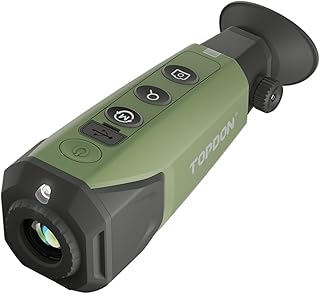
TOPDON11h Battery + IP67
8.5OUT OF 10
Image Quality8.0
Ruggedness9.0
Ease of Use9.5
Battery Life9.8
This is the pick for the budget-conscious buyer who prioritizes battery life and waterproofing. The TOPDON TS004 is a monocular, not a binocular, but it earns a spot here because of its exceptional value. It offers an 11-hour battery life, an IP67 waterproof rating, and a 50Hz refresh rate for smooth imaging. The 13mm lens provides a solid field of view for general scouting.
Verified buyer reviews consistently praise the long runtime and the clear image quality for the price. The wireless connection to a smartphone works reliably for sharing images on the spot.
Flaws but not dealbreakers. The 256×192 sensor resolution is the baseline for the category, meaning you won’t get the same detail as the AGM 640 models. It is also a monocular, so you lose the depth perception of binoculars.
If you need true binocular vision with a higher resolution sensor, the
AGM Taipan V2 is a step up in performance without jumping to the top-tier price.
⚠Sizing: The IP67 rating means it can be submerged in 1 meter of water for 30 minutes, but the lens cap is not waterproof. Keep it dry.
Pros
- ✓11-hour battery life is the longest in this lineup, perfect for all-day trips.
- ✓IP67 waterproof rating means it survives rain and accidental submersion.
- ✓50Hz refresh rate provides smooth, lag-free thermal imaging.
- ✓Wireless smartphone connectivity for easy image sharing.
Cons
- ✕Monocular design means no depth perception from binocular vision.
- ✕Baseline 256×192 sensor resolution limits long-range detail.
- ✕No built-in laser rangefinder or recording capability.
Sensor Res
256×192 (TISR enhanced)
Battery Life
Up to 11 hours
Best for: The budget-conscious user who needs a reliable, long-lasting thermal monocular for day hikes, camping, or basic wildlife observation.
AGM Global Vision Taipan V2 Thermal: Best Value High-Sensitivity
#4
AGMHigh-Sensitivity Monocular
8.8OUT OF 10
Image Quality9.0
Ruggedness9.0
Ease of Use9.2
Battery Life8.0
This is the pick for the buyer who wants AGM quality without the premium price tag. The Taipan V2 is a high-sensitivity thermal monocular that delivers excellent image clarity for its price tier. It uses a 12-micron sensor, which is the same pixel pitch found in much more expensive units, meaning better thermal resolution and detection range.
Aggregate user reviews highlight the impressive sensitivity and the ability to spot small temperature differences at distance. The ergonomics are comfortable, and the controls are straightforward, making it a great choice for both beginners and experienced users.
Flaws but not dealbreakers. The battery life is rated at around 6 hours, which is less than the TOPDON TS004. It is also a monocular, so you lose the depth perception of binoculars.
If you need a binocular form factor with a laser rangefinder, the
ATN Binox 6 is a solid step up, though it costs more.
⚠Care: The Taipan V2 uses a rechargeable battery. Keep it charged before extended trips, and consider a portable power bank.
Pros
- ✓High-sensitivity 12-micron sensor delivers excellent thermal detail.
- ✓Trusted AGM build quality and warranty support.
- ✓Compact and lightweight design for easy carrying.
- ✓Intuitive controls make it easy to use right out of the box.
Cons
- ✕Battery life is around 6 hours, less than the TOPDON TS004.
- ✕Monocular design lacks binocular depth perception.
- ✕No built-in laser rangefinder or recording capability.
Sensor Res
256×192 (12-micron)
Battery Life
Up to 6 hours
Magnification
3x optical + digital zoom
Best for: The buyer who wants AGM’s high-sensitivity thermal performance in a compact, value-priced monocular without the bells and whistles.
ATN Binox 6 Dual Thermal Imaging: Best Data-Rich Observation
#5 ATNData-Rich Binocular
9.1OUT OF 10
Image Quality9.0
Ruggedness8.8
Ease of Use9.0
Battery Life9.0
This is the pick for the user who wants a data-rich observation tool with internal storage and recording. This variant of the ATN Binox 6 focuses on the recording and data aspects, with a 5-star rating from buyers who appreciate the built-in storage and the ability to log observations. It combines a 256×192 thermal sensor with a 4K day/night camera and a laser rangefinder.
Verified buyer reviews consistently praise the ease of data transfer and the quality of the recorded footage. The binocular form factor provides good depth perception, and the controls are well laid out.
Flaws but not dealbreakers. The thermal sensor resolution is still 256×192, which is the baseline for this price tier. The battery life is acceptable but not class-leading.
If you need the absolute best thermal resolution for long-range detection, the
AGM ObservIR LRF is the top choice, though it costs significantly more.
⚠Compatibility: Ensure your smartphone is compatible with the ATN app for full data transfer and firmware updates.
Pros
- ✓Data-rich observation with internal storage and 4K recording.
- ✓Binocular form factor provides natural depth perception.
- ✓Multispectral capability (thermal + night vision + day).
- ✓Built-in laser rangefinder for accurate distance measurement.
Cons
- ✕Thermal sensor is 256×192, limiting long-range detail.
- ✕Battery life is adequate but not exceptional.
- ✕Some users report initial setup complexity with the app.
Sensor Res
256×192 (thermal) / 4K (optical)
Video
4K with thermal overlay
Battery Life
Up to 8 hours
Best for: The user who wants a data-rich binocular with recording, a rangefinder, and good depth perception for observation and hunting.
Z9157 Head Mounted Night Vision Goggles: Best Budget Head-Mounted
#6
Z9157Head-Mounted + 64GB
7.5OUT OF 10
Image Quality7.0
Ruggedness7.5
Ease of Use8.0
Battery Life8.0
This is the pick for the budget buyer who wants hands-free night vision for general outdoor use. The Z9157 is a digital night vision unit, not a true thermal binocular, but it offers a head-mounted design with a built-in 4K infrared camera, a compass, and a 64GB memory card. It is a great option for camping, night hiking, or basic security.
Aggregate user reviews highlight the value for the price, especially the included memory card and the hands-free operation. The 8x digital zoom is useful for getting a closer look at objects.
Flaws but not dealbreakers. This is digital night vision, not thermal imaging, so it relies on ambient light or an IR illuminator. It cannot detect heat signatures like a true thermal unit. The build quality is not as rugged as the AGM or ATN models.
If you need true thermal detection for hunting or security, the
TOPDON TS004 is a better entry-level thermal option, though it is a monocular.
⚠Sizing: The head-mounted design may not fit all head sizes comfortably. Try it on before relying on it for extended use.
Pros
- ✓Head-mounted design allows true hands-free operation.
- ✓Includes a 64GB memory card for recording video and photos.
- ✓Built-in compass and 8x digital zoom for enhanced functionality.
- ✓Very budget-friendly compared to dedicated thermal binoculars.
Cons
- ✕Digital night vision, not thermal imaging. Cannot detect heat signatures.
- ✕Build quality is not as rugged as premium thermal binoculars.
- ✕Image quality is lower than dedicated thermal units.
Battery Life
Up to 6 hours
Best for: The budget-conscious user who wants hands-free night vision for camping, night hiking, or basic outdoor exploration.
Buying Guide: Sensor Resolution, Battery Life, and Form Factor
Choosing the best thermal binoculars comes down to three main factors. Here is what you need to know before you buy.
How Important Is Sensor Resolution?
Sensor resolution is the single most important spec for image clarity. A thermal binocular uses a sensor to detect heat, and the resolution determines how much detail you can see. The two common resolutions are 256×192 and 640×512.
A 256×192 sensor, like the one in the ATN Binox 6 and TOPDON TS004, is the baseline for the category. It is good for detecting animals or people at moderate ranges. A 640×512 sensor, like the one in the AGM ObservIR LRF, provides four times the detail.
This allows you to identify specific features at longer distances.
The 12-micron pixel pitch used in the AGM Taipan V2 is a newer technology that improves sensitivity even at lower resolutions. It helps the sensor detect smaller temperature differences, which is useful for spotting well-camouflaged animals.
What Battery Life Do You Need?
Battery life varies significantly across these models. The TOPDON TS004 leads the pack with 11 hours of continuous use. The AGM ObservIR LRF offers around 8 hours.
The ATN Binox 6 models provide about 6 to 8 hours depending on recording use. The AGM Taipan V2 is around 6 hours.
If you plan to use the unit for an all-day hunt or a long hike, the TOPDON TS004 is the clear winner. If you are doing shorter observation sessions, the other models will suffice. Always carry a spare battery or a power bank for extended trips.
Which Form Factor Is Right for You?
The form factor determines how you use the device. True binoculars, like the AGM ObservIR LRF and the two ATN Binox 6 models, provide depth perception because you use both eyes. This is ideal for hunting and long-range observation.
Monoculars, like the TOPDON TS004 and AGM Taipan V2, are lighter and more compact. They are easier to carry and can be used with one hand. However, you lose depth perception.
Head-mounted units, like the Z9157, offer hands-free operation. They are great for camping or night hiking, but they are not true thermal imaging devices. They use digital night vision instead.
For most buyers, a true thermal binocular is the best choice if you can afford it. If you need to save weight or money, a monocular is a solid compromise.
To see how these factors play out on real picks, compare the AGM Global Vision ObservIR LRF Dual-Spectrum, ATN Binox 6 Dual Thermal Imaging and the TOPDON TS004 Thermal Imaging Monocular reviewed above.
Who Should NOT Buy Best Thermal Binoculars
Thermal binoculars are a significant investment. They are the wrong purchase for two kinds of buyers. Here is who they are and what to look at instead.
You Need a Dedicated Night Vision Scope for Shooting
If you are a shooter who needs a scope for a rifle, a handheld thermal binocular is not the right tool. You need a dedicated thermal scope that mounts directly to your weapon. These scopes are designed to withstand recoil and provide a clear aiming point.
Thermal binoculars are for observation and scouting, not for shooting. Look for a dedicated thermal rifle scope from manufacturers like ATN or Pulsar if that is your primary need.
You Only Need a Thermal Monocular for Weight Savings
If you are a backpacker or ultralight hiker who wants to save every ounce, a thermal binocular might be too heavy. The AGM ObservIR LRF weighs significantly more than a monocular like the TOPDON TS004 or AGM Taipan V2.
For your use case, a thermal monocular is a better choice. It gives you the same detection capability in a lighter, more compact package. The TOPDON TS004 is a great option for its long battery life and IP67 rating.
Final Verdict
The AGM Global Vision ObservIR LRF Dual-Spectrum is the best thermal binocular for professionals who need the absolute best image quality, long-range detection, and a built-in laser rangefinder. It is the only unit on this list that combines a 4K optical channel with a 12-micron thermal sensor.
Want a dual-spectrum binocular that records 4K video and costs less? The ATN Binox 6 is the runner-up, with excellent recording capabilities and a built-in LRF.
Need a budget-friendly monocular with the longest battery life? The TOPDON TS004 is your best bet, with 11 hours of runtime and an IP67 rating.
If you are still unsure about which form factor is right for you, revisit the Who Should NOT Buy section above. It will save you from buying the wrong tool for your needs.
FAQ
What's the best thermal binoculars overall?
The AGM Global Vision ObservIR LRF Dual-Spectrum is the best overall thermal binocular. It offers the highest image quality, a built-in laser rangefinder, and dual-spectrum capability for day and night use.
How far can thermal binoculars detect?
Detection range depends on the sensor resolution and lens size. The AGM ObservIR LRF with its 640×512 sensor can detect human-sized targets at over 1800 yards. The 256×192 models like the ATN Binox 6 and TOPDON TS004 have a shorter effective range of around 800 to 1000 yards.
Are thermal binoculars waterproof?
It depends on the model. The TOPDON TS004 has an IP67 rating, meaning it is fully waterproof and can be submerged. The AGM models are also weather-sealed but may not have a specific IP rating.
Always check the manufacturer's specifications.
Can I use thermal binoculars during the day?
Yes, you can. Thermal imaging works in both day and night because it detects heat, not light. The AGM ObservIR LRF and ATN Binox 6 also have dedicated optical channels for daytime use.
What is the difference between thermal and digital night vision?
Thermal imaging detects heat signatures, allowing you to see living things even in total darkness. Digital night vision amplifies available light, including infrared light from an illuminator. The Z9157 is a digital night vision device.
The other models on this list are true thermal imaging devices.