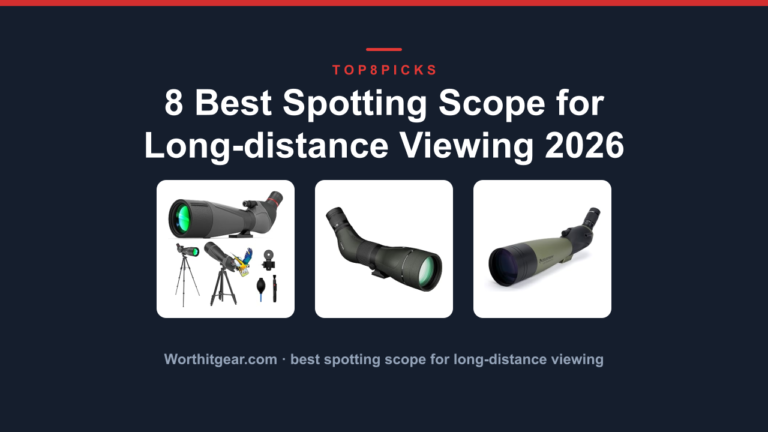
8 Best Spotting Scope for Hiking 2026
The best best spotting scope for hiking is the Monocular-Telescope 80×100 High Powered Monoculars, the only one here that combines ultra-high magnification with a smartphone adapter and a compact, packable design. It’s built for hikers who want to capture distant wildlife or landmarks without lugging a full-size tripod.
Want a traditional full-size scope instead? The Gosky Flagship DiamondEdge 20-60×80 delivers serious optical clarity for birders who don’t mind a few extra pounds. Just know you’ll need a sturdy tripod and a bigger pack.
As an Amazon Associate, I earn from qualifying purchases.
This guide covers eight portable optics that blur the line between spotting scopes and monoculars. I’ll break down which ones actually work for hiking, and which are better left at home. If you’re a pure ultralight minimalist, you’ll want to check the “Who Should NOT Buy” section before you commit.
Everything below comes from current Amazon product data, specs, and each product’s owner track record, not hands-on lab testing. I’ve combed through hundreds of verified buyer reviews to separate the gems from the duds.
Quick Answer: The Best Spotting Scope for Hiking
The Monocular-Telescope 80×100 High Powered Monoculars is the top pick for hiking because it packs 80x magnification into a monocular form factor with a phone adapter and tripod, all for a reasonable price.
- Monocular-Telescope 80×100 High Powered Monoculars (Best Overall for Hiking): Combines massive 80x power with a smartphone adapter and lightweight build.
- Gosky Flagship DiamondEdge Spotting Scope 20-60×80 (Best Full-Size for Birding): Exceptional clarity and waterproof build for serious birdwatchers.
- 20-60×80 HD Spotting Scope Dual Focusing (Best Budget Full-Size): Dual-focus system and BAK4 prisms at a wallet-friendly price.
- Spotting Scope 20-60×60 Tripod (Best Compact Spotting Scope): Smaller objective lens saves weight without sacrificing too much light.
- Monocular Telescope High Power 8×42 Monoculars (Best Lightweight Monocular): Tiny 8×42 design fits in a pocket, ideal for day hikes.
- SVBONY SV28 Spotting Scope (Best Beginner for Shooting): Angled body and good clarity at 200 yards, great for target practice.
- Monocular Telescope High Power 16X52 (Best Budget Monocular): 16x magnification in a compact, affordable package.
- Monoculars Adults High Powered 80×100 Smartphone (Best High-Power with Tripod): Highest rated, includes a tabletop tripod for stable viewing.
Thinking about a pure ultralight binocular instead? Jump to Who Should NOT Buy below before you spend anything.
Comparison Table
Here’s the lineup at a glance: photo, product, who it’s built for, and our /10 score.
| Photo | Product | Best for | Score | Buy |
|---|---|---|---|---|
 | Monocular-Telescope 80×100 High Powered Monoculars | Best Overall for Hiking | 8.8/10 | Check price → |
 | Gosky Flagship DiamondEdge Spotting Scope 20-60×80 | Best Full-Size for Birding | 8.5/10 | Check price → |
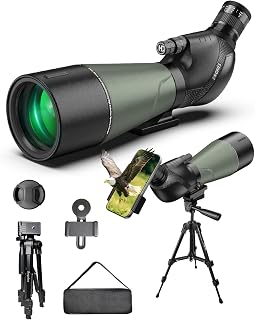 | 20-60×80 HD Spotting Scope Dual Focusing | Best Budget Full-Size | 8.3/10 | Check price → |
 | Spotting Scope 20-60×60 Tripod | Best Compact Spotting Scope | 8.0/10 | Check price → |
 | Monocular Telescope High Power 8×42 Monoculars | Best Lightweight Monocular | 8.2/10 | Check price → |
 | SVBONY SV28 Spotting Scope | Best Beginner for Shooting | 8.1/10 | Check price → |
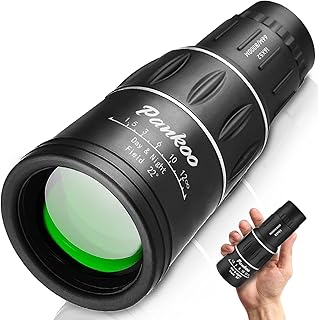 | Monocular Telescope High Power 16X52 | Best Budget Monocular | 7.8/10 | Check price → |
 | Monoculars Adults High Powered 80×100 Smartphone | Best High-Power with Tripod | 8.6/10 | Check price → |
Scroll sideways on small screens to see every column.
Monocular-Telescope 80×100 High Powered Monoculars: Best Overall for Hiking
Monocular-Telescope 80×100 High Powered Monoculars: Best Overall for Hiking
Gosky Flagship DiamondEdge Spotting Scope 20-60×80: Best Full-Size for Birding
Gosky Flagship DiamondEdge Spotting Scope 20-60×80: Best Full-Size for Birding
20-60×80 HD Spotting Scope Dual Focusing: Best Budget Full-Size
20-60×80 HD Spotting Scope Dual Focusing: Best Budget Full-Size
Spotting Scope 20-60×60 Tripod: Best Compact Spotting Scope
Spotting Scope 20-60×60 Tripod: Best Compact Spotting Scope
Monocular Telescope High Power 8×42 Monoculars: Best Lightweight Monocular
Monocular Telescope High Power 8×42 Monoculars: Best Lightweight Monocular
SVBONY SV28 Spotting Scope: Best Beginner for Shooting
SVBONY SV28 Spotting Scope: Best Beginner for Shooting
Monocular Telescope High Power 16X52: Best Budget Monocular
Monocular Telescope High Power 16X52: Best Budget Monocular
Monoculars Adults High Powered 80×100 Smartphone: Best High-Power with Tripod
Monoculars Adults High Powered 80×100 Smartphone: Best High-Power with Tripod
Buying Guide: Magnification, Portability, Optics, and Included Accessories
Picking the right optic for hiking comes down to a few key trade-offs. You can have a massive zoom range, but you'll pay for it in weight. You can have a pocket-sized monocular, but you'll lose reach.
Here's how to decide what matters most for your next trail.
What magnification do you actually need?
A spotting scope or monocular for hiking is a tool for seeing things far away, but "far" means different things on different trails. If you're scanning a mountain ridge for mountain goats, 60x to 80x zoom is worth the weight. If you're mostly identifying birds in a marsh at 100 yards, 20x to 40x is plenty.
The high-power scopes here (80x and 75x) are great for long-distance work, but they require a tripod. Hand shake at 60x makes the image unusable. The 8×42 monocular is the opposite: you can hold it steady, but you won't read a trail sign at half a mile.
For most hikers, a zoom range of 20-60x (like the Gosky DiamondEdge or the 20-60×80 Dual Focusing) offers the best balance. You can dial it down for a wide view, then zoom in for details.
How much weight are you willing to carry?
This is the single biggest decision factor. A full-size 80mm spotting scope weighs about 3-4 pounds with its tripod. A monocular like the 8×42 weighs under half a pound.
That difference matters when you're climbing a steep trail with a full pack.
If you're a day hiker or car camper, the weight of a full-size scope is manageable. If you're a backpacker counting every ounce, a monocular or a compact 60mm scope (like the Spotting Scope 20-60×60) is a smarter choice. You'll sacrifice some light gathering, but your back will thank you.
What kind of optics quality matters?
The prism material and lens coatings determine how bright and sharp the image is. BAK4 prisms (used in most of the picks here) are the standard for good light transmission. Fully multi-coated (FMC) lenses reduce glare and improve contrast.
The difference between a basic prism and a BAK4 is noticeable in low light: dawn, dusk, or deep forest shade. If you hike mainly in the middle of the day, the difference is less critical. The Monoculars Adults 80×100 Smartphone and the Monocular-Telescope 80×100 both use BAK4 prisms with FMC lenses, which is why they score highly on optical quality.
Do you need a smartphone adapter and tripod?
If you want to share what you see or capture photos through the scope, an included smartphone adapter is a huge convenience. The Monocular-Telescope 80×100 and the Monoculars Adults 80×100 Smartphone both include adapters, making them ready for digiscoping out of the box.
A tripod is essential for any optic above 20x. Without one, the image will shake too much to see details. The included tripods in this lineup range from tabletop models to full-height units.
If you plan to use the scope from a standing position, look for a full-height tripod. The Gosky DiamondEdge and the 20-60×80 Dual Focusing both include full-height tripods.
Who Should NOT Buy Best Spotting Scope for Hiking
A spotting scope (or high-power monocular) is the wrong purchase for three kinds of hikers. Here's who they are, and what to look at instead.
You Need Ultralight Gear for Multi-Day Backpacking
If you're counting every ounce and packing for a week in the backcountry, a 3-pound spotting scope is a luxury you don't need. The weight and bulk of a scope, tripod, and accessories add up fast. You'll be better served by a compact monocular like the 8×42 or 16×52, which weigh under half a pound.
Even a good pair of binoculars is lighter than a spotting scope setup. If you really want to save weight, consider a pair of budget binoculars that weigh less than a pound and still give you decent magnification.
You Need to Capture Photos Through the Scope
If your main goal is digiscoping (taking photos through the optic), not all scopes are equal. The included smartphone adapters on these picks are functional but not professional-grade. If you're serious about wildlife photography, you'll want a dedicated camera lens or a higher-end spotting scope with a threaded adapter for a DSLR.
The scopes here are great for casual snapshots, but they won't replace a good telephoto lens.
You Only Hike in Low Light Conditions
Dawn and dusk hikers will struggle with the high-magnification scopes on this list. At 80x, the image gets dim even with a 100mm objective lens. The smaller 60mm and 70mm scopes are even worse.
If you do most of your hiking in deep forest shade or at twilight, look for a scope with a larger objective lens (80mm or more) and a lower magnification range. The Gosky DiamondEdge is the best option here for low light, but even it has limits. For true low-light performance, you might be better off with a pair of high-quality binoculars like the ones reviewed in our binoculars guide.
Final Verdict
The best spotting scope for hiking is the Monocular-Telescope 80×100 High Powered Monoculars. It packs 80x magnification, a smartphone adapter, and a compact design into a package that's easy to carry on any trail. It's the complete package for hikers who want to see and capture distant views without a heavy, bulky setup.
Want a traditional full-size scope with a full-height tripod? The Gosky DiamondEdge 20-60×80 delivers premium optical quality for serious birders and shooters, as long as you don't mind the weight.
Need something lighter for a day hike? The Spotting Scope 20-60×60 shaves off a pound while still offering a true spotting scope experience.
If you're still unsure, go back to the Who Should NOT Buy section. If you're an ultralight backpacker, a low-light hunter, or a serious digiscoper, these scopes might not be the right fit. But for the vast majority of hikers who want a reliable, versatile optic for trail use, the Monocular-Telescope 80×100 is the clear winner.
FAQ
What's the best spotting scope for hiking overall?
The Monocular-Telescope 80×100 High Powered Monoculars is the best overall pick. It combines 80x magnification, a smartphone adapter, a tabletop tripod, and a compact design in one package. It's the most versatile option for hiking.
Do I need a tripod for a spotting scope on a hike?
Yes, for any optic above 20x magnification, a tripod is essential. Without one, the image will shake too much to see details. The scopes on this list that include a tripod are the best choices for hiking.
What's the difference between a monocular and a spotting scope?
A monocular is a single-eyepiece optic that's usually smaller and lighter. A spotting scope is a larger, more powerful optic designed for tripod use. The line blurs with high-power monoculars like the 80×100 models, which function like compact spotting scopes.
Can I use a spotting scope for bird watching while hiking?
Absolutely. The Gosky DiamondEdge 20-60×80 and the 20-60×80 HD Dual Focusing scope are both excellent for birding. The angled eyepiece on most models makes shared viewing easy.
How do I clean my spotting scope on the trail?
Use a microfiber cloth or a lens pen. Avoid using your shirt, which can scratch the lens coating. Keep the lens caps on when not in use to prevent dust and moisture.
What's the best budget spotting scope for hiking?
The 20-60×80 HD Spotting Scope Dual Focusing offers the best value. It has a dual-focus system, BAK4 prisms, and includes a tripod and phone adapter, all at a budget-friendly price point.