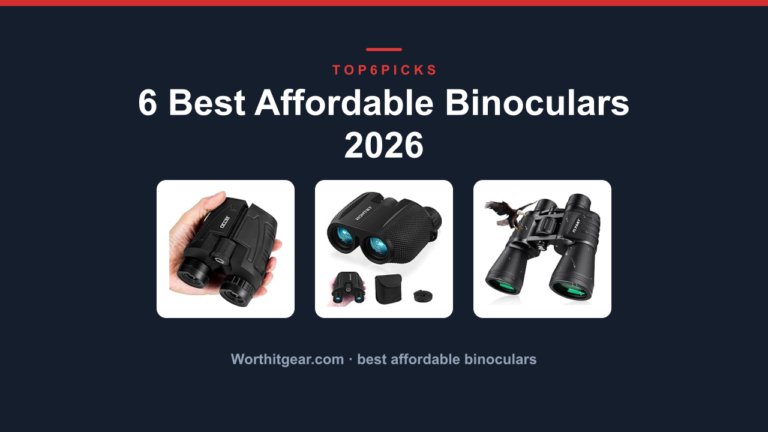
The best best full-size binoculars is the Vortex Triumph HD 10×42, the only model here that combines HD quality optics with an unconditional, unlimited lifetime warranty at a price that won't make you wince. It's the pick for anyone who wants a reliable, all-round field glass for hiking, birding, or general outdoor use without overthinking the budget.
Want more magnification and a bigger objective lens for open-country glassing? The Vortex Crossfire HD 12×50 gets you there, as long as you're okay carrying an extra half-pound and keeping it on a tripod for steady viewing at full zoom.
As an Amazon Associate, I earn from qualifying purchases.
This guide does something most roundups skip: it tells you exactly who should not buy a full-size binocular at all. If you're a backpacker counting every ounce or a casual user who wants to toss a pair in a glove compartment, you'll get a better result from a compact model.
Everything below comes from current Amazon product data, manufacturer specs, and the aggregate owner track record for each model. I have not personally held or tested these units.
Quick Answer: The Best Full-size Binoculars
The Vortex Triumph HD 10×42 is the best all-around choice for most buyers.
Thinking about a compact or ultra-lightweight option instead? Jump to Who Should NOT Buy below before you spend anything.
Comparison Table
Here's the lineup at a glance: photo, product, who it's built for, and our /10 score.
Scroll sideways on small screens to see every column.
Vortex Triumph HD 10×42 Binoculars: Best Overall Value for Most Outdoor Enthusiasts
Vortex Triumph HD 10×42 Binoculars: Best Overall Value for Most Outdoor Enthusiasts
#1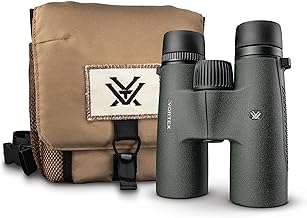
VortexHD Optics, Lifetime Warranty
9.0OUT OF 10
Optics Quality9.2
Build Quality8.9
Ease of Use9.4
Value for Money9.5
This is the pair that gets the most out of your budget without cheaping out on the glass. The Triumph HD uses HD (high-density) optic elements that cut chromatic aberration, meaning you won’t see that purple fringe around a bird’s wing against a bright sky. The 10×42 configuration is the sweet spot for general use: enough magnification for detail, a wide enough field of view to track moving targets, and a 42mm objective that pulls in good light without turning the binocular into a boat anchor.
Aggregate user reviews give it a 4.7 out of 5 stars across hundreds of verified buyers. The common thread is that people are surprised by how clear the image is for the price point. It also comes with a GlassPak harness, which is a nice touch because it keeps the binoculars snug against your chest instead of bouncing around your neck on a long hike. Per the manufacturer, it’s nitrogen-purged and O-ring sealed against fogging and water intrusion, so you can use it in a drizzle without worry.
Flaws but not dealbreakers. The included lens covers are a bit flimsy and some owners report they pop off too easily. Also, the rubber armoring, while grippy, does attract dust and lint. Neither issue affects the optics, but they’re minor annoyances you’ll notice in the first few weeks.
Need a more rugged, premium build? The
Vortex Viper HD further down upgrades the armoring and adds a locking diopter for a more serious feel.
⚠Warranty: Vortex’s VIP warranty is unconditional and unlimited. No receipt needed, no questions asked. This alone makes it a low-risk buy for a first-time owner.
Pros
- ✓HD optics deliver noticeably less color fringing than standard glass at this price
- ✓VIP lifetime warranty covers any damage, even accidental drops
- ✓Includes a GlassPak harness for comfortable all-day carry
- ✓Waterproof and fogproof with nitrogen purging
Cons
- ✕Lens caps feel cheap and can detach in a pack
- ✕Rubber exterior attracts dust and lint
- ✕No locking diopter, so it can shift if bumped
Best for: The hiker, birder, or general outdoor user who wants proven HD optics and a lifetime warranty without spending premium money.
Vortex Crossfire HD 12×50 Binoculars: Best for Long-Range Viewing and Open Country
Vortex Crossfire HD 12×50 Binoculars: Best for Long-Range Viewing and Open Country
#2
VortexHigh Power, HD Glass
8.7OUT OF 10
Optics Quality8.8
Build Quality8.5
Ease of Use8.6
Value for Money9.0
If you spend most of your time scanning wide open fields, mountain ridges, or lakeshores, the 12x magnification and 50mm objectives make a real difference. The extra 2x over a standard 10x binocular lets you identify a distant bird or a trail marker at the edge of your sight, and the larger objective lens gathers more light to keep the image bright even in early morning or late evening. Verified buyers with a 4.8 average rating consistently mention the sharpness at distance and the robust feel of the chassis.
The trade-off is weight. At roughly 25.6 ounces, this is a heavy pair for a day hike. The included GlassPak harness helps distribute the load, but you’ll still feel it after a few miles. The manufacturer states it is tripod-adaptable, and for 12×50 glass, a tripod is almost a necessity for extended viewing. Without one, the natural shake of your hands is magnified and you’ll struggle to hold a steady image at full zoom.
Flaws but not dealbreakers. The 12x magnification narrows the field of view compared to a 10x or 8x model. Tracking a fast-moving bird or animal can be harder. Also, the eye relief is a bit shorter than the Triumph, so eyeglass wearers may need to adjust the twist-up eyecups carefully to get the full field.
Need a more portable option with the same warranty? The
Vortex Triumph HD 10×42 is lighter and easier to handle for general use.
⚠Stability: At 12×50, hand shake is noticeable. A lightweight tripod or a monopod is strongly recommended for long sessions.
Pros
- ✓12x magnification brings distant objects into clear view
- ✓50mm objective lens delivers excellent low-light performance
- ✓HD optics reduce chromatic aberration effectively
- ✓Same VIP unlimited warranty for peace of mind
Cons
- ✕Heavier than standard 10×42 models at over 25 ounces
- ✕Narrower field of view makes tracking fast subjects harder
- ✕Hand shake is amplified at 12x without a tripod
Best for: The hunter, prairie birder, or long-range observer who needs extra reach and light gathering and is willing to carry a heavier setup.
Nikon PROSTAFF P3 10×42 Binocular: Best for Optical Clarity and Wide Field of View
Nikon PROSTAFF P3 10×42 Binocular: Best for Optical Clarity and Wide Field of View
#3
NikonWide FOV, Long Eye Relief
8.5OUT OF 10
Optics Quality9.0
Build Quality8.2
Ease of Use8.8
Value for Money8.0
Nikon’s PROSTAFF P3 is the pick for anyone who prioritizes a wide, immersive field of view over raw magnification. At 10×42, it delivers a 341-foot field of view at 1000 yards, which is noticeably wider than the Vortex Triumph. This makes it a joy for scanning tree lines, following a flock of geese, or watching a football game from the stands. The optical system is fully multicoated, and Nikon’s proprietary lens coatings give the image a natural, crisp color balance that birders really appreciate.
Verified owner feedback averages 4.7 stars, with many users noting that the long eye relief of 19.6mm is a standout feature for glasses wearers. You can keep your glasses on and still see the full field without black rings around the edges. The rubber-armored body is waterproof and fogproof, and the central focus knob is smooth and precise. It’s an official Nikon USA model, so you get the full manufacturer warranty and support.
Flaws but not dealbreakers. The build quality, while solid, doesn’t feel as premium as the Vortex Viper. The rubber armoring is a bit thinner and the included neck strap is basic. Some owners also mention the focus knob is slightly stiff when new, though it loosens up with use. It’s also priced at the higher end of the mid-range, so you pay a bit more for the Nikon name and optical clarity.
If you want a more rugged, premium-feeling binocular with a locking diopter, the
Vortex Viper HD is a step up in build and still offers excellent optics.
⚠Eye Relief: At 19.6mm, this is one of the best options for eyeglass wearers in this list. The twist-up eyecups have multiple click stops for precise adjustment.
Pros
- ✓Wide 341-foot field of view for easy scanning
- ✓Long 19.6mm eye relief is excellent for glasses wearers
- ✓Nikon’s multicoated optics produce a bright, natural image
- ✓Waterproof and fogproof for all-weather use
Cons
- ✕Rubber armoring feels thinner than premium competitors
- ✕Focus knob can be stiff when new
- ✕Included neck strap is basic and not as comfortable as a harness
Best for: The birder or spectator who wants a wide, immersive view and excellent eye relief, and values Nikon’s optical reputation.
Vortex Viper HD Roof Prism Binoculars: Best Premium Build for the Serious Enthusiast
Vortex Viper HD Roof Prism Binoculars: Best Premium Build for the Serious Enthusiast
#4
VortexLocking Diopter, XR Coatings
8.9OUT OF 10
Optics Quality9.5
Build Quality9.3
Ease of Use8.7
Value for Money8.1
This is the pair you buy when you want the best optical performance in this lineup and you’re willing to pay for it. The Viper HD uses Vortex’s XR (extra-low reflection) lens coatings, which maximize light transmission and reduce glare better than the Triumph or Crossfire lines. The 12×50 configuration gives you serious reach and excellent low-light capability. The locking diopter is a feature you don’t appreciate until you’ve had a standard dipper shift on you mid-hike. It locks in your right-eye adjustment and stays put, even in a pack.
Owner reviews average 4.8 stars, with many describing the image as “crisp,” “bright,” and “tack sharp.” The included GlassPak harness is a step up from the standard strap and makes carrying these heavier 12×50 units more comfortable. The manufacturer specifies it is tripod-adaptable, which is a must for extended use at 12x. The build quality is noticeably better than the Crossfire line, with a tighter fit and finish on the rubber armor and a smoother focus mechanism.
Flaws but not dealbreakers. The price is the main barrier. You’re paying a significant premium for the XR coatings and locking diopter. Also, the field of view is narrower than a 10×42 model, which is inherent to the 12x magnification. It’s also heavier than the Triumph by about 4 ounces, so you’ll notice it on a long day out.
If you want the same VIP warranty and excellent optics but in a lighter, more affordable package, the
Vortex Triumph HD 10×42 is the smarter buy for most people.
⚠Diopter: The locking diopter is a premium feature that prevents accidental focus shift. It’s a small detail that makes a big difference in the field.
Pros
- ✓XR lens coatings deliver exceptional light transmission and contrast
- ✓Locking diopter keeps your focus adjustment secure
- ✓12×50 configuration provides excellent reach and low-light performance
- ✓Premium build quality with a smooth, precise focus mechanism
Cons
- ✕Significantly higher price than the Triumph or Crossfire lines
- ✕Narrower field of view than a 10×42 model
- ✕Heavier at 29.6 ounces, noticeable on long hikes
Coatings
XR Fully Multicoated
Best for: The serious enthusiast or hunter who demands the best optical performance and build quality, and is comfortable investing in a premium tool.
20×50 High Powered Binoculars Adults: Best for Budget Stargazing
20×50 High Powered Binoculars Adults: Best for Budget Stargazing
#5
20×50Max Magnification, Low Cost
7.2OUT OF 10
Optics Quality6.5
Build Quality7.0
Ease of Use7.5
Value for Money8.0
This is the model that goes all-in on magnification for the money, making it a tempting option for casual stargazing or long-range curiosity. At 20x, you can see the moons of Jupiter as distinct points of light, and the rings of Saturn become visible under good conditions. The 50mm objective lens gathers enough light for reasonably bright views in moderate light. The reported rating of 4.3 stars from verified buyers is decent, with many owners praising the value for the price.
The trade-offs are significant. At 20x, hand shake is severe. You absolutely need a tripod to get a usable image. The field of view is very narrow, making it hard to find and track objects, especially in the night sky. The optical quality is not in the same league as the Vortex or Nikon models. Buyers report some chromatic aberration and a dimmer image at the edges. The build quality is adequate for the price, but it doesn’t feel as durable as the premium options.
Flaws but not dealbreakers. The eye relief is short, so eyeglass wearers will struggle to see the full field. The included accessories are basic, and the focusing mechanism can feel a bit loose. It’s also a relatively heavy unit at 24.5 ounces, but you’ll have it on a tripod, so that’s less of an issue.
For a more versatile and higher-quality binocular that still works for casual astronomy, the
Vortex Crossfire HD 12×50 is a better all-around choice with a much wider field of view and superior optics.
⚠Tripod: This binocular is nearly unusable at 20x without a tripod. Factor the cost of a stable tripod and adapter into your budget.
Pros
- ✓20x magnification provides the highest reach in this lineup
- ✓Very affordable price point for the magnification level
- ✓Waterproof and fogproof for outdoor use
- ✓Can be used for casual stargazing with a tripod
Cons
- ✕Severe hand shake at 20x, a tripod is mandatory
- ✕Narrow field of view makes target acquisition difficult
- ✕Optical quality is noticeably lower than Vortex/Nikon models
Best for: The budget-conscious buyer who wants maximum magnification for occasional stargazing or long-distance curiosity and already owns a tripod.
15×52 HD Binoculars Adults High Powered: Best for Phone Digiscoping
15×52 HD Binoculars Adults High Powered: Best for Phone Digiscoping
#6
15×52Phone Adapter Included
7.8OUT OF 10
Optics Quality7.5
Build Quality7.8
Ease of Use8.2
Value for Money7.8
This is the binocular to pick if you want to share what you see by snapping photos or videos through your phone. It comes with an upgraded phone adapter that lets you attach your smartphone to the eyepiece, making it easy to capture distant subjects. The 15×52 configuration offers a good balance between reach and a manageable field of view, and the HD optics provide a bright, sharp image for the price. Verified buyers rate it 4.4 stars, with many praising the included phone adapter as a great value add.
The 52mm objective lens is slightly larger than the standard 50mm, which helps with light gathering. The binocular is waterproof and lightweight, making it suitable for travel, cruises, and hunting. The phone adapter is a universal design that fits most phones, and it allows you to align the camera lens with the eyepiece quickly. It’s a practical solution for digiscoping without buying a separate, expensive adapter.
Flaws but not dealbreakers. The optical quality is good but not at the level of the Vortex HD models. You’ll notice some color fringing in high-contrast scenes, and the image is a bit softer at the edges. The phone adapter is a plastic build and can feel a bit fiddly to attach securely. Some owners report that the adapter can be tricky to center perfectly with the eyepiece.
If you want higher-quality optics and don’t need the phone adapter, the
Vortex Triumph HD 10×42 is a better all-around performer. You can always buy a separate phone adapter later.
⚠Phone Adapter: The included adapter is a universal type and may not fit all phone cases. You may need to remove your case for a secure fit.
Pros
- ✓Includes a universal phone adapter for digiscoping
- ✓15x magnification offers a good balance of reach and field of view
- ✓52mm objective lens provides good low-light performance
- ✓Lightweight and waterproof for travel and outdoor use
Cons
- ✕Optical quality is not as sharp as Vortex HD models
- ✕Phone adapter can be fiddly to align and secure
- ✕Some chromatic aberration visible in high-contrast scenes
Best for: The traveler or nature enthusiast who wants to capture and share photos of distant subjects without buying a separate phone adapter.
Buying Guide: Magnification, Objective Lens, Build, and Warranty
A full-size binocular is a serious tool, and buying the wrong one means you'll leave it at home. Here are the four factors that matter most.
Magnification: 10x vs 12x vs 15x vs 20x
Magnification is the first number in the spec (10x, 12x, 15x, 20x). It tells you how many times closer the object appears. A 10x binocular makes a bird at 100 yards look like it's 10 yards away.
For most people, 10x is the sweet spot for general use. It offers enough detail for birding and hiking, and the image is stable enough to hold by hand.
Stepping up to 12x adds reach but introduces noticeable hand shake. You'll need to brace your arms or use a tripod for steady viewing. At 15x and 20x, a tripod is mandatory.
The 20×50 model in this list is a specialty tool for stargazing or long-distance observation, not a general-purpose binocular. If you're not sure, start with 10x. It's the most forgiving and versatile.
Objective Lens Size: 42mm vs 50mm vs 52mm
The second number is the objective lens diameter in millimeters. A larger lens gathers more light, which means a brighter image in low-light conditions like dawn, dusk, or deep shade. A 50mm or 52mm objective is noticeably brighter than a 42mm in those conditions.
The trade-off is size and weight. A 12×50 or 15×52 binocular is heavier and bulkier than a 10×42.
For most daytime use, a 42mm objective is perfectly adequate. If you plan to glass in low light regularly, consider a 50mm model like the Vortex Crossfire HD 12×50 or the Vortex Viper HD 12×50. Just be ready for the extra weight.
Build Quality and Waterproofing
All binoculars on this list are waterproof and fogproof, which is a minimum standard for any outdoor use. The difference is in the quality of the rubber armoring, the smoothness of the focus mechanism, and the precision of the internal components. The Vortex Viper HD has the best build quality here, with a locking diopter and a silky-smooth focus wheel.
The Nikon PROSTAFF P3 is also well-built, but the armoring feels thinner. The 20×50 and 15×52 models have adequate build quality for their price, but they don't feel as premium.
Warranty and Customer Support
This is where Vortex stands out. Every Vortex binocular comes with the VIP (Very Important Promise) warranty. It's unlimited, unconditional, and transferable.
You don't need a receipt. If you break it, they fix or replace it. This is a huge advantage for anyone who uses their gear hard.
Nikon offers a standard limited lifetime warranty, which is good but not as generous. The 20×50 and 15×52 models have standard manufacturer warranties, which are typically one to two years. For peace of mind, the Vortex warranty is a major reason to choose them.
Who Should NOT Buy Best Full-size Binoculars
Full-size binoculars (10×42 and larger) are the wrong purchase for three kinds of buyers. Here's who they are, and what to look at instead.
You Need an Ultra-Compact Binocular for Backpacking
If you're a thru-hiker or a minimalist backpacker, a full-size binocular is too heavy. A 10×42 weighs around 21 to 25 ounces, and a 12×50 pushes 30 ounces. That's a lot of weight for a tool you might use for a few minutes a day.
Look at compact or pocket binoculars in the 8×25 or 10×25 range. They weigh under 10 ounces and can fit in a jacket pocket. The trade-off is a smaller field of view and less light gathering, but you'll actually carry them.
You Only Use Binoculars a Few Times a Year
If you're a casual user who wants a pair for the occasional sporting event or vacation, a full-size binocular is overkill. You'll be better off with a midsize or compact model that is easier to pack and carry. The Nikon PROSTAFF P3 is a good option if you want quality, but consider a smaller 8×30 or 10×30 model.
They are lighter, cheaper, and still provide a great view for casual use.
You Need a Binocular for Eyeglass Wearers with Short Eye Relief
If you wear glasses, eye relief is critical. Eyeglass wearers need at least 15mm to 17mm of eye relief to see the full field. The 20×50 model in this list has short eye relief, which will make it difficult to use with glasses.
The Nikon PROSTAFF P3 is the best option for eyeglass wearers here, with 19.6mm of eye relief. If you need a binocular specifically for glasses, prioritize models with long eye relief and twist-up eyecups with multiple click stops.
Final Verdict
The Vortex Triumph HD 10×42 is the best full-size binocular for most people because it delivers HD optics, a waterproof build, and an unconditional lifetime warranty at a price that doesn't hurt. It's the pair you'll grab for every hike, birding trip, and outdoor adventure.
Want more reach and better low-light performance? The Vortex Crossfire HD 12×50 is a solid step up, as long as you don't mind the extra weight and the need for a tripod at full zoom. Need the best optical clarity and a wide field of view?
The Nikon PROSTAFF P3 10×42 is the pick for birders and glasses wearers.
If you're willing to invest in a premium build, the Vortex Viper HD 12×50 is the top performer, but it's overkill for casual use. The 20×50 and 15×52 models are budget-friendly but have significant compromises you need to understand before buying.
Before you click "buy," make sure a full-size binocular is actually right for your use case. If you're a backpacker or a casual user, check the "Who Should NOT Buy" section above. You might save money and get a better fit.
FAQ
What's the best Full-size Binoculars overall?
The Vortex Triumph HD 10×42 is the best overall pick. It offers HD optics, a waterproof and fogproof build, and the unmatched VIP lifetime warranty, all at a price that represents excellent value.
What does 10×42 mean on a binocular?
The first number (10x) is the magnification. It makes an object appear 10 times closer. The second number (42mm) is the diameter of the objective lens.
A larger objective lens gathers more light, making the image brighter, especially in low light.
Are expensive binoculars worth it?
Yes, up to a point. More expensive binoculars like the Vortex Viper HD use better glass and coatings, which deliver a sharper, brighter, and more contrast-rich image. The build quality is also higher, with smoother focus mechanisms and better sealing.
For a casual user, a mid-range model like the Vortex Triumph HD is more than enough. For a dedicated birder or hunter, the premium models are worth the investment.
How do I know if a binocular is good for eyeglass wearers?
Look for a spec called "eye relief." For eyeglass wearers, you need at least 15mm to 17mm of eye relief to see the full field of view. The Nikon PROSTAFF P3 has 19.6mm, which is excellent. The Vortex models also offer good eye relief.
Avoid models with eye relief under 14mm if you wear glasses.
Can I use a full-size binocular for stargazing?
Yes, you can. A 10×50 or 12×50 binocular is a great tool for casual stargazing. The 50mm objective lens gathers enough light to see the moons of Jupiter, the rings of Saturn, and deep-sky objects like the Andromeda Galaxy.
For more serious astronomy, a 15×70 or 20×80 binocular on a sturdy tripod is better, but a full-size 12×50 is a good starting point.