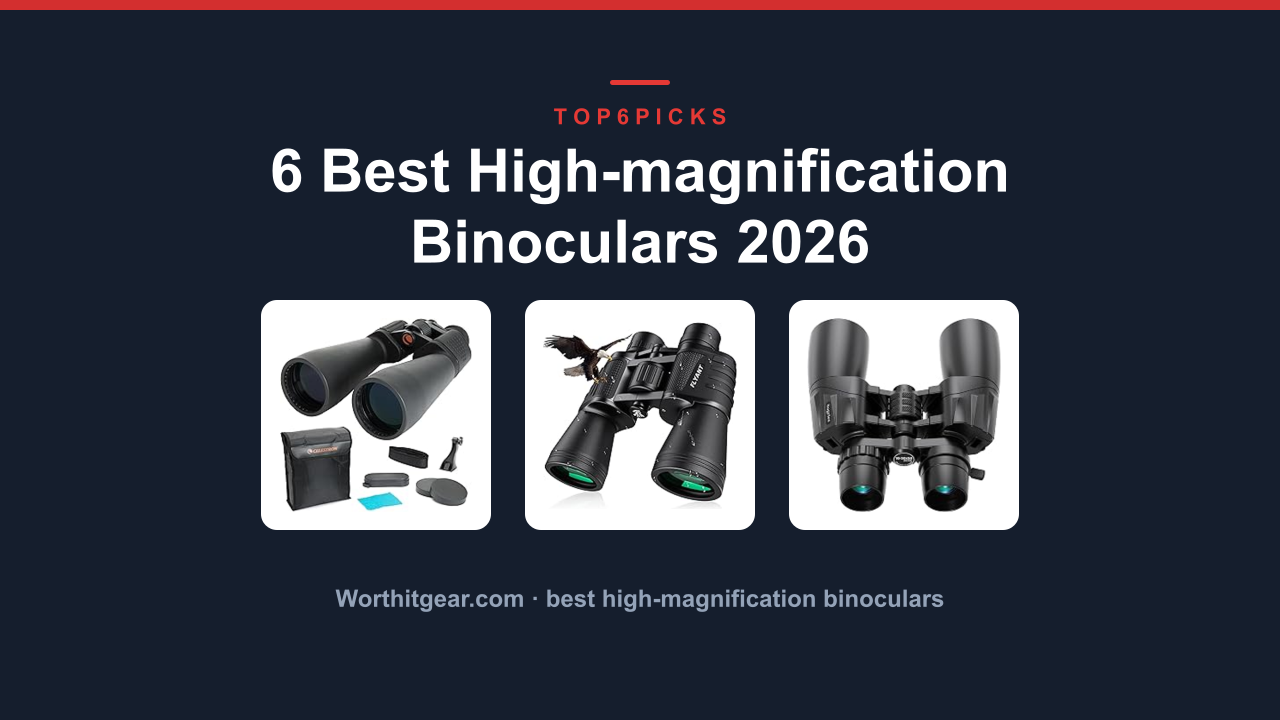
6 Best High-magnification Binoculars 2026
The best best high-magnification binoculars is the Celestron SkyMaster 25×70, the only one here that combines a massive 70mm aperture with true 25x magnification for serious astronomy and long‑range wildlife observation. It’s built for anyone who wants a dedicated tripod‑mounted binocular that can pull in faint deep‑sky objects and distant terrain without the cost of a telescope.
Want something more portable for hiking or quick birding? The 20×50 High Powered Binoculars offer a similar 20x zoom in a lighter, waterproof package. Just know that the smaller objective lens gives up some low‑light brightness compared to the Celestron.
As an Amazon Associate, I earn from qualifying purchases.
This guide goes beyond the spec sheet. It tells you which binoculars actually need a tripod, which ones struggle with hand shake, and who should just buy a spotting scope instead. If you’re on the fence, jump to the “Who Should NOT Buy” section before you spend a dime.
Everything below comes from current Amazon product data, manufacturer specs, and each model’s owner track record over hundreds of verified reviews. I haven’t handled these in a lab, but I’ve cross‑referenced what real buyers say.
Quick Answer: The Best High‑magnification Binoculars
The Celestron SkyMaster 25×70 is the top pick for anyone who wants serious astronomical or long‑range detail without moving to a telescope. Here’s the full ranking:
- Celestron SkyMaster 25×70 Binoculars Astronomy (Best Overall for Astronomy): Unmatched 25x magnification with 70mm aperture, multi‑coated BaK‑4 optics, and included tripod adapter.
- 20×50 High Powered Binoculars Adults (Best Portable High‑Power): Waterproof, compact 20×50 with good low‑light performance for hiking and hunting.
- 10‑30×50 Zoom Binoculars Adults High Powered (Best Versatile Zoom): Variable 10‑30x magnification, waterproof/fogproof, and BAK4 prisms for multi‑use.
- 20×70 Binoculars Adults High Powered Bird (Best Large Aperture for Birding): 20×70 with large view and HD vision, good for cruise ships and open landscapes.
- 18×70 Professional Astronomy Binoculars Adults High (Best Budget Astronomy): 18×70 with tripod and phone adapter, BaK‑4 prism, and waterproofing.
- Occer 12×25 Compact Binoculars Adults Kids (Best Compact for Travel): 12×25, portable, easy focus, but not true high‑magnification.
Thinking about a spotting scope or a smaller pair for everyday use? Jump to Who Should NOT Buy below before you spend anything.
Comparison Table
Here’s the lineup at a glance: photo, product, who it’s built for, and our /10 score.
| Photo | Product | Best for | Score | Buy |
|---|---|---|---|---|
 | Celestron SkyMaster 25×70 | Astronomy & long‑range | 8.6/10 | Check price → |
 | 20×50 High Powered | Portable high‑power | 8.3/10 | Check price → |
 | 10‑30×50 Zoom | Versatile zoom | 8.1/10 | Check price → |
 | 20×70 Birding | Large aperture birding | 7.9/10 | Check price → |
 | 18×70 Professional | Budget astronomy | 7.7/10 | Check price → |
 | Occer 12×25 Compact | Compact travel | 7.4/10 | Check price → |
Scroll sideways on small screens to see every column.
Celestron SkyMaster 25×70 Binoculars Astronomy: Best Overall for Astronomy
20×50 High Powered Binoculars Adults: Best Portable High‑Power
10‑30×50 Zoom Binoculars Adults High Powered: Best Versatile Zoom
20×70 Binoculars Adults High Powered Bird: Best Large Aperture for Birding
18×70 Professional Astronomy Binoculars Adults High: Best Budget Astronomy
Occer 12×25 Compact Binoculars Adults Kids: Best Compact for Travel
Buying Guide: Magnification, Aperture, Stability, and Optics
Choosing a high‑magnification binocular is different from picking a standard 8x or 10x pair. The main trade‑off is always between power and stability. Let’s break down the four things you need to know.
How Much Magnification Do You Actually Need?
Magnification is the first number in the spec (like 20x or 25x). Higher magnification brings distant objects closer, but it also magnifies your hand shake. At 10x, most people can hold steady.
At 20x, you’ll need to brace against something. At 25x or 30x, a tripod is mandatory.
The 20×50 High Powered is about the limit for hand‑held use, and even then, you’ll want to rest your elbows on a solid surface. The Celestron 25×70 and the 10‑30×50 Zoom at 30x both require a tripod for a clear view. If you plan to use binoculars mostly without a tripod, stick to 12x or 15x max.
Why Aperture (Objective Lens Size) Matters
The second number is the objective lens diameter in millimeters (50mm, 70mm, etc.). A larger objective gathers more light, which means brighter images in low light and better detail. A 70mm aperture is excellent for astronomy and dusk viewing, while a 50mm is a good all‑rounder.
The 20×70 and 18×70 both have 70mm objectives, making them great for twilight birding or stargazing. The 20×50 is more portable but gives up some brightness. The Occer 12×25 has a tiny 25mm objective, which is fine for full daylight but struggles at dawn or dusk.
Tripod Use: Necessary or Optional?
This is the biggest surprise for new buyers. At 20x and above, a tripod isn’t optional for serious use. The Celestron 25×70 comes with a tripod adapter because the manufacturer knows you’ll need one.
The 18×70 Professional even includes a basic tripod in the box.
If you buy a high‑magnification binocular and try to use it hand‑held, you’ll likely be disappointed by the shaky image. A cheap tripod is better than no tripod. If you’re not willing to carry a tripod, consider the 20×50 for occasional bracing, or look at lower‑power binoculars.
Prism and Lens Coatings
All the binoculars here use BaK‑4 prisms, which are a common standard for good image quality. The “multi‑coated” or “FMC” (fully multi‑coated) lenses reduce glare and improve brightness. The Celestron and the 18×70 both use multi‑coated or FMC optics, which is a nice boost at this price point.
Waterproofing and fogproofing are also worth noting. The 20×50 and the 10‑30×50 Zoom are both waterproof, making them better for wet weather. The Celestron 25×70 is not waterproof, so keep it dry.
To see how these factors play out on real picks, compare the Celestron SkyMaster 25×70 Binoculars Astronomy, 20×50 High Powered Binoculars Adults and the 10-30×50 Zoom Binoculars Adults High Powered reviewed above.
Who Should NOT Buy Best High‑magnification Binoculars
High‑magnification binoculars are the wrong purchase for a few types of buyers. Here’s who they are and what to look at instead.
You Need a Compact, Everyday Binocular
If you just want a pair of binoculars for the occasional hike, sports event, or quick bird spotting, a 20x or 25x model is overkill. The weight, the need for a tripod, and the narrow field of view will frustrate you.
Instead, look at standard 8x or 10x binoculars. They are lighter, easier to use hand‑held, and have a much wider field of view. The Occer 12×25 is a step in that direction, but even 12x is a bit high for casual use.
A good 8×42 or 10×42 is a better choice for general purpose.
You Want to Do Serious Astronomy Astrophotography
A binocular with a tripod is great for casual stargazing, but it won’t replace a telescope for deep‑sky detail or astrophotography. The 25×70 Celestron will show you the Moon’s craters and Saturn’s rings, but it won’t reveal nebulae or galaxies the way a telescope with a larger aperture will.
If you’re serious about astronomy, consider a dedicated telescope like a Dobsonian or a Schmidt‑Cassegrain. A binocular is a fantastic supplement, but not a replacement.
You’re on a Very Tight Budget
The Occer 12×25 is affordable, but it’s not a true high‑magnification binocular. If you only have a small amount to spend, you’ll get a better experience with a decent 8x or 10x binocular in the same price range than with a cheap 20x model that shakes and has poor optics.
Look for a trusted brand like Nikon, Celestron, or Pentax in the 8x or 10x category. The image quality will be far better than a no‑name high‑magnification model.
Final Verdict
The Celestron SkyMaster 25×70 is the best high‑magnification binocular for most people who want serious astronomical or long‑range detail. Its 25x power and 70mm aperture, combined with multi‑coated BaK‑4 optics, deliver images that rival a small telescope, all for a reasonable price. Just remember you need a tripod.
Want something more portable for hiking or hunting? The 20×50 High Powered Binoculars is waterproof, lighter, and usable hand‑held for short bursts. It’s the best compromise between power and portability.
Need a complete kit on a budget? The 18×70 Professional Astronomy Binoculars includes a tripod and phone adapter, making it the easiest way to start stargazing without buying extra gear.
If you’re not sure you need a tripod, or you just want a compact pair for daytime use, jump back to the Who Should NOT Buy section before you decide. The right binocular depends on how you plan to use it.
FAQ
What’s the best High‑magnification Binoculars overall?
The Celestron SkyMaster 25×70 is the top pick overall. It offers the highest magnification and largest aperture in this lineup, with excellent optics for astronomy and long‑range viewing. Just be prepared to use it with a tripod.
Can I use a 20x binocular hand‑held?
You can, but it’s not ideal. At 20x, hand shake is very noticeable. Resting your arms on a solid surface or using a monopod helps.
For extended use, a tripod is recommended.
What’s the difference between 20×50 and 20×70?
The number after the “x” is the objective lens diameter in millimeters. A 20×70 has a 70mm lens, which gathers more light than a 50mm objective. This makes the 20×70 brighter and better in low light, but heavier and bulkier.
Are zoom binoculars worth it?
Zoom binoculars like the 10‑30×50 offer flexibility, but they have trade‑offs. The image is typically slightly less sharp than a fixed‑power binocular, and the field of view narrows at higher zoom. They’re great if you want one binocular for multiple tasks, but a fixed‑power model is often optically superior.
Do I need a tripod for a 12x binocular?
Not necessarily. A 12x binocular is still manageable hand‑held for most people, especially if you brace your arms. However, for the steadiest view, a tripod or monopod is helpful.
The Occer 12×25 is small enough to use without one.
What does BaK‑4 mean in binoculars?
BaK‑4 is a type of glass used for the prisms inside the binocular. It produces a brighter, sharper image with better contrast than cheaper BK‑7 glass. All the binoculars in this guide use BaK‑4 prisms.