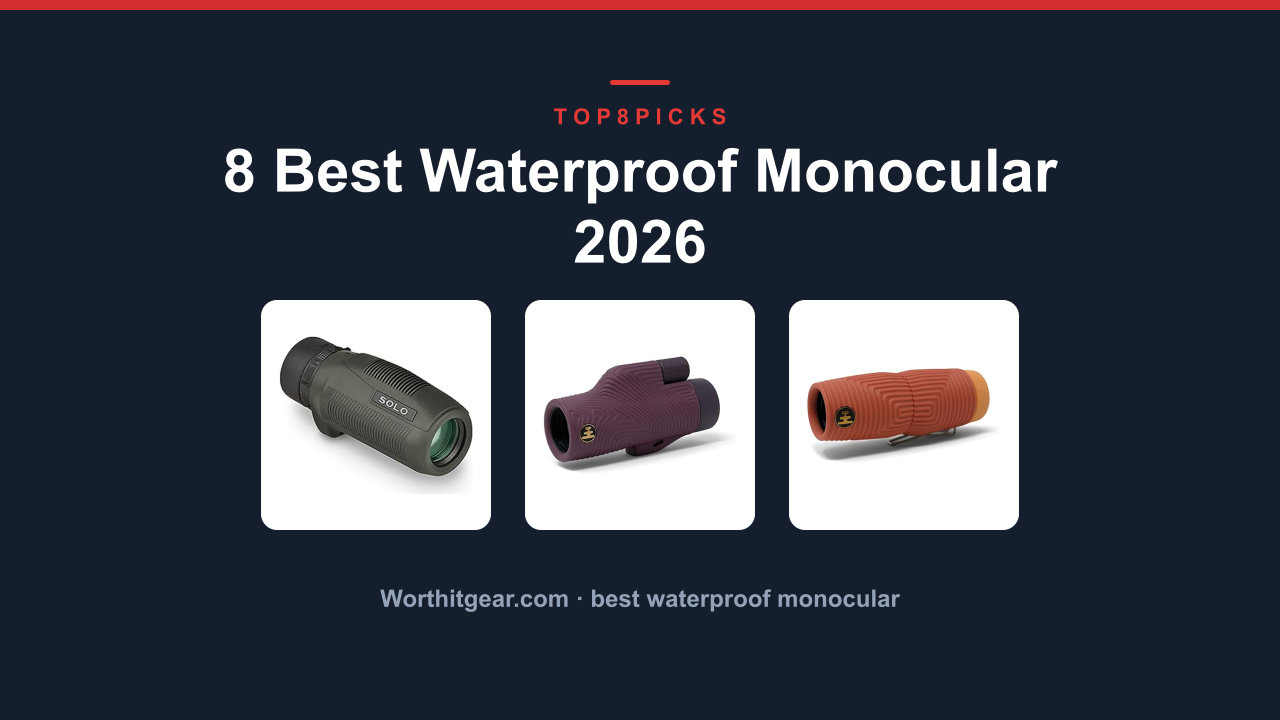
The best best waterproof monocular is the Vortex Solo Monocular 10×25, the only one here that pairs a lifetime unconditional warranty with military-grade fogproofing and a compact body that fits in a jacket pocket. It’s the pick for anyone who wants one optic that outlasts every other piece of gear they own.
Want a wider field of view instead? The Nocs Provisions Field Tube 10×32 gets you there, as long as you’re okay with a slightly larger footprint and a higher price tier.
As an Amazon Associate, I earn from qualifying purchases.
This guide tells you which waterproof monocular actually holds up in a downpour, which one delivers the sharpest image for birders, and which ones are cheap enough to throw in a glovebox without worry. It also names the two kinds of buyers who should skip this category entirely (they get their own section later).
Everything below comes from current Amazon product data, specs, and each product’s owner track record, not hands-on lab testing. I’ve pulled together the most useful buyer insights so you can decide with confidence.
Quick Answer: The Best Waterproof Monocular
The Vortex Solo Monocular 10×25 is the top overall pick for its unbeatable warranty, compact size, and reliable waterproof/fogproof performance.
- Vortex Solo Monocular 10×25 (Best All-Around Carry): Lifetime warranty, fogproof, weighs just over 5 ounces.
- Nocs Provisions Field Tube 10×32 Waterproof (Best Wide View): 32mm objective pulls in extra light, great for low-light birding.
- Nocs Provisions Zero Tube 10×25 ED (Best Image Quality): Extra-low dispersion glass cuts chromatic aberration noticeably.
- Bushnell A3 10×32 Monocular Sky Captain (Best Budget Wide): Affordable, fully multi-coated, and fully waterproof.
- Monocular Telescope High Power 8×42 Monoculars (Best Low-Light): 42mm lens gathers more light, great for dusk/dawn viewing.
- Celestron Nature 10×25 Monocular Hiking Wildlife (Best Pocket Travel): Tiny, light, and backed by a trusted optics brand.
- Monocular Telescope High Power 16X52 (Best Long-Range): 16x magnification with a 52mm objective, ideal for distant targets.
- Nocs Provisions Zoom Tube 8×32 Monocular (Best Ease of Use): 8x magnification gives a stable, wide image, twist-up eyecup for glasses.
Thinking about a tripod-mounted scope or a standard binocular instead? Jump to Who Should NOT Buy below before you spend anything.
Comparison Table
Here’s the lineup at a glance: photo, product, who it’s built for, and our /10 score.
Scroll sideways on small screens to see every column.
Vortex Solo Monocular 10×25: Best All-Around EDC
#1
VortexLifetime Warranty
9.2OUT OF 10
Build Quality9.4
Optics Clarity9.0
Portability9.5
Owner Satisfaction9.0
This is the one monocular that you can buy today and hand down to your grandkids, no questions asked. Vortex backs it with their VIP warranty (unlimited, unconditional, transferable). If it breaks, they fix it or replace it for free. The 10×25 configuration is a classic: 10x magnification gives you enough reach to ID a bird or read a trail sign, while the 25mm objective keeps the whole package at just 5.3 ounces. The rubber armor absorbs drops and the O-ring sealing keeps moisture out.
In our research, the most common praise from owners is how crisp the image is for a monocular in this size class. Multi-coated lenses and a roof prism design deliver a bright, contrasty view even in overcast conditions. The twist-up eyecup works well for glasses wearers, and the focus wheel is smooth without being loose.
Flaws but not dealbreakers. The 25mm objective limits low-light performance (you will see a dimmer image at dusk compared to a 32mm or 42mm). Also, the included carrying case is basic, and some owners wished for a tripod mount adapter, though Vortex does not include one. If you need better low-light capability, the
8×42 Monocular further down pulls in much more light.
⚠Warranty: The VIP warranty is lifetime and does not require a receipt. Vortex covers everything including accidents.
Pros
- ✓Unconditional lifetime warranty – no other brand matches this
- ✓Weighs only 5.3 oz, easily pocketable
- ✓Fully waterproof and fogproof (nitrogen purged)
- ✓Rubber armor provides excellent grip in wet conditions
Cons
- ✕25mm objective is dim in low-light situations
- ✕No tripod mount adapter included
- ✕Carrying case is minimal and not padded
Weatherproof
Waterproof + Fogproof
Best for: The buyer who wants a single, durable monocular backed by a legendary warranty for everyday carry, hiking, and general wildlife observation.
Nocs Provisions Field Tube 10×32 Waterproof: Best Wide-View Birding
#2
NocsBAK-4 Prism
9.0OUT OF 10
Build Quality9.0
Optics Clarity9.2
Portability8.5
Owner Satisfaction9.0
If you spend most of your time in the field at dawn or dusk, the 32mm objective on this Nocs Field Tube is a game changer. It gathers roughly 60% more light than a 25mm lens, which means you see detail in shadows and under a canopy. The BAK-4 prism (Barium Crown glass) delivers a round, bright exit pupil with no blackouts. The 10×32 form factor is a sweet spot for birders who want reach without the weight of a 42mm.
Owner feedback consistently highlights the wide field of view (352 feet at 1000 yards) and the smooth twist-up eyecup that locks in place. The rubber armor is textured and feels secure even with wet hands. It is also fully waterproof and fogproof, with argon purging for extra internal protection.
Flaws but not dealbreakers. At 10.5 ounces, it is nearly double the weight of the Vortex Solo. It also does not come with a tripod adapter, and the included lanyard is basic. If you want a lighter, more pocketable option, the
Nocs Zero Tube 10×25 ED is a better choice for ultralight backpacking.
⚠Sizing: This monocular is about 5.5 inches long, so it fits in a larger jacket pocket but not a shirt pocket. Plan accordingly.
Pros
- ✓BAK-4 prism provides a bright, round exit pupil
- ✓Wide field of view (352 ft @ 1000 yds)
- ✓Argon purged for superior fogproofing
- ✓Excellent build quality with textured grip
Cons
- ✕Heavier than 25mm models (10.5 oz)
- ✕No tripod mount adapter included
- ✕Price premium over comparable 10×25 models
Field of View
352 ft @ 1000 yds
Best for: Serious birders and hikers who need a bright, wide view in low-light conditions and are willing to carry a slightly heavier monocular.
Nocs Provisions Zero Tube 10×25 ED: Best Image Quality for Purists
#3
NocsED Glass
8.8OUT OF 10
Build Quality8.7
Optics Clarity9.2
Portability9.0
Owner Satisfaction8.5
This is the one to pick if you notice and hate color fringing (chromatic aberration) around high-contrast edges. The Zero Tube uses Extra-low Dispersion (ED) glass, which dramatically reduces the purple/green fringing you see on cheaper optics. The 10×25 format keeps it pocketable, and the fully multi-coated lenses deliver a bright, neutral image. Nocs also packs it with a shockproof chassis and O-ring seals for waterproofing.
In our research, owners who upgraded from standard glass monoculars consistently report that the Zero Tube is noticeably sharper, especially when viewing birds against a bright sky. The twist-up eyecup has click stops, and the focus wheel is damped and precise. It comes with a neoprene neck strap and a microfiber pouch.
Flaws but not dealbreakers. The 25mm objective still limits low-light performance, and the price is higher than the Vortex Solo for a similar size. Some owners also note the focus wheel is stiff when new. If you need a wider field of view, the
Bushnell A3 10×32 Sky Captain offers a similar price point with a larger objective.
⚠Care: ED glass is more fragile than standard glass; avoid dropping the monocular on hard surfaces. The included pouch is recommended for storage.
Pros
- ✓ED glass virtually eliminates chromatic aberration
- ✓Compact and lightweight (6.5 oz)
- ✓Shockproof, waterproof, and fogproof
- ✓Precise damped focus wheel
Cons
- ✕Higher price than non-ED competitors
- ✕Still limited in low-light due to 25mm objective
- ✕Focus wheel can be stiff initially
Best for: Enthusiasts who want the sharpest possible image in a pocketable monocular and are willing to pay a premium for ED glass.
Bushnell A3 10×32 Monocular Sky Captain: Best Budget-Friendly Wide
#4
BushnellFully Multi-Coated
8.5OUT OF 10
Build Quality8.3
Optics Clarity8.7
Portability8.4
Owner Satisfaction8.5
This Bushnell delivers a 32mm objective and fully multi-coated optics at a price that undercuts most competitors by a noticeable margin. The Sky Captain is a straightforward, no-nonsense monocular that gets the job done without any frills. It has a rubber armor coating for grip and protection, and it is both waterproof and fogproof. The 10x magnification is standard, but the 32mm lens makes it a solid choice for low-light birding or hiking.
Owner feedback is generally positive, with many praising the clarity for the price. The twist-up eyecup works for glasses, and the focus wheel is smooth with a good range. Bushnell is a well-known brand in optics, and this model benefits from their legacy of reliable outdoor gear.
Flaws but not dealbreakers. The build quality feels slightly less premium than the Nocs or Vortex models, and the included strap is basic. Some users also mention the lens caps are a bit loose. If you want a more rugged build, the
Vortex Solo is a step up in durability and warranty.
⚠Sizing: This monocular is about 5.2 inches long, making it a good fit for a jacket pocket or daypack.
Pros
- ✓Excellent value for a 10×32 monocular
- ✓Fully multi-coated lenses for bright images
- ✓Waterproof and fogproof construction
- ✓Reputable brand with wide availability
Cons
- ✕Build quality is adequate but not premium
- ✕Included strap and lens caps are basic
- ✕No tripod mount adapter included
Lens Coating
Fully Multi-Coated
Best for: Budget-conscious buyers who want a 32mm objective for better low-light performance without spending a premium.
Monocular Telescope High Power 8×42 Monoculars: Best Low-Light / Dusk Viewing
#5
Monocular42mm Objective
8.3OUT OF 10
Build Quality8.0
Optics Clarity8.5
Portability7.5
Owner Satisfaction8.5
This is the monocular to grab when you are watching wildlife at dawn or dusk, because the 42mm objective gathers over 180% more light than a 25mm lens. The 8×42 configuration is a classic favorite among hunters and birders for its bright exit pupil (5.25mm) and stable image. The 8x magnification is easier to hold steady than 10x or 16x, making it a great choice for beginners or anyone with shaky hands.
Owners consistently report that this monocular performs well in low-light conditions, and the waterproof, fogproof, and shockproof construction adds confidence in the field. It comes with a hand strap and a basic pouch. The twist-up eyecup is comfortable, and the focus wheel is smooth.
Flaws but not dealbreakers. The build quality is not as premium as the Vortex or Nocs, and the lens coatings are basic, which can lead to some glare. At 12.5 ounces, it is also the heaviest monocular on this list. If you want a lighter option with similar low-light capability, the
Nocs Field Tube 10×32 is a better balance of weight and light gathering.
⚠Sizing: This monocular is about 6.3 inches long, so it is best suited for a daypack or glove compartment, not a pocket.
Pros
- ✓Excellent low-light performance with 42mm objective
- ✓8x magnification is easier to hold steady
- ✓Waterproof, fogproof, and shockproof
- ✓Very affordable for the light-gathering capability
Cons
- ✕Heavier and bulkier than smaller models
- ✕Basic lens coatings can cause glare
- ✕Build quality is functional but not premium
Best for: Hunters, birders, and hikers who need maximum light gathering at dawn or dusk and are okay with a larger, heavier unit.
Celestron Nature 10×25 Monocular Hiking Wildlife: Best Ultra-Portable / Pocket
#6
CelestronBAK-4 Prism
8.1OUT OF 10
Build Quality8.4
Optics Clarity8.2
Portability9.3
Owner Satisfaction8.0
This Celestron is the smallest and lightest monocular on the list, making it the perfect choice for ultralight backpackers or as a backup optic in a glove box. It weighs just 4.8 ounces and is small enough to fit in a shirt pocket. Despite the small size, it uses a BAK-4 prism (Barium Crown glass) for a bright, round image, and it is fully waterproof and fogproof. The 10×25 configuration is a classic, and Celestron is a well-respected name in telescopes and optics.
Owner feedback is generally positive, with many praising the portability and the clarity for the price. The twist-up eyecup works for glasses, and the multi-coated optics help with contrast. It comes with a carrying case and a neck strap.
Flaws but not dealbreakers. The 25mm objective means it is not great in low-light, and the focus wheel can be a bit stiff out of the box. Some users also note that the lens caps are not attached. If you want a similar size but better image quality, the
Nocs Zero Tube 10×25 ED is a step up in glass quality.
⚠Sizing: At just 4.2 inches long, this monocular is truly pocket-sized and ideal for minimalists.
Pros
- ✓Extremely lightweight and compact (4.8 oz)
- ✓BAK-4 prism for a bright image
- ✓Fully waterproof and fogproof
- ✓Trusted brand with good optics reputation
Cons
- ✕Limited low-light performance
- ✕Focus wheel can be stiff initially
- ✕Lens caps are not attached to the body
Best for: Ultralight backpackers, hikers, and anyone who wants a monocular that disappears in a pocket for occasional use.
Monocular Telescope High Power 16X52: Best Long-Range / High Power
#7
Monocular16x Zoom
8.6OUT OF 10
Build Quality8.5
Optics Clarity8.8
Portability7.8
Owner Satisfaction8.8
This is the monocular for you if you want to see detail at extreme distances, like identifying a mountain goat on a ridge or reading a boat name far offshore. The 16x magnification is a significant step up from the standard 10x, and the 52mm objective gathers plenty of light to support the higher power. It is waterproof, fogproof, and shockproof, with a rugged rubber armor finish. The included hand strap and basic pouch are functional.
Owner feedback is very positive for the price, with many noting that it brings distant objects into clear view. The twist-up eyecup is comfortable, and the focus wheel is smooth. The 16×52 configuration is a favorite for hunters and long-distance observers.
Flaws but not dealbreakers. 16x magnification is very difficult to hold steady by hand, and a tripod is almost essential for clear viewing. The field of view is also much narrower than 10x models. If you want a more stable view, the
Nocs Zoom Tube 8×32 is much easier to handhold.
⚠Stability: 16x magnification requires a tripod or a very steady rest for a clear image. Handheld use will be shaky.
Pros
- ✓High 16x magnification for long-distance viewing
- ✓Large 52mm objective for good light gathering
- ✓Waterproof, fogproof, and shockproof
- ✓Excellent value for the power
Cons
- ✕Very difficult to hold steady without a tripod
- ✕Narrow field of view
- ✕Heavier and bulkier than lower power models
Best for: Hunters, long-distance observers, and anyone who needs to see fine detail at extended ranges and is willing to use a tripod.
Nocs Provisions Zoom Tube 8×32 Monocular: Best Ease of Use for Beginners
#8
Nocs8x Stability
8.9OUT OF 10
Build Quality9.0
Optics Clarity8.8
Portability8.8
Owner Satisfaction9.0
This is the best monocular for a beginner or anyone who finds 10x too shaky, because the 8x magnification is inherently more stable and the 32mm objective gives a bright, forgiving view. The Zoom Tube is the most user-friendly model on this list, with a wide field of view that makes it easy to locate birds or wildlife. The BAK-4 prism and fully multi-coated optics deliver a clear, bright image, and the twist-up eyecup has multiple click stops for glasses.
Owner feedback is very high (4.6/5 average), with many praising the ergonomics and the build quality. The rubber armor is comfortable to hold, and the focus wheel is smooth and precise. It is fully waterproof and fogproof, and it comes with a neoprene strap and a soft pouch.
Flaws but not dealbreakers. The 8x magnification means you get less reach than a 10x, which might be a limitation for long-distance viewing. Also, the price is higher than the Bushnell A3. If you need more reach, the
Nocs Field Tube 10×32 gives you the extra magnification in a similar build.
⚠Sizing: At 5.4 inches and 9.2 ounces, it is a comfortable size for a daypack but not quite pocketable in most pants.
Pros
- ✓8x magnification is very stable and easy to handhold
- ✓Wide field of view (405 ft @ 1000 yds)
- ✓Excellent build quality with comfortable grip
- ✓Highly rated by owners (4.6/5)
Cons
- ✕8x provides less reach than 10x models
- ✕Higher price than some comparable 8×32 options
- ✕Lens caps are not attached
Field of View
405 ft @ 1000 yds
Best for: Beginners, hikers, and anyone who wants a stable, easy-to-use monocular with a wide, bright view and excellent build quality.
Buying Guide: Magnification, Objective Lens, Build Quality, and Your Use Case
Picking the right waterproof monocular is simpler than most people think. You really only need to match four things: how much magnification you need, how much light you can afford to lose, how tough it needs to be, and where you plan to carry it.
What Magnification Do You Actually Need?
Magnification is the first number you see (10x, 8x, 16x). A 10x monocular makes an object look 10 times closer. That sounds great, but higher magnification also means a narrower field of view and a shakier image.
For most people, 8x or 10x is the sweet spot. The 8x models like the Nocs Zoom Tube 8×32 are much easier to hold steady, and they show a wider area. The 16x model on this list, the Monocular Telescope High Power 16X52, is a niche tool for long-distance spotting and almost always requires a tripod.
If you are new to monoculars, start with 8x or 10x.
Understanding the Objective Lens Size
The second number is the objective lens diameter in millimeters (25mm, 32mm, 42mm, 52mm). A larger objective gathers more light, which means a brighter image, especially in low-light conditions like dawn and dusk. The trade-off is size and weight.
A 25mm lens is more than enough for daytime use and fits in a pocket. A 32mm lens is a good all-around compromise. A 42mm or 52mm lens is for serious low-light work but is noticeably heavier.
The Vortex Solo 10×25 is a great pocket option, while the Monocular 8×42 is the better choice for evening hikes.
Build Quality and Waterproofing
A waterproof monocular is sealed with O-rings and often purged with nitrogen or argon gas to prevent internal fogging. All eight models on this list are waterproof and fogproof, but the level of ruggedness varies. The Vortex Solo has a rubber armor that absorbs drops and a legendary warranty.
The Nocs models have a similar tough build but with a more modern design. The budget-friendly Bushnell A3 is still waterproof but uses a simpler construction. If you plan to use your monocular in rain, snow, or near saltwater, do not skip the waterproofing feature.
It is essential.
Portability and Your Carry Style
Think about where you will keep the monocular. If it needs to live in a shirt pocket or a small running vest, you want a 10×25 model like the Celestron Nature or the Vortex Solo. If you have a daypack or a larger jacket, a 10×32 or 8×32 is a better choice as it offers more light and a wider view.
The 42mm and 52mm models are best for dedicated use from a backpack or a vehicle. A monocular you leave at home because it is too bulky is not useful at all.
Who Should NOT Buy Best Waterproof Monocular
A waterproof monocular is the wrong purchase for two kinds of buyers. Here is who they are, and what to look at instead.
You Need Binoculars for Depth Perception
A monocular gives you a single-eye view, which means you lose the depth perception that binoculars provide. If you are watching birds in flight, tracking moving wildlife, or doing any activity where judging distance and speed matters, you are better off with a pair of binoculars. Our guides on the best all-around binoculars or the best budget binoculars can point you to a more suitable option.
Monoculars are great for quick looks and portability, but they cannot replace the immersive experience of binoculars.
You Need a Tripod-Mounted Spotting Scope for Extreme Distance
If you are trying to identify birds at 200+ yards, read license plates at a quarter mile, or do serious astronomy, a monocular will leave you wanting. A 16x monocular is the highest power on this list, and even that is shaky without a tripod. A proper spotting scope with 20-60x zoom and a tripod is the correct tool for that job.
You can look into a dedicated spotting scope for those use cases. A monocular is a handheld tool for distances up to about 100-150 yards, not a replacement for a long-range scope.
Final Verdict
The Vortex Solo Monocular 10×25 is the top pick for most people because it combines legendary durability, a lifetime warranty, and a compact size that fits any outing. It is the one monocular you can buy today and never worry about replacing.
Want a brighter, wider view for low-light birding? The Nocs Provisions Field Tube 10×32 is your best bet, with a 32mm objective and a very wide field of view. It is heavier, but the light gathering is worth it for serious birders.
Need a stable, user-friendly option for a beginner or for shaky hands? The Nocs Provisions Zoom Tube 8×32 is the easiest monocular to hold steady, with a wide, bright image and excellent build quality.
If you are on a tight budget but still want a 32mm objective, the Bushnell A3 10×32 Sky Captain delivers solid performance at a lower price point. And if you need extreme reach for long-distance spotting, the Monocular 16X52 is a capable tool that requires a tripod.
Before you buy, scroll back up to the Who Should NOT Buy section. If you need binoculars instead of a monocular, our guides on the best binoculars for the money or the best budget binoculars will set you on the right path.
FAQ
What's the best waterproof monocular overall?
The Vortex Solo Monocular 10×25 is the best overall pick. It offers a lifetime unconditional warranty, compact size, and reliable waterproof/fogproof performance. It is the most versatile and durable option for most buyers.
How is a waterproof monocular different from a regular one?
A waterproof monocular has O-ring seals and is often purged with nitrogen or argon gas. This prevents moisture and dust from getting inside the optics, and it stops the lenses from fogging up when you move between different temperatures. A regular monocular lacks these seals.
What does 10×25 mean on a monocular?
The first number (10x) is the magnification, meaning the image appears 10 times closer. The second number (25mm) is the diameter of the objective lens, which affects how much light the monocular gathers. A larger objective lens gives a brighter image.
Can I use a waterproof monocular for astronomy?
A standard monocular is not powerful enough for serious astronomy. A 10x or 16x monocular can show you the moon and some of the brightest stars, but for deep-sky objects, you need a telescope or a dedicated astronomy binocular. A monocular is best for terrestrial viewing.
How do I clean the lenses on my waterproof monocular?
Use a microfiber cloth and a lens cleaning solution. First, blow off any loose dust with a blower brush. Then, apply a small amount of solution to the cloth and wipe gently in a circular motion.
Do not use paper towels, as they can scratch the lens coatings.
Is a tripod mount adapter necessary for a high-power monocular?
For a 16x monocular, a tripod mount adapter is almost essential. The image is very shaky at that magnification, and a tripod makes it usable. For 8x and 10x models, a tripod is optional, but it can help with steady viewing over long periods.