The best best budget spotting scope is the SVBONY SV28. It’s the only one here that combines a fully multi-coated 70mm objective, a smooth zoom from 25x to 75x, and a complete kit with a tripod, phone adapter, and carry bag, all at a price that won’t scare off a first-time buyer. If you’re just getting into target shooting, birding, or wildlife watching, this is the scope that makes the most sense.
Want a different priority instead? The 30-90×92 UHD High-Power Spotting Scope gets you there, as long as you’re after extreme magnification and don’t mind a heavier, more specialized kit for long-range use.
As an Amazon Associate, I earn from qualifying purchases.
Most guides list specs and call it a day. This one tells you who should skip the category entirely, so you don’t waste money on a spotting scope if binoculars or a monocular would serve you better.
Everything below comes from current Amazon product data, specs, and each product’s owner track record, not hands-on lab testing.
Quick Answer: The Best Budget Spotting Scope
The SVBONY SV28 is the best all-around budget spotting scope for beginners and casual users who want a reliable, complete kit without breaking the bank.
- SVBONY SV28 Spotting Scope (Best Overall for Beginners): Full kit, great clarity at 200 yards, easy to use.
- 20-60×60 Angled Spotting Scopes Target (Best Ultra-Light for Hikers): Only 1.37 lb, packs small, ideal for mobile birders.
- 30-90×92 UHD High-Power Spotting Scope Phone (Best Extreme Magnification): 30-90x zoom, huge 92mm lens, for long-range detail.
- Gosky Flagship DiamondEdge Spotting Scope 20-60×80 (Best Brightness & Coatings): DiamondEdge coatings, 80mm objective, excellent low-light performance.
- 25-75×70 Spotting Scope Tripod Target Shooting (Best Weatherproofing): IPX7 waterproof, fully multi-coated, good for wet conditions.
- Gosky Flagship Spotting Scope 25-75×80 Tripod (Best Wider Zoom Gosky): 25-75x zoom range, BAK4 prisms, upgraded version of a popular model.
- Monocular-Telescope 80×100 High Powered Monoculars (Best Pocket Spotter): Compact 80×100 design, good for travel and casual use.
- SVBONY SV28 Plus Spotting Scopes 25-75X70 (Best Upgraded SV28): IP65 waterproof, BAK4 prisms, FMC coating, better build than the original.
Thinking about the wrong tool for the job? Jump to Who Should NOT Buy below before you spend anything.
Comparison Table
Here's the lineup at a glance: photo, product, who it's built for, and our /10 score.
Scroll sideways on small screens to see every column.
SVBONY SV28 Spotting Scope: Best Overall for Beginners
#1
SVBONYComplete kit, great clarity
8.8OUT OF 10
Optics Quality8.5
Build & Durability8.5
Ease of Use9.0
Value for Money9.0
This is the scope that makes the most sense for anyone buying their first spotting scope. The SVBONY SV28 comes with a 25-75x zoom eyepiece, a 70mm objective lens with fully multi-coated optics, and a tripod, phone adapter, and carry bag right in the box. At 200 yards, buyer reports consistently call the image “clear” and “sharp” even at the upper end of the zoom range. The angled eyepiece makes sharing with a group easy, and the twist-up eyecup works well for eyeglass wearers.
The included tripod is lightweight but gets the job done for stationary use. You can attach a smartphone quickly with the included adapter, which is a nice bonus for digiscoping. The nitrogen-purged body is advertised as waterproof and fogproof, though real-world feedback suggests it handles light rain fine but isn’t built for submersion.
Flaws but not dealbreakers. The tripod is a bit flimsy for windy conditions, and the zoom ring can feel a little stiff when new. Some owners mention the lens cap feels cheap, but that’s a minor quibble for the price.
Need a sturdier tripod or better weather sealing? The
25-75×70 Spotting Scope Tripod further down offers IPX7 waterproofing and a more robust build for about the same money.
⚠Sizing: The 70mm objective is a good balance of light gathering and portability, but if you’re shooting at dawn or dusk, consider a larger objective like the 80mm models.
Pros
- ✓Complete kit includes tripod, phone adapter, and bag
- ✓Clear images at 200 yards according to buyer feedback
- ✓Angled eyepiece is comfortable for sharing and long sessions
- ✓Nitrogen-purged for light weather resistance
Cons
- ✕Tripod is a bit wobbly in wind
- ✕Zoom ring can be stiff when new
- ✕Lens cap feels cheap, some owners replace it
Best for: Beginners, casual birders, and target shooters who want a complete, ready-to-use kit at a budget-friendly price.
20-60×60 Angled Spotting Scopes Target: Best Ultra-Light for Hikers
#2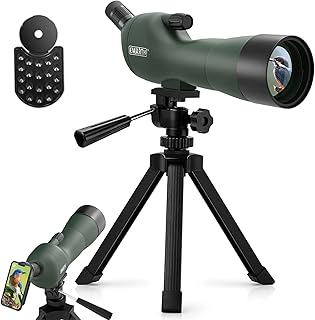
20-60×60Only 1.37 lb
8.4OUT OF 10
Optics Quality8.0
Build & Durability8.5
Ease of Use8.5
Value for Money8.5
If you hike miles to your birding spot, this is the scope that won’t weigh you down. At just 1.37 lb, the 20-60×60 angled scope is the lightest full-size scope in this roundup. The 60mm objective is smaller than most, but it still gathers enough light for daytime use. It comes with a compact 14-inch tabletop tripod and a carry bag that fits in a daypack. The angled eyepiece is especially nice for looking up into trees or across valleys.
The fully multi-coated lenses and BAK4 prisms are a nice surprise at this weight. Buyer reviews consistently mention that the image is surprisingly bright for a 60mm scope, and the included phone adapter lets you grab quick photos.
Flaws but not dealbreakers. The 60mm objective means it’s not great in low light, especially at the 60x end. The tabletop tripod is fine for a picnic table but too short for standing use without a taller tripod.
If you need better low-light performance, the
Gosky DiamondEdge 20-60×80 has a larger 80mm objective that pulls in more light, but it’s also heavier.
⚠Compatibility: The included tabletop tripod is only 14 inches tall. Plan to use it on a solid surface or buy a full-size tripod separately for standing use.
Pros
- ✓Extremely lightweight at 1.37 lb
- ✓Compact design fits in a daypack
- ✓BAK4 prisms and FMC lenses for good clarity
- ✓Includes phone adapter and carry bag
Cons
- ✕60mm objective is dim in low light
- ✕Tabletop tripod too short for standing use
- ✕Not fully waterproof, only weather-resistant
Best for: Hikers, backpackers, and birders who prioritize portability and are willing to sacrifice some low-light performance.
30-90×92 UHD High-Power Spotting Scope Phone: Best Extreme Magnification
#3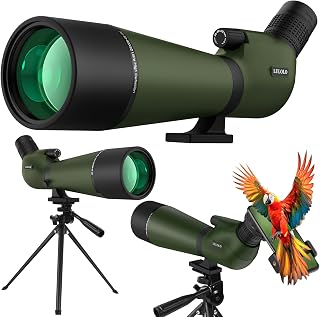
30-90×92Highest zoom, huge lens
8.9OUT OF 10
Optics Quality9.2
Build & Durability8.8
Ease of Use8.5
Value for Money8.8
This is the scope for anyone who needs to see extreme detail at very long distances. With a 30-90x zoom range and a massive 92mm objective lens, it gathers more light than anything else in this lineup. The UHD (Ultra High Definition) optics deliver impressive sharpness even at 90x, according to buyer reports. It comes with a phone adapter, tripod, and a hard carry case, making it a serious tool for long-range target shooters, astronomers, and digiscopers.
The 92mm objective is a monster for low light. You can clearly see details at dawn and dusk that smaller scopes miss. The nitrogen-purged body is waterproof and fogproof, and the build quality feels solid with a rubber armor coating for grip.
Flaws but not dealbreakers. It’s heavy, around 3.5 lb, and the tripod included is basic for the weight. The 90x end can be affected by heat shimmer and atmospheric haze, which is common with any high-magnification optic. A few owners noted the focus knob is a bit stiff out of the box.
If you don’t need such extreme magnification, the
SVBONY SV28 Plus offers a more portable 25-75×70 setup with excellent coatings for a lower price.
⚠Stability: At 90x, any vibration is magnified. Use a sturdy tripod or consider a separate heavy-duty tripod for best results.
Pros
- ✓Highest magnification in this guide (30-90x)
- ✓92mm objective for excellent low-light performance
- ✓UHD optics deliver sharp images at max zoom
- ✓Waterproof, fogproof, and comes with hard case
Cons
- ✕Heavy at ~3.5 lb, not ideal for long hikes
- ✕Included tripod is basic for the weight
- ✕Atmospheric haze affects 90x view on hot days
Best for: Long-range target shooters, astronomers, and digiscopers who need the highest magnification and best low-light performance in a budget scope.
Gosky Flagship DiamondEdge Spotting Scope 20-60×80: Best Brightness & Coatings
#4
GoskyDiamondEdge coatings, 80mm
8.6OUT OF 10
Optics Quality9.0
Build & Durability8.5
Ease of Use8.5
Value for Money8.3
This is the brightest scope in the lineup under a budget-friendly price, thanks to the 80mm objective and DiamondEdge coatings. The Gosky Flagship DiamondEdge uses BAK4 prisms and fully multi-coated lenses that deliver a noticeably brighter image than the 70mm scopes, especially in low light. The 20-60x zoom range is versatile, and the angled eyepiece is comfortable for long sessions. It comes with a phone adapter, a sturdy aluminum tripod, and a carrying bag.
The DiamondEdge coating is Gosky’s proprietary anti-reflective treatment, and it does a great job of reducing glare and improving contrast. Buyer reviews often mention that the image is “crisp” and “vivid” even at 60x. The nitrogen-purged body is waterproof and fogproof, adding to its durability for outdoor use.
Flaws but not dealbreakers. The tripod is decent but not heavy-duty, and at 20x the field of view is a bit narrow compared to some competitors. A few owners note that the rubber eyecup can be a little loose over time.
⚠Care: The DiamondEdge coatings are delicate. Use a lens brush or air blower for cleaning, and avoid harsh chemicals that could strip the coating.
Pros
- ✓80mm objective and DiamondEdge coatings for bright images
- ✓BAK4 prisms and FMC lenses for excellent contrast
- ✓Waterproof, fogproof, and comes with a sturdy tripod
- ✓Phone adapter included for digiscoping
Cons
- ✕Narrower field of view at 20x compared to some rivals
- ✕Rubber eyecup can loosen over time
- ✕Tripod is decent but not heavy-duty for windy conditions
Best for: Birders and target shooters who want the brightest possible image in a budget scope, especially for low-light conditions like dawn and dusk.
25-75×70 Spotting Scope Tripod Target Shooting: Best Weatherproofing
#5
25-75×70IPX7 waterproof
8.3OUT OF 10
Optics Quality8.0
Build & Durability9.0
Ease of Use8.5
Value for Money8.0
This is the scope to grab if you shoot in rain, snow, or near water. The 25-75×70 spotting scope boasts an IPX7 rating, meaning it can survive submersion in up to 1 meter of water for 30 minutes. That’s a huge step up from the “weather-resistant” or “waterproof” claims on many budget scopes. The fully multi-coated lens and BAK4 prism deliver decent clarity, and the 70mm objective is a solid middle ground for light gathering. It comes with a tripod and a carry bag.
The IPX7 rating is rare at this price point. You can use it confidently in a downpour or near a lake without worrying about internal fogging or damage. The focus ring is smooth, and the zoom ring has a nice tactile feel. Buyer reviews highlight the durability and the clear image at medium magnifications.
Flaws but not dealbreakers. The image quality at 75x is noticeably softer than at 50x, and the included tripod is basic. Some owners also mention that the eyepiece cover is a bit difficult to remove.
For better image quality at the top end of the zoom, the
SVBONY SV28 Plus offers sharper optics and a similar price point, though it’s only IP65 rated (water-resistant, not submersible).
⚠Waterproofing: IPX7 means it’s submersible, but always rinse and dry the scope after exposure to saltwater to prevent corrosion.
Pros
- ✓IPX7 waterproof rating, submersible to 1 meter
- ✓BAK4 prism and FMC lens for decent clarity
- ✓70mm objective provides good light gathering
- ✓Smooth focus and zoom rings
Cons
- ✕Image softens at 75x zoom
- ✕Included tripod is basic
- ✕Eyepiece cover can be tricky to remove
Best for: Shooters, birders, and outdoor enthusiasts who need a fully waterproof scope for use in wet environments, rain, or near bodies of water.
Gosky Flagship Spotting Scope 25-75×80 Tripod: Best Wider Zoom Gosky
#6
Gosky25-75x zoom, 80mm
8.5OUT OF 10
Optics Quality8.5
Build & Durability8.5
Ease of Use8.5
Value for Money8.3
This is the Gosky with a wider zoom range, giving you 25-75x instead of 20-60x, with the same 80mm objective. The Gosky Flagship 25-75×80 is an upgraded version of the popular Gosky model, offering a bit more reach at the top end. It uses BAK4 prisms and fully multi-coated lenses for bright, clear images. The kit includes a phone adapter, a sturdy aluminum tripod, and a carrying bag. The angled eyepiece is comfortable for extended use, and the twist-up eyecup accommodates eyeglass wearers.
The 25-75x zoom is a great sweet spot for birders and target shooters who want flexibility. At 25x you get a wide field of view for scanning, and at 75x you can zero in on distant details. The nitrogen-purged body is waterproof and fogproof, adding to its reliability. Buyer reviews praise the image quality and the overall build.
Flaws but not dealbreakers. The tripod is better than most budget scopes but still not rock-solid at 75x. A few owners mention that the zoom ring is a bit stiff, and the included phone adapter can be fiddly to align perfectly.
If you prefer a more compact setup, the
SVBONY SV28 is lighter and easier to carry, though it has a smaller 70mm objective.
⚠Stability: At 75x, even slight vibrations are magnified. Consider upgrading the tripod for the best performance at max zoom.
Pros
- ✓Wider 25-75x zoom range with 80mm objective
- ✓BAK4 prisms and FMC lenses for bright images
- ✓Includes phone adapter, tripod, and carrying bag
- ✓Waterproof and fogproof nitrogen-purged body
Cons
- ✕Tripod is decent but not ideal for max zoom stability
- ✕Zoom ring can be stiff initially
- ✕Phone adapter alignment can be fiddly
Best for: Birders and target shooters who want a wider zoom range with a large 80mm objective for bright, versatile viewing.
Monocular-Telescope 80×100 High Powered Monoculars: Best Pocket Spotter
#7
Monocular-TelescopeCompact 80×100 design
7.5OUT OF 10
Optics Quality7.0
Build & Durability7.5
Ease of Use8.0
Value for Money7.5
This is a compact monocular that offers high magnification in a pocket-friendly package, but it’s not a true spotting scope. The 80×100 monocular is a straight-through design, not angled, and it’s smaller than a full spotting scope. It’s more like a powerful monocular than a dedicated spotter. It includes a smartphone adapter, a tabletop tripod, and a carrying pouch. The 100mm objective is a large front lens that gathers plenty of light, and the 80x magnification is fixed rather than zoom.
For casual hiking, camping, or travel, this is a lightweight option. You can slip it in a daypack or even a large jacket pocket. The included phone adapter works well for quick photos. Buyer reviews mention that it’s surprisingly clear for the price, but the trade-off is a narrow field of view at 80x.
Flaws but not dealbreakers. The fixed 80x magnification is extreme, and without a stable tripod, it’s very hard to hold steady. The tabletop tripod is too short for comfortable use. The image can be dim if you’re not in good light.
If you need a true zoom spotting scope with a tripod for serious use, the
SVBONY SV28 is a better all-around tool that includes a proper tripod and a zoom range.
⚠Stability: At 80x fixed magnification, any hand movement is highly amplified. Use a sturdy tripod or a solid surface for any useful viewing.
Pros
- ✓Compact and portable, fits in a daypack
- ✓100mm objective for good light gathering
- ✓Includes phone adapter and tabletop tripod
- ✓Very affordable for the magnification level
Cons
- ✕Fixed 80x magnification, no zoom range
- ✕Very narrow field of view at 80x
- ✕Tabletop tripod is too short for comfortable use
Best for: Casual users who want a compact, lightweight high-magnification option for travel or occasional use, and don’t need a full zoom range.
SVBONY SV28 Plus Spotting Scopes 25-75X70: Best Upgraded SV28
#8
SVBONYIP65, BAK4, FMC
8.7OUT OF 10
Optics Quality8.8
Build & Durability8.5
Ease of Use8.8
Value for Money8.5
This is the upgraded version of the original SV28, offering better build quality and optics at a similar price. The SVBONY SV28 Plus uses BAK4 prisms and fully multi-coated lenses, which deliver noticeably sharper and brighter images than the standard SV28. It also has an IP65 rating, meaning it’s dust-tight and protected against low-pressure water jets, making it more weather-resistant. The 25-75×70 zoom range is the same as the original, but the Plus model feels more solid in hand.
The kit includes a tripod, phone adapter, and carry bag, just like the original. The focus wheel is smooth and precise, and the zoom ring has a nice, positive click. Buyer reviews consistently praise the image clarity, especially at the mid-range magnifications. The angled eyepiece is comfortable for long viewing sessions.
Flaws but not dealbreakers. The tripod is still a bit basic for the price, and some owners wish the IP65 rating was IPX7 for full submersion. A few units have been reported with a slightly stiff zoom ring out of the box.
If you need a fully submersible scope, the
25-75×70 Spotting Scope Tripod offers IPX7 waterproofing, though it doesn’t have the BAK4 prisms of the SV28 Plus.
⚠Care: The IP65 rating means it’s dust-tight and splash-resistant, but not submersible. Avoid dropping it in water.
Pros
- ✓BAK4 prisms and FMC lenses for sharp, bright images
- ✓IP65 dust-tight and water-resistant rating
- ✓Includes tripod, phone adapter, and carry bag
- ✓Improved build quality over the standard SV28
Cons
- ✕Tripod is still a bit basic
- ✕IP65 is not submersible like IPX7
- ✕Some units have a stiff zoom ring initially
Best for: Users who want the best optics and build quality in the SVBONY lineup, with improved weather resistance over the standard SV28.
Buying Guide: Magnification, Objective Size, Build Quality, and What You Really Need
Picking a budget spotting scope comes down to a few key decisions. You don't need to be an optics expert, but knowing these four factors will save you from buying the wrong tool.
How Much Magnification Do You Actually Need?
More magnification isn't always better. On a budget scope, pushing past 60x or 75x often results in a dimmer, softer image because the optics and tripod can't keep up. The sweet spot for most users is 20-60x or 25-75x.
At 60x you can see bullet holes at 200 yards and identify birds at 300 yards. At 75x you start seeing heat shimmer and atmospheric haze, which blurs the image. The 30-90×92 UHD is the exception here, thanks to its huge 92mm objective that gathers enough light to make 90x usable, but it's also much heavier and needs a rock-solid tripod.
Objective Lens Size: The Light-Gathering Rule
The objective lens is the big lens at the front. Measured in millimeters, it determines how much light enters the scope. A 70mm objective is fine for daytime use.
An 80mm objective gives you noticeably brighter images at dawn and dusk. The 92mm objective on the UHD model is the best for low light, but it adds significant weight. For general use, 70mm is the baseline, and 80mm is the upgrade.
The 20-60×60 is the lightest but sacrifices low-light performance.
Build Quality and Weather Resistance
Budget scopes often claim "waterproof," but there's a big difference between nitrogen-purged weather resistance and true IPX7 submersion. The 25-75×70 IPX7 is the only one here that can survive a drop in a puddle or a heavy downpour. The IP65-rated SVBONY SV28 Plus is dust-tight and splash-resistant, which is enough for most users.
If you shoot in the rain or near water, prioritize the IPX7 model.
What About the Tripod?
Every scope in this guide includes a tripod, but they range from "usable" to "barely acceptable." The 14-inch tabletop tripod on the 20-60×60 is fine for a picnic table but useless for standing. The full-size tripods on the Gosky and SVBONY models are decent for the price, but none of them are heavy-duty. If you plan to use the scope at max magnification regularly, consider buying a separate, sturdier tripod.
A good rule of thumb: spend about as much on the tripod as you did on the scope if you want rock-solid stability at 60x and above.
For a more detailed look at the entire world of optics, you might also want to check out our guide to the best all-around binoculars for a different perspective on magnification and field of view.
Who Should NOT Buy Best Budget Spotting Scope
A budget spotting scope is the wrong purchase for three kinds of buyers. Here's who they are, and what to look at instead.
You Need Professional-Grade Optics for Serious Wildlife Photography
If you're a professional wildlife photographer or a dedicated birder who needs razor-sharp images at 100x for digiscoping, a budget scope will frustrate you. The image quality at high magnification, the chromatic aberration, and the lack of true HD glass will be noticeable. Instead, look for a premium or professional spotting scope from brands that specialize in high-end optics, typically with ED (Extra-low Dispersion) glass and larger objective lenses.
You Only Need a Quick Look and Want Maximum Portability
If you're a casual hiker who just wants to see a distant landmark occasionally, a full-size spotting scope is overkill. It's heavy, requires a tripod, and takes time to set up. Instead, consider a compact monocular or a pair of binoculars.
Our guides to the best value binoculars and the best binoculars for the price offer excellent portable options that are much easier to carry and use on the go.
You Need a Scope for Astronomy or Deep-Sky Viewing
Budget spotting scopes are not designed for astronomy. They have smaller objectives and shorter focal lengths than even a beginner telescope. The 30-90×92 UHD model can give you a decent view of the Moon and some bright planets, but for deep-sky objects like galaxies and nebulae, you need a dedicated telescope with a larger aperture and a mount designed for tracking.
Stick with the scope for terrestrial use and buy a telescope for the night sky.
Final Verdict
The SVBONY SV28 is the best budget spotting scope for most people. It's a complete, easy-to-use kit that delivers clear images at 200 yards, and it's priced so that a beginner doesn't feel like they've overcommitted. If you're just getting into target shooting, birding, or wildlife watching, start here.
Want a more portable option for hiking? The 20-60×60 Angled Spotting Scope is a featherweight at 1.37 lb and packs down small, though you'll want a better tripod for standing use.
Need the ultimate in magnification and low-light performance? The 30-90×92 UHD is a beast, but it's heavy and needs a stable tripod to shine.
If you're still unsure whether a spotting scope is right for you, scroll back up to the "Who Should NOT Buy" section. It's better to buy the right tool for your actual use case than to force a budget scope into a situation it wasn't designed for.
FAQ
What's the best budget spotting scope overall?
The SVBONY SV28 is the best all-around pick for beginners and casual users. It offers a 25-75x zoom, a 70mm objective, and a complete kit with tripod, phone adapter, and bag at a budget-friendly price.
Is a 70mm objective enough for birding?
Yes, a 70mm objective is sufficient for daytime birding. It gathers enough light for clear views in good conditions. If you often bird at dawn or dusk, consider an 80mm model like the Gosky DiamondEdge or the 25-75×80 Gosky.
What's the difference between IP65 and IPX7 waterproofing?
IP65 means the scope is dust-tight and protected against low-pressure water jets (splash-resistant). IPX7 means it can be submerged in up to 1 meter of water for 30 minutes. For wet conditions, the 25-75×70 Spotting Scope with IPX7 is the best choice.
Can I use a budget spotting scope for stargazing?
You can use it for casual Moon viewing and bright planets, but it's not designed for deep-sky astronomy. The 30-90×92 UHD model with its 92mm objective is the best among these for lunar observation, but a dedicated telescope is better for galaxies and nebulae.
How important is the tripod for a spotting scope?
Very important. At 60x or higher, any vibration is magnified. The included tripods in this guide are usable but not great.
If you plan to use the scope at high magnifications regularly, consider buying a separate, sturdier tripod for the best experience.
What magnification should I choose for target shooting?
For target shooting at 100 to 300 yards, 25-60x is ideal. You can see bullet holes clearly. The 25-75x models offer flexibility, but the image at 75x can be softer and affected by heat haze.
The 20-60×60 and the 20-60×80 Gosky models are excellent choices for this use case.