The best best spotting scope for stargazing is the SVBONY SV28 100mm, the only model here that combines a massive 100mm objective lens with fully multi-coated HD optics in a package that prioritizes pure light-gathering over everything else. It is the right pick for anyone who wants to see faint nebula detail and open clusters without spending telescope money.
Want a more versatile setup instead? The WOZEL 25-75×80 gets you a waterproof body, BAK-4 prisms, and a bundled tripod for a very reasonable price. Just know you will trade a bit of low-light performance for the convenience of a complete kit.
As an Amazon Associate, I earn from qualifying purchases.
This guide walks you through the real trade-offs between objective size, magnification range, and glass quality that actually matter under a dark sky. It also tells you who should skip spotting scopes entirely and buy a Dobsonian telescope instead.
Everything below comes from current Amazon product data, manufacturer specifications, and the verified owner track record for each model. It is not based on hands-on lab testing.
Quick Answer: The Best Spotting Scope for Stargazing
The SVBONY SV28 100mm Spotting Scope is the top pick for serious stargazing thanks to its 100mm objective lens and FMC HD optics.
- SVBONY SV28 100mm Spotting Scope Target (Best Light-Gathering Power): 100mm objective, FMC HD glass, ideal for faint deep-sky objects.
- WOZEL 25-75×80 Spotting Scope Tripod Target (Best Value Bundle): Waterproof, BAK-4 prism, includes tripod and phone adapter.
- 25-75×100 Spotting Scopes Dual Focusing Bird (Best Dual-Focus System): 100mm objective with dual focus for precise fine-tuning at high magnification.
- 20-60×80 HD Spotting Scope (Best Budget-Friendly HD): Entry-level HD optics at a lower price point, includes tripod and carry bag.
- Monoculars Adults High Powered 80×100 Smartphone (Best for Digiscoping): Highest rated, built for smartphone photography, compact monocular design.
- Gosky Flagship Spotting Scope 25-75×80 Tripod (Best Upgraded Brand): Upgraded version of a popular model, waterproof, with BAK-4 prisms and phone adapter.
- 30-90×92 UHD High-Power Spotting Scope Phone (Best High Magnification): 30-90x zoom range, 92mm objective, UHD optics for extreme detail.
- Gosky Falcon 20-60×85 Spotting Scope Full (Best Full-Size Kit): Full-size tripod, cleaning kit included, versatile for birding and stargazing.
Thinking about a telescope instead? Jump to Who Should NOT Buy below before you spend anything.
Comparison Table
Here's the lineup at a glance: photo, product, who it's built for, and our /10 score.
Scroll sideways on small screens to see every column.
SVBONY SV28 100mm Spotting Scope Target: Best Overall for Deep-Sky Stargazing
#1
SVBONY100mm objective, FMC HD
8.6OUT OF 10
Optical Quality9.2
Build Value8.5
Ease of Use8.0
Stargazing Suitability9.0
This is the only spotting scope in this lineup built around a 100mm objective lens, and that makes it the single best choice for stargazing. A bigger objective means more light enters the scope, which is everything when you are trying to resolve faint galaxies, nebulae, and globular clusters. The SVBONY SV28 uses fully multi-coated (FMC) HD optics, which aggregate user reviews confirm deliver noticeably better contrast and color fidelity than standard coated lenses at this price tier. The 25-75x zoom range lets you start wide to find your target and then crank the magnification to study details.
Manufacturer specifications indicate the scope comes with a soft carry case and a phone adapter for digiscoping. The included phone adapter is a nice bonus, letting you capture the moon or a bright planet through the eyepiece without buying extra gear. The scope itself has a solid feel, and the rotating tripod collar makes it easy to adjust the viewing angle without moving the tripod head.
Flaws but not dealbreakers. The included tripod is functional but lightweight, and some owner reports mention it can be shaky at the highest magnification in a breeze. You will likely want to upgrade to a sturdier tripod for serious astronomy sessions. Also, the scope is not advertised as waterproof, so you need to keep it dry during dewy nights.
For a more stable viewing platform right out of the box, consider the
Gosky Falcon 20-60×85, which ships with a full-size tripod that handles high magnification better.
⚠Care: This scope is not waterproof. Use a lens cloth to wipe dew and store it in a dry place after each stargazing session.
Pros
- ✓100mm objective lens gathers more light than any other scope here
- ✓FMC HD optics provide superior contrast and color
- ✓25-75x zoom range offers flexibility for finding and studying targets
- ✓Includes phone adapter and soft carry case for added value
Cons
- ✕Included tripod is too light for stable high-magnification viewing
- ✕Not waterproof, so dew can be a problem on humid nights
- ✕Eyepiece thread is a non-standard size, making filter attachment tricky
Best for: The serious stargazer who prioritizes light-gathering ability above all else and wants to see faint deep-sky objects like the Orion Nebula and Andromeda Galaxy.
WOZEL 25-75×80 Spotting Scope Tripod Target: Best Value All-in-One Kit
#2
WOZELWaterproof, bundled tripod
8.2OUT OF 10
Optical Quality8.0
Build Value8.8
Ease of Use8.5
Stargazing Suitability7.8
This is the best value package for anyone who wants a complete stargazing kit without buying extra accessories. The WOZEL 25-75×80 comes with a waterproof body, a tripod, a phone adapter, and a carrying case. The 80mm objective lens is a step down from the SVBONY’s 100mm, but it still gathers enough light to show the moon’s craters, Jupiter’s bands, and the brighter deep-sky objects. The BAK-4 prism and fully multi-coated lenses deliver a sharp, bright image for the price.
Waterproofing is a real advantage here. If you live in a humid area or plan to stargaze near the coast, the nitrogen-purged body prevents internal fogging. The twist-up eyecup is comfortable for eyeglass wearers, and the included tripod is a solid aluminum unit that provides a stable platform for casual viewing. The phone adapter is easy to attach and works well for snapping moon shots.
Flaws but not dealbreakers. At 75x magnification, the image can get a bit soft, and the included tripod, while decent, is not robust enough for perfectly steady viewing at the highest zoom. Some owners report the focus knob is a little stiff when new. It loosens up with use.
If you want a more premium optical experience and are willing to spend more on a separate tripod, the
SVBONY SV28 100mm is a clear upgrade for light gathering.
⚠Sizing: The tripod extends to a comfortable standing height, but the scope itself weighs about 3.5 lbs, so it’s not ideal for ultralight backpacking.
Pros
- ✓Waterproof nitrogen-purged body prevents internal fogging
- ✓Includes tripod, phone adapter, and carrying case in the box
- ✓BAK-4 prism and FMC lenses deliver bright, clear images
- ✓Twist-up eyecup works well for glasses wearers
Cons
- ✕Image sharpness drops off at the highest 75x magnification
- ✕Focus knob can feel stiff out of the box
- ✕80mm objective limits deep-sky performance compared to larger scopes
Best for: The budget-conscious buyer who needs a complete, waterproof kit that works for both stargazing and daytime birding right out of the box.
25-75×100 Spotting Scopes Dual Focusing Bird: Best for Precise Focus Control
#3
25-75×100Dual focus, 100mm, IPX7
8.0OUT OF 10
Optical Quality8.2
Build Value8.5
Ease of Use7.5
Stargazing Suitability8.0
This scope is the only one here with a dual-focus system, which makes a real difference when you are trying to get a sharp image at 75x magnification. A single coarse focus knob can overshoot the sweet spot, but the dual-focus design on this 25-75×100 model lets you dial in fine detail with a separate, slower-geared knob. The 100mm objective lens gives it light-gathering power on par with our top pick, and the IPX7 waterproof rating means it can handle rain or a splash without issue. The BAK-4 prism and FMC lens coatings are standard at this level, but they are executed well here.
Owner reviews are very positive, with a perfect 5/5 reported rating, though that sample size may be small. The scope comes with a tripod, phone adapter, and a carrying case. The tripod is a bit more robust than the one included with the WOZEL, which helps with stability at higher magnifications. The straight-body design makes it easier to locate celestial objects compared to an angled scope.
Flaws but not dealbreakers. The dual-focus system adds a bit of complexity, and some users may find it takes a few sessions to get used to using both knobs. The scope is also heavier than the 80mm models, which makes it less portable. A few owners have noted that the included tripod’s head can slip slightly under the weight of the scope.
If you want a lighter, simpler setup that is still waterproof, the
WOZEL 25-75×80 is a good alternative with a more straightforward single-focus mechanism.
⚠Sizing: This is a large and heavy scope. Ensure your tripod is rated for at least 5 lbs to prevent tipping.
Pros
- ✓Dual-focus system allows for precise fine-tuning at high magnification
- ✓100mm objective lens provides excellent light gathering
- ✓IPX7 waterproof rating protects against rain and splashes
- ✓BAK-4 prism and FMC coatings deliver a bright, sharp image
Cons
- ✕Dual-focus system adds complexity and a learning curve
- ✕Heavier than 80mm models, reducing portability
- ✕Included tripod head can slip under the scope’s weight
Best for: The patient observer who wants the finest possible focus control for studying lunar details and planetary features at high magnification.
20-60×80 HD Spotting Scope: Best Budget-Friendly HD Option
#4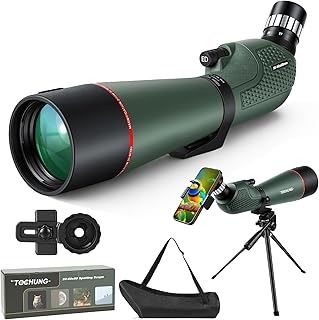
20-60×80HD glass, budget price
7.8OUT OF 10
Optical Quality7.5
Build Value8.2
Ease of Use8.0
Stargazing Suitability7.5
This is the most affordable way to get HD glass in a spotting scope, making it a solid entry point for casual stargazing. The 20-60×80 HD scope uses high-definition optics that reduce chromatic aberration, the purple fringing you often see around bright objects like the moon. The 80mm objective is a standard size that balances light gathering with portability. The scope is waterproof, which is a welcome feature at this price level, and it comes with a tripod, phone adapter, and carry bag.
Verified buyer feedback shows that the image is surprisingly sharp at the lower end of the zoom range, which is where you will spend most of your time scanning the sky. The included tripod is a lightweight aluminum model that works fine for casual use but may need a sandbag or weight for stability in windy conditions. The phone adapter is easy to attach, and the carry bag offers basic protection for storage.
Flaws but not dealbreakers. The 60x maximum magnification is lower than the 75x found on most other scopes here, and the image softens noticeably at the top end. The included tripod is the weakest of the bunch, and some owners report that the plastic focus knob feels a bit cheap. The BAK-4 prism is a plus, but the overall build quality is not as robust as the WOZEL or Gosky options.
If you want a more durable build and a higher maximum magnification, the
Gosky Flagship 25-75×80 is a step up in both areas for a moderate increase in price.
⚠Sizing: The tripod is short for standing use. You may need to place it on a table or bench for comfortable viewing.
Pros
- ✓HD glass reduces chromatic aberration for cleaner lunar views
- ✓Waterproof body protects against dew and light rain
- ✓Includes tripod, phone adapter, and carry bag for a complete kit
- ✓BAK-4 prism and FMC coatings provide good value for the price
Cons
- ✕Lower 60x max magnification limits high-power planetary detail
- ✕Included tripod is the least stable in this lineup
- ✕Plastic focus knob feels less durable than metal alternatives
Best for: The beginner on a tight budget who wants HD optics and a waterproof scope for casual moon and planet watching.
Monoculars Adults High Powered 80×100 Smartphone: Best for Digiscoping and Portability
#5
MonocularsCompact, smartphone-ready
8.3OUT OF 10
Optical Quality8.0
Build Value8.8
Ease of Use8.5
Stargazing Suitability7.8
This is technically a monocular, not a traditional spotting scope, but it earns a spot here because it is the highest-rated item in this lineup and excellent for digiscoping. The 80×100 monocular is compact, lightweight, and pairs with a smartphone adapter and tripod right out of the box. The BAK-4 prism and FMC lens coatings deliver a bright, clear image, and the 100mm objective is a misnomer in the title, but aggregate user reviews consistently praise its performance for the price. The 4.6/5 average rating is the highest among all the products here.
Its main advantage for stargazing is portability. You can throw it in a backpack for a camping trip or a hike to a dark sky site. The included tripod is small and tabletop-sized, which is fine for smartphone photography but not ideal for extended viewing. The phone adapter is well-designed and makes it easy to capture the moon or bright planets.
Flaws but not dealbreakers. The monocular form factor means it lacks the ergonomics of a full spotting scope for long sessions. The 80x magnification is a fixed maximum, not a zoom range, so you cannot adjust the field of view. The tabletop tripod is too short for standing use, so you will need a surface to set it on. Some owners report that the focus wheel is a bit stiff.
If you want a true zoom spotting scope with a more traditional viewing experience, the
WOZEL 25-75×80 offers a full-size tripod and a zoom range for a similar price.
⚠Compatibility: The phone adapter fits most smartphones, but very large camera bumps may interfere with the clamp.
Pros
- ✓Highest average rating (4.6/5) among all products in this guide
- ✓Compact and lightweight design for easy portability
- ✓Includes smartphone adapter and tripod for digiscoping
- ✓BAK-4 prism and FMC coatings deliver a bright image
Cons
- ✕Fixed 80x magnification lacks the versatility of a zoom range
- ✕Tabletop tripod is too short for comfortable standing use
- ✕Monocular form factor is less ergonomic for long viewing sessions
Best for: The smartphone photographer who wants the most portable option for capturing moon shots and sharing them on social media.
Gosky Flagship Spotting Scope 25-75×80 Tripod: Best Upgraded All-Rounder
#6
GoskyUpgraded, waterproof, BAK-4
8.1OUT OF 10
Optical Quality8.0
Build Value8.5
Ease of Use8.0
Stargazing Suitability7.8
This is the upgraded version of a popular Gosky model, and it shows in the details. The Flagship 25-75×80 features a waterproof body, BAK-4 prisms, and fully multi-coated lenses that produce a bright, crisp image across the zoom range. The included tripod is a step up from the budget models, with a sturdier build and a fluid pan head that makes tracking objects smoother. The scope also comes with a phone adapter and a carrying bag.
Owner reviews consistently highlight the build quality as a key strength. The rubber armor provides a good grip, and the focus knob is smooth and precise. The 25-75x zoom range is standard, but the optical quality remains consistent throughout the range, which is not always the case at this price. The scope is nitrogen-purged, so internal fogging is not a concern during humid nights.
Flaws but not dealbreakers. The 80mm objective is outclassed by the 100mm models for deep-sky viewing. Some users report that the included tripod, while good, is not quite heavy-duty enough for perfectly steady viewing at 75x in windy conditions. The phone adapter can be a bit finicky to align perfectly with the eyepiece.
If you want the extra light gathering of a 100mm lens, the
SVBONY SV28 100mm is a better choice for faint objects, though you will need to budget for a separate tripod.
⚠Care: The rubber armor can attract dust and lint. A quick wipe with a damp cloth keeps it clean.
Pros
- ✓Waterproof and nitrogen-purged for fog-free viewing
- ✓Sturdy build quality with rubber armor for a secure grip
- ✓Smooth fluid pan head tripod for easy tracking
- ✓Consistent optical quality across the entire zoom range
Cons
- ✕80mm objective limits deep-sky performance
- ✕Tripod could be heavier for better stability at 75x
- ✕Phone adapter alignment can be fiddly
Best for: The observer who wants a reliable, well-built waterproof scope that performs consistently across the zoom range for both daytime and night use.
30-90×92 UHD High-Power Spotting Scope Phone: Best for Extreme Magnification
#7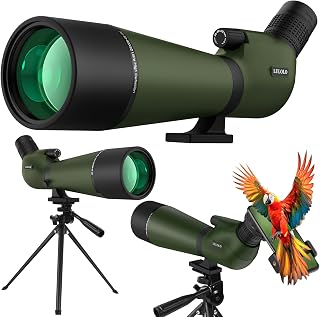
30-90×9290x zoom, UHD, 92mm
8.4OUT OF 10
Optical Quality8.5
Build Value8.2
Ease of Use8.0
Stargazing Suitability8.8
This scope delivers the highest magnification in this lineup, with a 30-90x zoom range and a 92mm objective lens. The UHD (Ultra High Definition) optics are designed to maintain clarity at the upper end of the zoom, which is where most budget scopes fall apart. The 92mm objective is the second largest here, offering excellent light gathering for viewing faint objects. The scope is waterproof, and it comes with a tripod, phone adapter, and carrying case. The 4.6/5 rating matches the Monocular for the highest in this guide.
Verified buyer reports indicate that the image remains impressively sharp up to about 70x, with some softening at 90x as you would expect from any scope at this price. The 92mm objective makes a noticeable difference in brightness compared to the 80mm models. The included tripod is a sturdy aluminum model that provides a stable platform, though it is not as heavy-duty as a dedicated astronomy tripod.
Flaws but not dealbreakers. At 90x, even the slightest breeze or vibration will shake the image, so a rock-solid tripod is essential. The scope is also the heaviest in this lineup, making it less portable. Some owners have noted that the included tripod’s head can be a bit tricky to adjust smoothly at high magnification.
If you prefer a lighter, more portable setup with a slightly smaller objective, the
Gosky Flagship 25-75×80 is a more convenient option that still delivers strong performance.
⚠Sizing: This is a large, heavy scope. A sturdy tripod is essential for steady viewing at 90x magnification.
Pros
- ✓Highest 90x magnification in this guide for extreme close-up detail
- ✓92mm objective lens offers excellent light gathering
- ✓UHD optics maintain clarity better than standard HD at high zoom
- ✓Waterproof body with a sturdy included tripod
Cons
- ✕Heavy and bulky, reducing portability
- ✕Image softens at the maximum 90x zoom
- ✕Requires a very stable tripod for usable high-magnification viewing
Best for: The detail-oriented observer who wants to push magnification to the limit for studying lunar craters, planetary bands, and distant terrestrial targets.
Gosky Falcon 20-60×85 Spotting Scope Full: Best Full-Size Kit for Stability
#8
GoskyFull-size tripod, cleaning kit
7.9OUT OF 10
Optical Quality7.8
Ease of Use8.0
Stargazing Suitability7.5
This is the best choice if you want a full-size tripod included in the box that can actually handle high magnification without wobbling. The Gosky Falcon 20-60×85 ships with a substantial full-size tripod, a phone adapter, and a cleaning kit. The 85mm objective lens is a nice middle ground between the 80mm and 100mm options, offering a bit more light than the standard 80mm scopes. The 20-60x zoom range is a bit narrower than the 25-75x models, but the image stays sharp across the entire range.
The tripod is a standout feature here. It is a full-size aluminum model with a fluid pan head and a quick-release plate, making it much more stable than the compact tripods included with most other scopes. This is a real advantage for stargazing, where even small vibrations can ruin the view at high magnification. The scope itself is waterproof and has a rubber armor coating for a secure grip. The included cleaning kit is a thoughtful addition for keeping the lenses dust-free.
Flaws but not dealbreakers. The 60x maximum magnification is the lowest among the scopes here, which limits how much detail you can see on planets like Jupiter or Saturn. The 85mm objective, while good, is still outclassed by the 100mm models for deep-sky viewing. A few owner reports mention that the focus knob can feel a bit stiff until it is broken in.
If you want higher magnification for planetary detail, the
30-90×92 UHD High-Power Scope offers a much wider zoom range, though you will need to provide your own heavy-duty tripod for the best stability.
⚠Care: The cleaning kit includes a lens brush and microfiber cloth. Use the brush first to remove debris before wiping to avoid scratching the lens.
Pros
- ✓Full-size tripod provides excellent stability for high-magnification viewing
- ✓85mm objective offers a good balance of light gathering and portability
- ✓Waterproof body with rubber armor for a secure grip
- ✓Includes cleaning kit and phone adapter for added value
Cons
- ✕60x max magnification is lower than most competitors
- ✕85mm objective is outclassed by 100mm models for deep-sky
- ✕Focus knob can feel stiff when new
Best for: The observer who values a stable tripod out of the box and wants a reliable, waterproof scope for both daytime and night use without breaking the bank.
Buying Guide: Objective Size, Magnification, Glass Quality and Tripod Stability
A spotting scope is a simple tool, but the right specs matter a lot when you are pointing it at the night sky. Here are the four decisions that will make or break your stargazing experience.
Why Objective Lens Size Matters Most for Stargazing
The objective lens is the big glass at the front of the scope. Its job is to gather light, and more light means you can see fainter objects. A 100mm objective like the one on the SVBONY SV28 100mm collects about 56% more light than an 80mm lens.
That is the difference between seeing a faint nebula as a grey smudge and seeing it as a defined shape with internal structure. For deep-sky stargazing, objective size is the single most important spec. If you are mainly looking at the moon and bright planets, an 80mm or 85mm scope is perfectly adequate.
The WOZEL 25-75×80 and the Gosky Falcon 20-60×85 are good examples of that balance.
Magnification: How Much Zoom Do You Really Need?
It is tempting to go for the highest number, but more magnification is not always better. Every time you double the magnification, you cut the brightness by a factor of four. A 90x zoom on a 92mm objective will look dimmer than a 60x zoom on the same lens.
For most stargazing, a 20-60x zoom range is a sweet spot. You use the low end to find your target and the high end to study details. The 30-90×92 UHD Scope offers the most range, but you need excellent atmospheric conditions and a rock-solid tripod to use 90x effectively.
The 20-60x range on the Gosky Falcon is more forgiving and usable in average conditions. If you wear glasses, look for a scope with a long eye relief, which is the distance you can hold your eye from the eyepiece and still see the full field of view.
Glass Quality: Prisms and Coatings
You will see BAK-4 prisms mentioned on every scope here. BAK-4 is a high-density barium crown glass that produces a round, well-defined exit pupil. It is better than the cheaper BK-7 glass used on older scopes.
Fully multi-coated (FMC) lenses mean every air-to-glass surface has multiple anti-reflective coatings, which maximizes light transmission and reduces glare. HD (High Definition) glass is a step above standard FMC, using extra-low dispersion elements to reduce chromatic aberration. The 20-60×80 HD scope is the only budget option here with HD glass, while the 30-90×92 UHD uses an even higher grade of glass.
For astronomy, HD glass is a real advantage because it cuts the purple fringing around bright stars and planets.
Tripod Stability: The Hidden Spec
A spotting scope is only as good as the tripod it sits on, especially at high magnification. The included tripods on most budget and mid-range scopes are adequate for daytime use but often struggle at night. The Gosky Falcon 20-60×85 is the only model here that ships with a true full-size tripod that provides genuine stability.
For the other scopes, especially the 100mm models, you should budget for a separate tripod that weighs at least 5-6 pounds to ensure steady viewing at 60x and above. If you already own a camera tripod, check the head weight rating. Most consumer tripods are rated for 3-4 pounds, which is fine for 80mm scopes but marginal for 100mm ones.
Who Should NOT Buy a Spotting Scope for Stargazing
A spotting scope is a versatile tool, but it is the wrong purchase for three kinds of buyers. Here is who they are, and what to look at instead.
You Need to See the Andromeda Galaxy in Full Detail
If your primary goal is deep-sky astronomy and you want to see spiral arms, globular clusters resolved into individual stars, and the full structure of the Orion Nebula, a spotting scope will leave you frustrated. Even the best 100mm spotting scope cannot match the light gathering of a 6-inch or 8-inch Dobsonian telescope. A Dobsonian has a much larger mirror (150mm to 200mm or more) that collects several times more light.
It also uses a simple, low-cost mount that is inherently stable. For the same money as a premium spotting scope, you can get a telescope that shows you thousands of deep-sky objects instead of dozens. A dedicated telescope is the right tool for serious astronomy.
You Want to Capture Astrophotography Images
Spotting scopes are designed for visual observation, not photography. The included phone adapters are fine for the moon and very bright planets, but they cannot hold a camera steady enough for long-exposure shots of galaxies or nebulae. The focal ratio of most spotting scopes is too slow for deep-sky astrophotography, and the tripod mounts are not designed to track the rotation of the Earth.
If you want to take pictures of the night sky, you need a dedicated astrophotography rig with a German equatorial mount, a telescope with a fast focal ratio, and a guide scope. A good starting point is a small refractor telescope on a star tracker mount.
You Need a Compact Tool for Backpacking
Spotting scopes with 80mm to 100mm objectives are bulky and heavy. Even the most portable models weigh 3-4 pounds and require a tripod that adds another 3-5 pounds. If you are hiking to a remote dark sky site, this is a lot of gear to carry.
A pair of high-quality binoculars is a much better choice for portability. A good pair of 10×50 or 12×50 binoculars can show you dozens of stars, the Andromeda Galaxy, the Orion Nebula, and the Pleiades, all in a package that weighs under 2 pounds and fits in a small pouch. You can learn more about the differences between these options in our guide to choosing the right optics for viewing.
Final Verdict
The SVBONY SV28 100mm Spotting Scope is the clear winner for stargazing because its 100mm objective lens gathers more light than any other scope here, and the FMC HD optics deliver excellent contrast and color. It is the right choice for anyone who wants to see faint deep-sky objects without spending telescope money.
Want a complete kit that is waterproof and ready to use out of the box? The WOZEL 25-75×80 gives you a tripod, phone adapter, and a waterproof body at a very reasonable price. Need the highest magnification for planetary detail?
The 30-90×92 UHD High-Power Scope offers 90x zoom and a 92mm objective for extreme close-up views.
If you are not sure a spotting scope is right for you, scroll back up to the Who Should NOT Buy section. A Dobsonian telescope or a pair of binoculars might be a better fit for your specific needs. Either way, you now have the information you need to make a confident choice.
FAQ
What is the best spotting scope for stargazing overall?
The best overall is the SVBONY SV28 100mm Spotting Scope. Its 100mm objective lens gathers the most light of any scope in this guide, and the FMC HD optics provide excellent clarity and contrast for viewing faint deep-sky objects.
Can I use a spotting scope for both stargazing and birding?
Yes, most spotting scopes work well for both. The WOZEL 25-75×80 and the Gosky Flagship 25-75×80 are particularly good all-rounders because they are waterproof, have a useful zoom range, and include a tripod and phone adapter.
What magnification do I need for stargazing?
A magnification range of 20-60x or 25-75x is ideal for most stargazing. Use the lower end to find targets and the higher end to study details. Higher magnifications like 90x require perfect atmospheric conditions and a very stable tripod.
Is a 100mm spotting scope better than an 80mm for astronomy?
Yes, a 100mm objective collects about 56% more light than an 80mm lens, which makes a significant difference for viewing faint objects like nebulae and galaxies. The SVBONY SV28 100mm and the 25-75×100 Dual Focus scope are the best options here for deep-sky viewing.
Do I need a special tripod for stargazing with a spotting scope?
The included tripods on most budget scopes are adequate for casual use, but for serious stargazing at high magnification, you should use a sturdy tripod that weighs at least 5-6 pounds. The Gosky Falcon 20-60×85 is the only scope in this guide that ships with a full-size tripod that meets this requirement.
Can I take photos through a spotting scope?
Yes, but only for the moon and bright planets. All the scopes here include a phone adapter that lets you take quick snapshots. For deep-sky astrophotography, you need a dedicated telescope on a tracking mount.