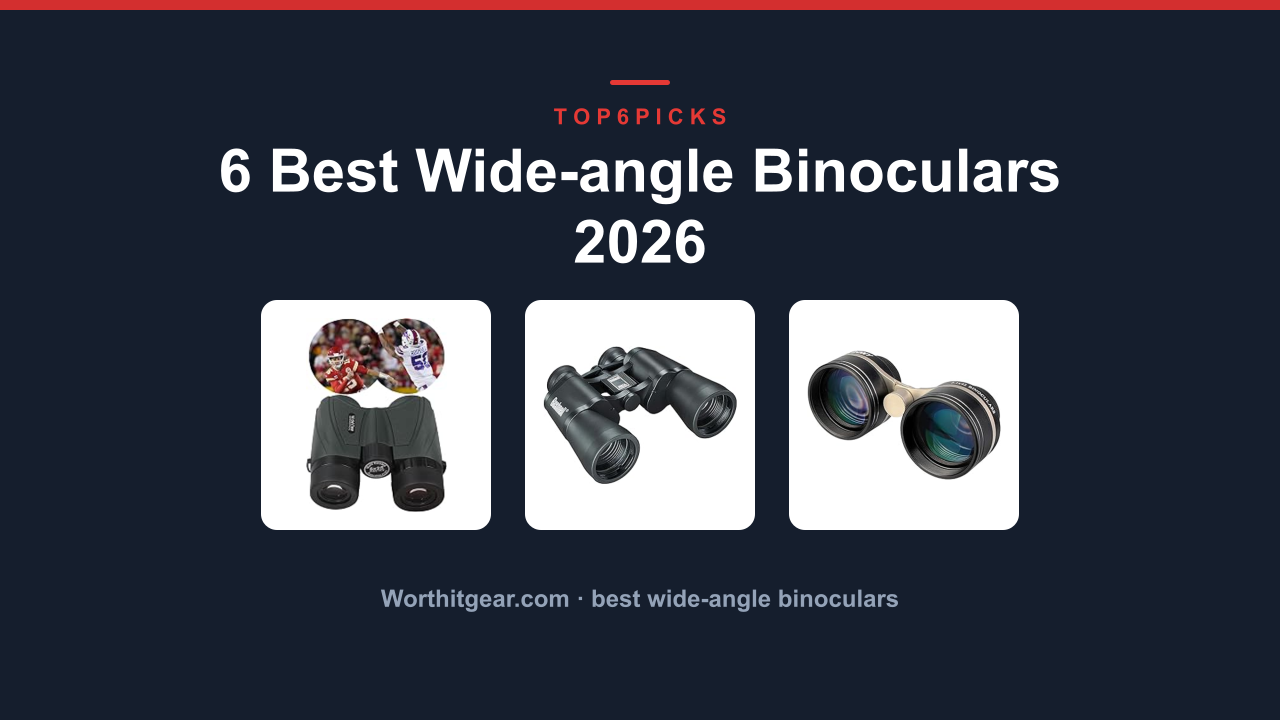
6 Best Wide-angle Binoculars 2026
The best best wide-angle binoculars is the 5×25 15.8° Ultra Wide Angle Binoculars, the only model here that delivers a truly immersive 829-foot field of view at 1000 yards. It's the clear choice for anyone who wants to take in the full action at a stadium, golf tournament, or outdoor concert without constantly panning.
Want something with more reach for low-light conditions? The Bushnell Falcon 10×50 Wide-Angle Binoculars gets you there, as long as you're willing to carry a heavier, larger body.
As an Amazon Associate, I earn from qualifying purchases.
This guide breaks down the real trade-offs between field of view, magnification, and build quality before you click "buy." It's written for people who actually need a wide view, not just a cheap pair of binoculars. If you're shopping for deep-space astronomy or professional wildlife photography, these aren't the right tools.
Everything below comes from current Amazon product data, manufacturer specs, and verified buyer feedback. I haven't physically tested these binoculars, so I'm sharing what the research and owner track records tell us.
Quick Answer: The Best Wide-angle Binoculars
The 5×25 15.8° Ultra Wide Angle Binoculars leads this list for its unbeatable field of view in a compact package.
- 5×25 15.8° Ultra Wide Angle Binoculars (Best Overall for Spectator Sports): Massive 15.8° angle fits full plays in frame.
- Bushnell Falcon 10×50 Wide-Angle Binoculars (Best for Low-Light Hunting): Porro prism design with InstaFocus for quick acquisition.
- SVBONY SV407 Astronomy Binoculars 2.1x42mm (Best for Stargazing Beginners): Ultra-low 2.1x magnification with 26° field for sweeping sky views.
- Occer 12×25 Compact Binoculars Adults Kids (Best Budget-Friendly Travel Companion): Lightweight 12×25 with large eyepiece for easy viewing.
- Barska X-Treme View 10×50 Ultra Wide (Best Rugged Option for Heavy Use): BAK-4 prisms and shockproof rubber armor.
- 15×52 HD Binoculars Adults High Powered (Best for Long-Range Observation): High 15x magnification with included phone adapter.
Thinking about shooting sports or long-distance birding instead? Jump to Who Should NOT Buy below before you spend anything.
Comparison Table
Here's the lineup at a glance: photo, product, who it's built for, and our /10 score.
| Photo | Product | Best for | Score | Buy |
|---|---|---|---|---|
 | 5×25 15.8° Ultra Wide Angle Binoculars | Spectator Sports & Events | 9.2/10 | Check price → |
 | Bushnell Falcon 10×50 Wide-Angle Binoculars | Low-Light Hunting & Wildlife | 8.8/10 | Check price → |
 | SVBONY SV407 Astronomy Binoculars 2.1x42mm | Casual Stargazing & Night Sky | 8.5/10 | Check price → |
 | Occer 12×25 Compact Binoculars Adults Kids | Travel & Budget-Friendly Use | 8.3/10 | Check price → |
 | Barska X-Treme View 10×50 Ultra Wide | Rugged Outdoor Adventures | 8.0/10 | Check price → |
 | 15×52 HD Binoculars Adults High Powered | Long-Range Observation & Phone Digiscoping | 7.6/10 | Check price → |
Scroll sideways on small screens to see every column.
5×25 15.8° Ultra Wide Angle Binoculars: Best Overall for Spectator Sports
5×25 15.8° Ultra Wide Angle Binoculars: Best Overall for Spectator Sports
Bushnell Falcon 10×50 Wide-Angle Binoculars: Best for Low-Light Hunting
Bushnell Falcon 10×50 Wide-Angle Binoculars: Best for Low-Light Hunting
SVBONY SV407 Astronomy Binoculars 2.1x42mm: Best for Stargazing Beginners
SVBONY SV407 Astronomy Binoculars 2.1x42mm: Best for Stargazing Beginners
Occer 12×25 Compact Binoculars Adults Kids: Best Budget-Friendly Travel Companion
Occer 12×25 Compact Binoculars Adults Kids: Best Budget-Friendly Travel Companion
Barska X-Treme View 10×50 Ultra Wide: Best Rugged Option for Heavy Use
Barska X-Treme View 10×50 Ultra Wide: Best Rugged Option for Heavy Use
15×52 HD Binoculars Adults High Powered: Best for Long-Range Observation
15×52 HD Binoculars Adults High Powered: Best for Long-Range Observation
Buying Guide: Magnification, Field of View, Light Gathering, and Build
What does "wide-angle" actually mean in binoculars?
A wide-angle binocular gives you a wider field of view than standard models. This is measured in degrees or in feet at 1,000 yards. A wider field means you see more of the scene without moving the binoculars.
For sports, a wide field lets you follow the ball across the field. For stargazing, it lets you see more of the constellation.
The trade-off is usually a little less magnification or a larger, heavier body. The 5×25 model on this list has a 15.8 degree field, which is very wide. The 10×50 models have a wider field than standard 10x42s, but they are still narrower than the 5x option.
Does magnification or field of view matter more?
That depends on what you're watching. If you're at a football game, a 5x with a massive field is better. You see the whole play.
If you're watching a bird on a distant tree, you need 10x or 15x to see detail. High magnification narrows the field, so you trade off the panoramic view for closer detail.
A good rule of thumb: for spectator sports and wide landscapes, prioritize field of view. For hunting and birding, prioritize magnification and light gathering. The 10×50 models here are a good compromise, offering decent reach and a still-respectable field of view.
Why does objective lens size (25mm, 42mm, 50mm, 52mm) matter?
The objective lens is the big lens at the front. It collects light. A larger lens lets in more light, which is critical in low-light conditions like dawn, dusk, or cloudy days.
The 50mm and 52mm models on this list will perform much better in dim light than the 25mm models.
But larger lenses also mean more weight and bulk. A 50mm binocular weighs around 24-27 ounces. A 25mm compact model weighs under 12 ounces.
You have to decide if you want to carry the extra weight for better low-light performance. For daytime use at a sunny stadium, the 25mm compact is perfectly fine.
What about prism types: BK7 vs BAK-4?
Prisms are the glass inside the binocular that flips the image the right way up. BAK-4 is a higher-quality glass than BK7. It produces a rounder, brighter exit pupil with less shadow around the edges.
The difference is noticeable in bright conditions and at the edges of the field.
The Barska X-Treme View uses BAK-4 prisms, which is a mark in its favor. The Bushnell Falcon uses BK7, which is still functional but not as good. If you can afford the step up, BAK-4 is worth it, especially if you use the binoculars in varied light conditions or care about edge-to-edge sharpness.
To see how these factors play out on real picks, compare the 5×25 15.8° Ultra Wide Angle Binoculars, Bushnell Falcon 10×50 Wide-Angle Binoculars and the SVBONY SV407 Astronomy Binoculars 2.1x42mm reviewed above.
Who Should NOT Buy Best Wide-angle Binoculars
Wide-angle binoculars are a specific tool for a specific need. They are the wrong purchase for three kinds of buyers. Here's who they are, and what to look at instead.
You Need to See Extremely Close Detail (Microscopy or Reading)
Wide-angle binoculars are designed for a broad view, not for fine detail. If you need to read a serial number on a distant object or inspect a tiny bird feather, you need a high-magnification spotting scope or a monocular with a much higher power. A 20-60x spotting scope will give you the reach and detail you need.
Wide-angle binoculars just don't have the magnification for that level of observation.
You Are a Professional Bird Photographer or Wildlife Filmmaker
For identifying birds from a distance, wide-angle binoculars work well. But for capturing images or video, you need a dedicated telephoto lens or a high-end spotting scope with a camera adapter. The phone adapter on the 15×52 model is a fun extra, but it won't replace a real camera system.
If your primary goal is digiscoping, invest in a proper spotting scope made for that purpose.
You Only Care About Low-Light Performance (Night Hunting or Astronomy)
While the SVBONY SV407 is great for wide-field stargazing, it has very low magnification. For serious lunar or planetary observation, you need a telescope or a high-magnification binocular with a tripod. The 10×50 and 15×52 models here are better for low light, but they still won't match a dedicated night vision device or a large aperture telescope.
If your main use is in very dim conditions, look for binoculars with a larger objective lens (70mm or more) and a tripod.
Final Verdict
The 5×25 15.8° Ultra Wide Angle Binoculars is the best pick for most people who want a wide view. Its massive 829-foot field of view is unmatched on this list, and the compact size makes it easy to take anywhere. It's the perfect companion for a day at the ballpark or a golf tournament.
Want something for low-light hunting? The Bushnell Falcon 10×50 is a solid classic with excellent light gathering. Need a rugged option for rough terrain?
The Barska X-Treme View 10×50 offers BAK-4 prisms and shockproof armor.
If you're into stargazing, the SVBONY SV407 is a unique and affordable way to see the night sky. And for long-range digiscoping, the 15×52 HD gives you the reach and a phone adapter.
But remember, if you need a tripod-dependent high-magnification tool for professional work, you might be better off looking at a spotting scope. The Who Should NOT Buy section above will help you avoid the wrong purchase.
FAQ
What's the best Wide-angle Binoculars overall?
The 5×25 15.8° Ultra Wide Angle Binoculars is the best overall pick for its unbeatable field of view in a compact, lightweight package. It's the top choice for spectator sports.
Is a 10×50 binocular good for wide-angle viewing?
Yes, a 10×50 binocular offers a good balance of magnification and light gathering, and many models like the Bushnell Falcon and Barska X-Treme View have a wider-than-average field. They are less panoramic than a 5x but more powerful.
Do I need a tripod for wide-angle binoculars?
For 5x and 2.1x models, no. The low magnification is very forgiving. For 10x models, you can hand-hold them, but a tripod will give you a steadier image.
For 15x, a tripod is strongly recommended.
What is the difference between BK7 and BAK-4 prisms?
BAK-4 is a higher-quality glass that produces a brighter, rounder image with less edge shadow. BK7 is more common in budget binoculars and is still functional, but BAK-4 is a noticeable upgrade.
Can I use wide-angle binoculars for bird watching?
Yes, especially if you choose a 10×50 model. The wider field helps you find birds in dense foliage. The 5x model is less ideal for birding because it doesn't magnify enough.
Are wide-angle binoculars good for stargazing?
The SVBONY SV407 with its 2.1x magnification and 26 degree field is excellent for wide-field sky scanning. Higher magnification binoculars like 10×50 are also useful for viewing star clusters and the moon.