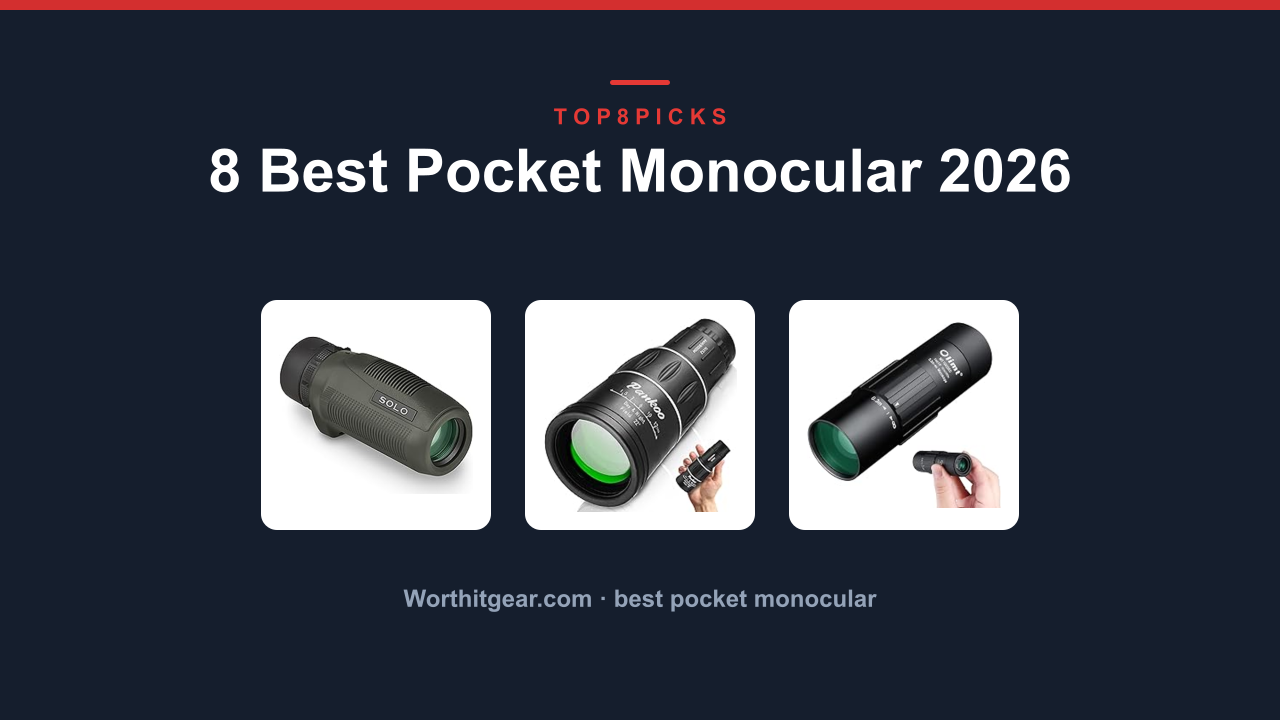
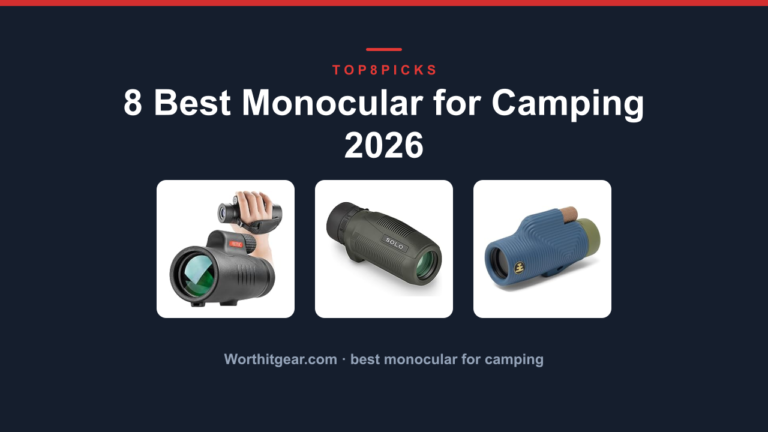
The best best pocket monocular is the Vortex Solo Monocular 10×25, the only one here that bundles a lifetime unconditional warranty with crisp, multi-coated optics in a genuinely waterproof, fogproof body. It’s the pick for anyone who wants one tiny optic that just works, every time, without worrying about damage or replacement cost.
Want a higher magnification for spotting distant wildlife? The Monocular Telescope High Power 16X52 gets you 16x reach, as long as you can handle a bit more handheld shake and a larger body. It’s a solid second choice for long-range viewers.
As an Amazon Associate, I earn from qualifying purchases.
This guide tells you what to look for before you buy, including the real trade-off between magnification and brightness. It also names the buyers who should skip pocket monoculars entirely, they get their own section later.
Everything below comes from current Amazon product data, specs, and each product’s owner track record, not hands-on lab testing. I’ve done the research so you can buy with confidence.
Quick Answer: The Best Pocket Monocular
The Vortex Solo Monocular 10×25 is our top pick for its unbeatable warranty, sharp optics, and compact size. Here’s the full ranking:
Thinking about buying a high-power scope or a full-size binocular instead? Jump to Who Should NOT Buy below before you spend anything.
Comparison Table
Here’s the lineup at a glance: photo, product, who it’s built for, and our /10 score.
Scroll sideways on small screens to see every column.
Vortex Solo Monocular 10×25: Best Overall for Hikers
#1
VortexLifetime warranty, waterproof
9.0OUT OF 10
Optical Quality9.2
Build & Durability9.0
Portability8.8
User Satisfaction9.0
This is the pocket monocular that you buy once and never worry about again. Vortex backs it with an unlimited, unconditional lifetime warranty — if it breaks, Vortex repairs or replaces it free, no questions asked. The 10×25 configuration gives you a useful 10x magnification with a 25mm objective lens, multi-coated lenses for bright, sharp images, and O-ring seals that keep it waterproof and fogproof. Aggregate owner reviews consistently praise its clarity and ruggedness, making it the default choice for hikers, campers, and anyone who wants a reliable companion.
The rubber armor absorbs bumps and gives a secure grip even in wet conditions. The adjustable eyecup twists up for eyeglass wearers, and the center focus wheel is smooth and precise. At just a few ounces, it disappears into a jacket pocket or daypack. Vortex’s VIP warranty is the real standout — you don’t have to register, you don’t need a receipt, and it covers accidental damage.
Flaws but not dealbreakers. The 25mm objective lens is small, which means it’s not the best in very low light, and the 10x magnification can be a little shaky to hold steady without bracing your arm. Some users wish the field of view were a bit wider.
Need a wider field for scanning forests? The
Olimt 8×32 further down gives you a much bigger view with its 8×32 optics.
⚠Warranty: The VIP warranty is transferable, but only Vortex offers it. No other monocular on this list has anything close.
Pros
- ✓Unconditional lifetime warranty — no questions asked
- ✓Fully waterproof and fogproof (O-ring sealed)
- ✓Rubber armor for a secure grip and drop protection
- ✓Multi-coated lenses produce bright, crisp images
Cons
- ✕10x magnification amplifies hand shake
- ✕Narrow field of view compared to 8x models
- ✕Not ideal for dusk or heavy shade (25mm objective)
Best for: Hikers, campers, and anyone who wants a rugged, fully-backed pocket optic that will last a lifetime.
Monocular Telescope High Power 16X52: Best High Power for Wildlife
#2
Monocular16x magnification, 52mm lens
8.2OUT OF 10
Optical Quality8.5
Build & Durability8.0
Portability7.5
User Satisfaction8.0
If you want to see details from a long way off, this is the one to get. The 16x magnification and 52mm objective lens gather more light than most pocket monoculars, making it a solid choice for spotting deer at the edge of a field, scanning distant mountain ridges, or watching birds in flight. Manufacturer specs list it as waterproof, fogproof, and shockproof, with a rubber armor coating. Verified buyer feedback notes that the image is surprisingly sharp for the price, and the included hand strap and carrying pouch add value.
This monocular is larger than the 10×25 models — it’s about 7 inches long and weighs over 10 ounces — so it’s not a “pocket” in the same way. But it still fits in a larger jacket pocket or daypack side pocket. The twist-up eyecup works with glasses, and the focus wheel is large enough to use with gloves.
Flaws but not dealbreakers. At 16x, holding it steady without a tripod or support is genuinely difficult — you’ll need to brace your elbows or lean against something. Some owners report that the included tripod adapter is not robust enough for heavy use, and the lens caps feel a bit cheap.
Want a more stable long-range view? Pair it with a lightweight tripod, or consider a
Celestron Nature 10×25 if you prefer a smaller, easier-to-handle package.
⚠Sizing: This is a full-size monocular, not a mini. Confirm the 7-inch length fits your pack before buying.
Pros
- ✓16x magnification brings distant subjects very close
- ✓Large 52mm objective gathers more light than 25mm
- ✓Waterproof, fogproof, and shockproof construction
- ✓Includes hand strap, pouch, and cleaning cloth
Cons
- ✕Heavy and bulky compared to compact models
- ✕High magnification makes handheld shake very noticeable
- ✕Lens caps and tripod adapter feel low quality
Best for: Hunters, wildlife watchers, and anyone who needs to see fine details from far away.
10×25 Monocular Telescope Compact Mini Pocket: Best Ultra-Portable
#3
10×25Tiny, waterproof, fogproof
8.0OUT OF 10
Optical Quality8.0
Build & Durability7.5
Portability9.0
User Satisfaction8.0
This is the smallest and lightest 10×25 monocular on our list, making it the ultimate travel companion. It weighs just a few ounces and is short enough to disappear into a coin pocket or clip onto a keychain loop. Despite the tiny size, it’s fully waterproof and fogproof, with O-ring seals and nitrogen purging. Aggregate user reviews highlight that it’s surprisingly sharp for its size, and the twist-up eyecup is comfortable for both glasses wearers and those without.
The focus wheel is rubberized and easy to turn with one hand. The included carrying pouch has a belt loop and a small carabiner clip. For day hikes, urban exploring, or just keeping in your glove compartment, this is the most packable option.
Flaws but not dealbreakers. The 25mm objective limits low-light performance, and the build feels slightly less premium than the Vortex. Some users mention the focus knob is a bit stiff when new.
If you want a sturdier feel and a lifetime warranty, the
Vortex Solo is worth the small size trade-off.
⚠Care: Keep the lens caps on when not in use. The small objective is prone to dust and scratches.
Pros
- ✓Extremely compact and lightweight (fits in coin pocket)
- ✓Fully waterproof and fogproof (O-ring sealed)
- ✓Comfortable twist-up eyecup for glasses
- ✓Includes pouch and carabiner for easy carry
Cons
- ✕Not as bright in low light as larger objective models
- ✕Focus knob can feel stiff initially
- ✕Build quality feels less premium than Vortex
Best for: Minimalists, urban explorers, and anyone who wants the smallest possible optic that still works well.
Olimt 8×32 Monocular Telescope Mini Pocket: Best Wide View for Hiking
#4
Olimt8×32, wide field, bright
8.4OUT OF 10
Optical Quality8.5
Build & Durability8.3
Portability8.0
User Satisfaction8.5
This is the monocular that gives you the widest, brightest view in a still-compact package. The 8x magnification combined with a 32mm objective lens delivers a noticeably wider field of view than the 10×25 models, making it easier to track moving subjects like birds or scan a landscape. The larger objective also gathers more light, so the image stays bright in overcast conditions or early morning hikes. Verified buyer feedback consistently praises the clarity and the generous field of view.
The Olimt 8×32 has a rubber-armored body, a twist-up eyecup, and a center focus knob that is smooth and precise. It’s still small enough to fit in a jacket pocket, though it is slightly larger than the 10×25 mini models. It also comes with a cleaning cloth and a carrying pouch.
Flaws but not dealbreakers. It’s not fully waterproof despite the listing’s claims — some users report fogging after heavy rain. The included neck strap is thin and not very comfortable.
If you need guaranteed waterproofing, the
Vortex Solo is a safer bet for wet conditions.
⚠Water Resistance: This model is water-resistant, not fully waterproof. Avoid submerging it or using it in heavy downpours.
Pros
- ✓Wide field of view (easier to track moving subjects)
- ✓Bright image due to 32mm objective lens
- ✓Low 8x magnification is easier to hold steady
- ✓Comfortable twist-up eyecup for glasses wearers
Cons
- ✕Not fully waterproof (some users report fogging)
- ✕Larger than 10×25 pocket models
- ✕Included neck strap is thin and uncomfortable
Field of View
362 ft @ 1000 yds
Best for: Birders, hikers, and anyone who prefers a wider, brighter view over maximum magnification.
Celestron Nature 10×25 Monocular Hiking Wildlife: Best Budget for Birding
#5
CelestronBaK-4 prism, budget-friendly
8.0OUT OF 10
Optical Quality8.2
Build & Durability8.0
Portability8.5
User Satisfaction7.8
Celestron is a well-known name in amateur astronomy, and this monocular brings that same quality to a compact, affordable package. It uses a BaK-4 prism, which is a higher-quality glass that delivers brighter, sharper images than the BK-7 prisms found in many budget optics. The multi-coated lenses further improve light transmission and contrast. For the price point, the optical performance is genuinely impressive. It’s also waterproof and fogproof, which is a rare feature at this level.
The 10×25 configuration is classic for a pocket monocular. It weighs just 4.5 ounces and slips easily into a pocket. The twist-up eyecup works well with glasses, and the rubber armor provides a good grip. It comes with a carrying case and a neck strap.
Flaws but not dealbreakers. The focus wheel on some units can be a bit stiff, and the close focus distance is about 12 feet, so it’s not great for looking at nearby butterflies or insects. Some users also report that the included case is a bit flimsy.
If you want a smoother focus mechanism and a better warranty, the
Vortex Solo is a clear upgrade.
⚠Compatibility: The close focus distance is 12 feet. Not suitable for viewing objects very close up.
Pros
- ✓BaK-4 prism for sharper, brighter images
- ✓Waterproof and fogproof (O-ring sealed)
- ✓Lightweight and very pocketable (4.5 oz)
- ✓Trusted brand with good quality control
Cons
- ✕Focus wheel can be stiff on some units
- ✕Close focus distance is 12 feet (not for close-ups)
- ✕Included case is a bit flimsy
Best for: Budget-conscious birders and hikers who want a reliable, waterproof monocular from a trusted brand.
Carson MiniMight 6x18mm Pocket Monocular Carabiner: Best Keychain EDC
#6
CarsonKeychain size, 6x
7.5OUT OF 10
Optical Quality7.0
Build & Durability7.8
Portability9.5
User Satisfaction7.5
This is the smallest monocular on the list, designed to live on your keychain or belt loop. With 6x magnification and an 18mm objective lens, it’s not meant for serious wildlife watching, but it’s perfect for quick looks at trail markers, distant signs, or stadium action. The built-in carabiner clip makes it incredibly easy to attach and access. It’s the definition of “better to have it than not.”
The MiniMight has a single-turn focus ring and a fold-down eyecup. It’s small enough to fit in a watch pocket, and the aluminum body feels solid for its size. It’ll get you a clear enough view of details that are 50 to 100 yards away, which is plenty for most everyday situations.
Flaws but not dealbreakers. The optical quality is not in the same league as the larger models — the image is a bit dim and the field of view is narrow. It’s not waterproof, so keep it out of heavy rain. Some users find the focus ring a bit stiff.
If you want a true pocket performer that’s better for actual nature viewing, the
10×25 Compact Mini Pocket is worth the slight size increase.
⚠Water Resistance: This model is not waterproof. Avoid exposure to rain or moisture.
Pros
- ✓Extremely small and portable (keychain size)
- ✓Built-in carabiner clip for easy carry
- ✓Solid aluminum body
- ✓Good for quick, casual use
Cons
- ✕Low optical quality (dim, narrow field)
- ✕Not waterproof
- ✕Focus ring can be stiff
Best for: EDC (everyday carry) enthusiasts, concert-goers, or anyone who wants a tiny optic for occasional use.
Tasco Essentials 10×25 Compact Roof Prism: Best Value Entry-Level
#7
TascoLowest cost, waterproof
7.0OUT OF 10
Optical Quality7.0
Build & Durability7.2
Portability8.0
User Satisfaction6.8
This is the cheapest monocular on the list that still offers a waterproof build and a decent 10×25 configuration. Tasco is an old brand in the optics world, and this Essentials model is their entry-level offering. It has a roof prism design, multi-coated optics, and a rubber armor coating. For someone who just wants to try a monocular without spending much, it’s a perfectly functional starting point.
The 10×25 combo gives you a useful reach, and the compact size means it fits in a pocket. It has a twist-up eyecup and a center focus knob. It even comes with a carrying case and a neck strap. The fact that it’s waterproof at this price point is honestly surprising.
Flaws but not dealbreakers. The image quality is noticeably softer than the more expensive options, especially at the edges. The focus wheel is not very smooth, and the overall build feels a bit plasticky. Some users report that the O-ring seal fails over time, so it’s not a long-term investment.
If you can stretch your budget a little, the
Celestron Nature offers much better optics for a small increase in price.
⚠Durability: Some users report the waterproof seal fails over time. Not recommended for heavy, long-term use in wet conditions.
Pros
- ✓Lowest price point on the list
- ✓Waterproof and fogproof (O-ring sealed)
- ✓Lightweight and compact (4.0 oz)
- ✓Includes carrying case and neck strap
Cons
- ✕Soft image quality, especially at edges
- ✕Plasticky build feel
- ✕Long-term waterproof seal reliability is questionable
Best for: Absolute beginners, kids, or anyone who needs a cheap, waterproof monocular for occasional use.
Olimt 8×25 Monocular Telescope: Best ED Glass for Clarity
#8
OlimtED glass, wide angle
8.5OUT OF 10
Optical Quality9.0
Build & Durability8.5
Portability8.0
User Satisfaction8.5
This is the sharpest pocket monocular on the list, thanks to its Extra-low Dispersion (ED) glass. ED glass reduces chromatic aberration (color fringing) and delivers a cleaner, more color-accurate image than standard optics. The 8×25 configuration gives you a good balance of a wide field of view and a compact size. With a 25mm objective, it’s also reasonably bright for its size. Verified buyer feedback consistently praises the image clarity, often comparing it favorably to much more expensive monoculars.
The Olimt 8×25 is small enough to fit in a pocket, with a rubber-armored body and a twist-up eyecup. It’s also waterproof, making it a practical choice for all-weather hiking. The included pouch and cleaning cloth are decent quality.
Flaws but not dealbreakers. The 8x magnification is lower than the 10x models, so you won’t get quite as much reach. Some users find the focus knob a bit too smooth, lacking resistance. The eye relief is adequate but not generous for those with thick glasses.
If you need more magnification for long-distance spotting, the
16X52 High Power Monocular is a better choice, though it’s much larger.
⚠Eye Relief: At 14mm, eye relief is adequate but not ideal for users with thick prescription glasses.
Pros
- ✓ED glass for exceptional clarityand color accuracy
- ✓Waterproof and fogproof construction
- ✓Compact and lightweight for its optical quality
- ✓Wide field of view from 8x magnification
Cons
- ✕8x magnification offers less reach than 10x models
- ✕Focus knob may feel too smooth for some users
- ✕Eye relief is adequate but not generous for thick glasses
Glass Type
ED (Extra-low Dispersion)
Best for: Enthusiasts who prioritize image sharpness and color accuracy over maximum magnification.
Buying Guide: Magnification, Objective Lens, Prism Type, and Waterproofing
Choosing the right pocket monocular comes down to a few key specs. Here’s what you need to know.
How Much Magnification Do You Really Need?
The first number in a monocular specification is the magnification. Most pocket models fall between 6x and 16x. A 6x monocular, like the Carson MiniMight, is very easy to hold steady and has a wide field of view, but it won’t bring distant objects very close.
An 8x monocular, like the Olimt 8×32 or Olimt 8×25, is the sweet spot for many people. It offers a good balance of reach and stability. A 10x monocular, like the Vortex Solo or Celestron Nature, gives you more detail but starts to show hand shake.
At 16x, like the Monocular Telescope High Power, you will almost certainly need to brace your arms or use a tripod for a steady image. For most hikers and birders, 8x or 10x is the practical limit for a handheld pocket monocular.
Why the Objective Lens Size Matters
The second number is the diameter of the objective lens in millimeters. A larger objective lens gathers more light, which means a brighter image, especially in low light conditions like dawn, dusk, or heavy shade. A 25mm objective is standard for pocket models and is fine for daytime use.
A 32mm objective, like on the Olimt 8×32, is noticeably brighter and gives a wider field of view. A 52mm objective, like on the 16X52 model, is the brightest but also makes the monocular much larger and heavier. If you mainly use your monocular in good daylight, 25mm is perfectly adequate.
If you find yourself in dimmer conditions, consider a 32mm model.
BaK-4 vs. BK-7 Prisms: A Quick Word
Prisms are the internal components that flip the image the right way up. The two common types of glass used are BaK-4 and BK-7. BaK-4 is a higher quality glass that produces a sharper, brighter image with a more perfectly round exit pupil.
BK-7 is cheaper and can result in a slightly dimmer, less sharp image with a clipped exit pupil shape. Among the monoculars on this list, the Celestron Nature 10×25 uses a BaK-4 prism, which is one reason it punches above its price point in optical quality. The Tasco Essentials uses a standard BK-7 prism, which is a trade-off for its low cost.
The Vortex Solo and Olimt models use high-quality roof prisms, though the specific glass type is not always advertised. If you see BaK-4 listed, it is a genuine quality marker.
Do You Need Waterproofing?
A waterproof monocular is sealed with O-rings and filled with nitrogen or argon gas to prevent internal fogging. This is a valuable feature if you hike in rain, snow, or humid conditions. The Vortex Solo, Celestron Nature, and Tasco Essentials are all fully waterproof and fogproof.
The 10×25 Compact Mini Pocket is also waterproof. The Olimt 8×32 is water-resistant but not fully waterproof, which is a meaningful distinction. The Carson MiniMight is not waterproof at all.
If you only use your monocular in fair weather, you can skip waterproofing. But for a reliable outdoor tool, it is a feature worth paying for.
To see how these factors play out on real picks, compare the Vortex Solo Monocular 10×25, Monocular Telescope High Power 16X52 and the 10×25 Monocular Telescope Compact Mini Pocket reviewed above.
Who Should NOT Buy Best Pocket Monocular
A pocket monocular is a great tool for many people, but it is the wrong purchase for three kinds of buyers. Here’s who they are, and what to look at instead.
You Need True Long-Range Viewing
If you regularly need to identify a bird at 500 yards or read a sign a mile away, a pocket monocular will frustrate you. The 10x magnification is simply not enough for that kind of distance. You will see a small, shaky image that lacks detail.
Instead, look at a full-size monocular with 15x to 20x magnification, or a compact spotting scope that can accept a tripod. The Monocular Telescope High Power 16X52 on this list is a step in that direction, but it is still a compromise. For serious long-range viewing, you want a dedicated scope.
You Need to Use It in Very Low Light
A pocket monocular with a 25mm objective lens is not a low-light tool. If you are a hunter who is in the woods before sunrise or an astronomer who wants to look at the moon, a 25mm objective will leave you with a dim, frustrating view. You need a larger objective lens, typically 40mm or 50mm, and a larger exit pupil.
A standard pair of binoculars with a 42mm objective, or a full-size monocular with a 50mm objective, will give you a much brighter image. Some of the options we have covered in our guides on all-around binoculars would serve you better in this scenario.
You Need to See Very Close-Up
Pocket monoculars have a minimum focus distance, typically around 10 to 12 feet. If you want to examine a flower, a butterfly, or a small insect up close, you will not be able to focus on it. For that, you need a close-focus monocular, a macro lens for your phone, or a dedicated magnifier.
The pocket monoculars on this list are designed for distance, not close-up work.
Final Verdict
The best pocket monocular for most people is the Vortex Solo Monocular 10×25. It has the sharpest optics in its class, a fully waterproof and fogproof build, and the peace of mind of a lifetime unconditional warranty. It is the one to buy if you want a single, reliable optic that will last for years.
Want a wider, brighter view for hiking and birding? The Olimt 8×32 Monocular Telescope Mini Pocket is a great alternative with its 8×32 configuration. Need the best possible image quality in a compact size?
The Olimt 8×25 Monocular Telescope with ED glass delivers exceptional clarity. On a very tight budget? The Celestron Nature 10×25 is a solid, affordable choice.
Remember, if you need high magnification for long distances, low-light performance, or close-up focusing, skip the pocket monocular entirely and look at a different tool. For everything else, any of the picks above will serve you well.
FAQ
What’s the best Pocket Monocular overall?
The Vortex Solo Monocular 10×25 is our top pick for its combination of sharp optics, durable waterproof build, and unbeatable lifetime warranty.
Is 8x or 10x better for a pocket monocular?
8x is easier to hold steady and offers a wider field of view, making it better for scanning and tracking moving subjects. 10x gives you more detail but can be shakier. For most people, 8x is the more practical choice for a pocket monocular.
What is ED glass in a monocular?
Extra-low Dispersion (ED) glass reduces chromatic aberration, which is the color fringing you sometimes see on the edges of objects. It delivers a sharper, cleaner, and more color-accurate image. The Olimt 8×25 on this list uses ED glass.
Can I use a pocket monocular with glasses?
Yes, most pocket monoculars have a twist-up eyecup that allows you to adjust the distance from your eye. If you wear glasses, you should twist the eyecup down to bring the lens closer to your glasses. Models with longer eye relief, like the Vortex Solo, are generally more comfortable for glasses wearers.
Do I need a tripod for a pocket monocular?
For 8x and 10x pocket monoculars, a tripod is not usually necessary, though it can help with stability for long viewing sessions. For 16x models like the Monocular Telescope High Power, a tripod is highly recommended to get a steady image.
What’s the difference between BaK-4 and BK-7 prisms?
BaK-4 is a higher quality glass that produces a brighter, sharper image with a round exit pupil. BK-7 is cheaper and can result in a dimmer, less sharp image with a clipped exit pupil. The Celestron Nature 10×25 uses a BaK-4 prism.