What Does Fully Multi-Coated Mean on Binoculars
If you've ever shopped for binoculars, you've seen "fully multi-coated" on the spec sheet and wondered what it actually means. Here's the direct answer: fully multi-coated means every glass-air surface inside the binocular has multiple layers of anti-reflective coating applied to it. That directly translates to more light reaching your eyes.
The result is a brighter, sharper, and more contrasty image.
Per ISO 14132-1:2015, the standard that defines optical coating terminology, a fully multi-coated binocular treats all air-to-glass surfaces with multiple layers. A single-coated surface reflects about 1.5 percent of incoming light. A fully multi-coated surface cuts that to under 0.3 percent.
Across 10 to 16 glass-air surfaces in a typical binocular, that difference adds up fast.
Quick Answer
Fully multi-coated means every lens and prism surface gets multiple anti-reflective layers. This boosts light transmission to 85 to 92 percent. It cuts glare and ghosting.
It makes dim scenes look brighter. You get better contrast and color accuracy as a result.
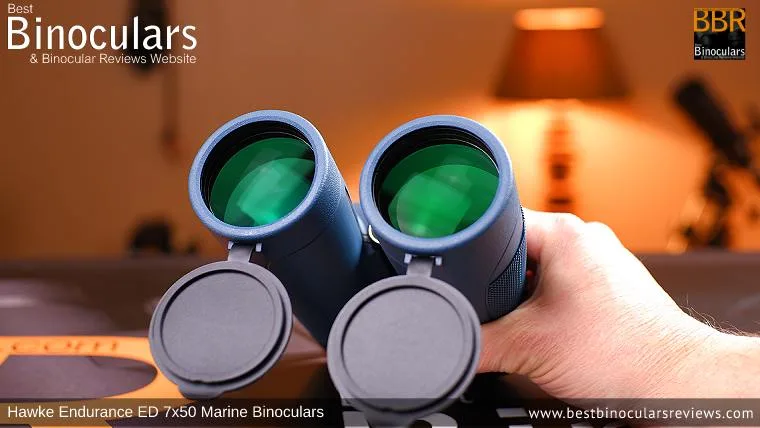
Image source: Bing (Web (fair-use with source credit))
What "Fully Multi-Coated" Actually Means (And Why It's Confusing)
Here's the simplest way to think about it. Every time light passes from air to glass inside a binocular, a small percentage bounces back. That lost light never reaches your eye.
It also scatters around inside the tube, creating haze and glare.
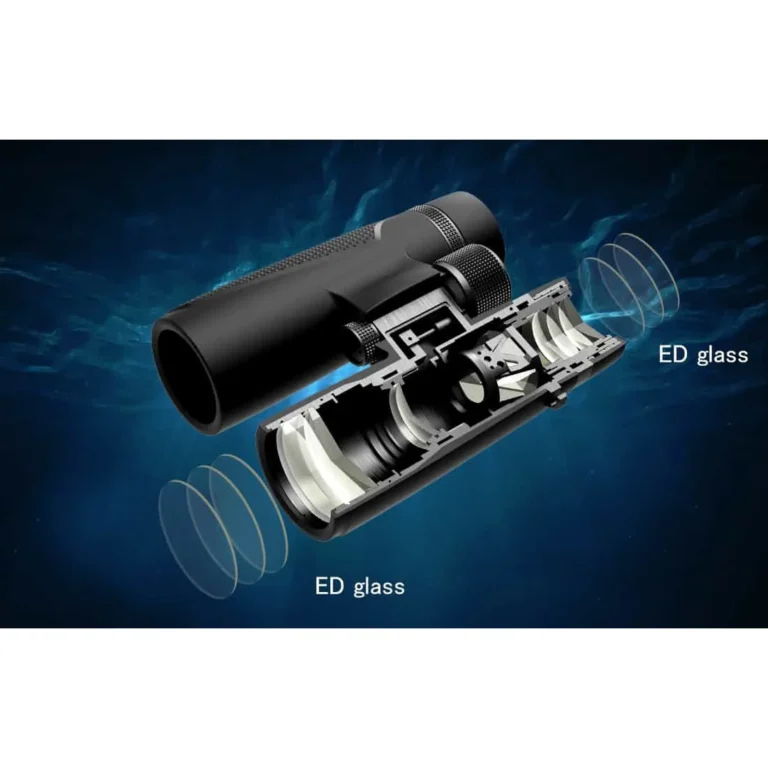
A coating is a microscopically thin layer of material applied to the glass surface. It works by canceling out reflected light waves through interference. The result is that more light passes through the glass instead of bouncing off it.
"Fully multi-coated" means every single lens and prism surface gets this treatment. Not just the front objective lens. Not just the eyepiece.
Every surface that air touches. In a roof prism binocular, that's typically 10 to 16 surfaces. Each one gets multiple layers of coating.
The "multi" part is important too. It means multiple layers, not just one. A single layer works well at one specific wavelength of light.
Multiple layers work across the entire visible spectrum. That's why fully multi-coated binoculars produce images that look natural and color-true, not tinted green or blue like older single-coated optics.
As of 2026, this is the standard coating level for any binocular worth buying. The confusing part is that manufacturers don't all use the same terminology. Some brands call their budget models "fully multi-coated" when the coating quality is poor.
Others use "multi-coated" to mean something different entirely. That's why you need to know the difference.
The real takeaway here is simple. Fully multi-coated is the baseline for decent optics. It's not a premium feature.
It's the minimum you should accept for any serious use.
The Marketing Trick: "Multi-Coated" vs. "Fully Multi-Coated"
This is where binocular companies get clever with language. If you're not paying close attention, you can easily buy the wrong product.
"Multi-coated" means some surfaces have multiple layers of coating. "Fully multi-coated" means all surfaces have multiple layers. The difference is just one word, but the performance gap is real.
Here's how manufacturers use this to their advantage. A pair of binoculars might have eight glass-air surfaces. The front lens and eyepiece get multi-coating.
The internal prisms get single coating or nothing at all. On the box, it says "multi-coated." That's technically true. But it's not the same as fully multi-coated.
The optical path matters here. Light passes through every surface in sequence. If even one surface is poorly coated, it becomes a bottleneck.
That single surface reflects light and reduces contrast. The image looks dimmer and hazier than it should.
Aggregate reviews of budget binoculars confirm this pattern. A pair labeled "multi-coated" often has coatings on the outside lenses only. The internal prisms are bare glass.
A pair labeled "fully multi-coated" treats every surface. The difference in low-light performance is immediately noticeable.
Some brands take this further. They use phrases like "fully multi-coated optics" on the packaging. But the fine print reveals that the coating only applies to the lenses, not the prisms.
That's still not a true fully multi-coated binocular.
The honest approach is to look for the exact phrase "fully multi-coated" in the specifications. Then check whether the prisms are also treated. For roof prism binoculars, you also need phase-correction coating on the prisms.
That's a separate issue, but it matters just as much.
How Fully Multi-Coated Compares to Every Other Coating Level
To understand where FMC fits, you need to see the whole coating hierarchy. Each level represents a step up in light transmission and image quality.
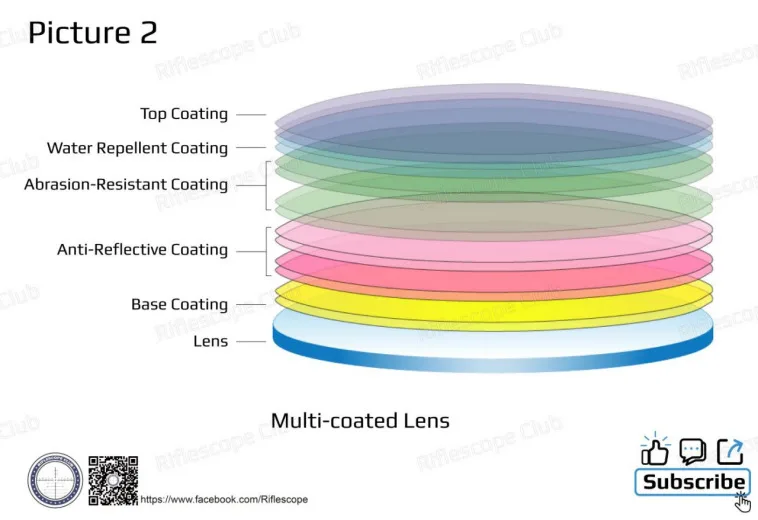
Image source: Bing (Web (fair-use with source credit))
Coated (single layer, some surfaces)
This is the bottom of the barrel. A single layer of anti-reflective coating applied to some surfaces, usually just the front lens. The rest of the glass is bare.
Light transmission sits around 70 to 75 percent. Images look dim, washed out, and slightly tinted.
Who is this for? Honestly, almost no one. You might find these on toy binoculars or emergency backup pairs.
For any real use, skip them.
Multi-Coated (multiple layers, some surfaces)
Multiple layers of coating on some surfaces, typically the front and rear lenses. The internal prisms often remain uncoated. Light transmission hits about 80 to 85 percent.
Image quality is decent in bright daylight but falls apart in low light.
This is where most budget binoculars sit. They look good in the store under bright fluorescent lights. Take them outside at dusk, and the limitations become obvious.
Fully Multi-Coated (multiple layers, all surfaces)
Multiple layers on every glass-air surface in the optical path. Light transmission reaches 85 to 92 percent. Colors look natural.
Contrast stays high. Glare and ghosting are dramatically reduced.
This is the baseline for any binocular used for birding, hunting, or astronomy. It's not a luxury upgrade. It's the standard that makes the optics actually work well.
What Phase-Correction and Dielectric Coatings Add
If you're looking at roof prism binoculars, FMC is only half the story. Roof prisms need phase-correction coating. Without it, the image loses contrast and sharpness.
Many budget roof prism binoculars have FMC on the lenses but lack phase-correction on the prisms. The result is a disappointing image.
Dielectric coatings are another step up. They go on the prism surfaces and reflect nearly 99 percent of light. Combined with FMC, they produce the brightest images available.
You'll find these on premium binoculars from companies like Nikon, Vortex, and Zeiss.
Silver prism coatings are a mid-range alternative. They reflect about 95 to 98 percent of light. That's still excellent, just not as good as dielectric.
What Else Matters: Glass Quality, Prisms, and Mechanical Build
Fully multi-coated is important. But it's not the only factor that determines image quality. You can have FMC on cheap glass and still get a mediocre view.
The glass itself matters. BK-7 glass is common in budget binoculars. It's adequate but produces a slightly soft image at the edges.
BaK-4 glass is higher quality. It transmits more light and produces sharper edges. Most mid-range and premium binoculars use BaK-4.
Prism type also affects performance. Porro prisms are the traditional design. They're optically simpler and more efficient.
Roof prisms are more compact and durable. But they need phase-correction coating to perform well.
The mechanical build matters too. A binocular with FMC on great glass is useless if the focus mechanism is loose or the alignment is off. Collimation errors cause double images and eye strain.
That's a common problem with cheap binoculars, even ones with FMC.
Waterproofing and fog-proofing are other considerations. Many fully multi-coated binoculars are also nitrogen-purged and O-ring sealed. That protects the coatings from moisture and internal fogging.
If you're using binoculars in wet conditions, that matters.
The point is simple. FMC is necessary but not sufficient. Look for the full package: FMC, BaK-4 glass, phase-correction for roof prisms, and solid mechanical construction.
A cheap pair with FMC and BK-7 glass will still disappoint you.
Who Actually Needs Fully Multi-Coated? (Real Use Cases)
Not everyone needs FMC. If you use binoculars once a year at a daytime sporting event, basic multi-coating might be fine. But for most serious applications, FMC makes a real difference.

Image source: Bing (Web (fair-use with source credit))
Birdwatchers and Wildlife Observers
Birding happens at dawn and dusk. That's when birds are most active. It's also when light is lowest.
FMC gives you the extra brightness you need to see field marks and feather details. Without it, you lose contrast and color accuracy.
Aggregate reviews from birding forums consistently rank FMC as a must-have feature. The difference between multi-coated and fully multi-coated is visible in the first few minutes of use at dawn.
Hunters in Low-Light Conditions
Hunters face the same challenge. Legal shooting hours often start before sunrise and end after sunset. Every bit of light matters.
FMC pushes light transmission past 85 percent. That translates to seeing game animals clearly when they're moving through shadows.
Hunters also benefit from reduced glare. FMC cuts veiling glare that can obscure details in backlit scenes. That's a real advantage when you're glassing into a low sun.
Astronomy and Stargazing
Astronomy is the most demanding use case. You're looking at faint objects against a dark background. Every photon counts.
FMC combined with large objective lenses and BaK-4 prisms gives you the best view of star clusters, nebulae, and planets.
For astronomy, FMC is non-negotiable. Single-coated or multi-coated binoculars will show dim stars as barely visible. FMC makes them pop.
Casual Daytime Users (Where You Can Save Money)
If you only use binoculars for daytime sports, sightseeing, or general outdoor observation, you can save money. Basic multi-coating performs well in bright light. The difference between MC and FMC is minimal when the sun is high.
But here's the catch. Most binoculars in the "good enough" category are only marginally cheaper than the entry-level FMC models. The price difference is often 20 to 30 dollars.
For that small amount, you get significantly better performance. It's usually worth the upgrade even for casual use.
When Fully Multi-Coated Isn't Worth the Extra Money
Here's the honest truth. Fully multi-coated binoculars cost more than their multi-coated counterparts. The price premium typically runs 20 to 50 percent.
For some users, that extra money is wasted.
You can skip FMC if you meet all three conditions. First, you only use binoculars in bright daylight. Second, you never glass at dawn or dusk.
Third, you're on a tight budget and the upgrade means sacrificing other features.
Let's look at a concrete example. A pair of 8×42 binoculars with multi-coating costs around $80. The same model with fully multi-coating costs $120.
The $40 difference buys you brighter images in low light. If you only use them at noon, you won't notice the difference.
The edge case worth knowing about is cheap FMC. Some sub-$80 binoculars advertise "fully multi-coated" optics. In our research, these often use poor quality glass that negates the coating advantage.
The coatings themselves may be thin or unevenly applied. You get the label without the performance.
Another scenario where FMC doesn't matter is with very small objective lenses. A compact 8×25 binocular with a 3.1mm exit pupil is already limited by its small aperture. FMC helps, but not enough to transform the experience.
The physics of light collection matters more than the coating.
If you're buying binoculars for a child or as a backup pair, save your money. Basic multi-coating is fine for casual use. Just be aware of the limitations.
The image will be dimmer and less contrasty in anything other than perfect light.
The smart approach is to allocate your budget wisely. If you have $150 to spend, a fully multi-coated 8×42 with BK-7 glass beats a multi-coated 8×42 with BaK-4 glass. The FMC gives you more real-world brightness.
The glass upgrade only matters once the coatings are good enough.
How to Verify if Your Binoculars Are Truly Fully Multi-Coated
Manufacturers know that FMC is a selling point. Some stretch the truth. Here's how to check if you're getting what you paid for.
The simplest test is the reflection test. Hold the binoculars under a bright light. Look at the reflection from the objective lens.
A single-coated lens reflects a distinct color, usually blue or amber. A multi-coated lens shows a weaker reflection with a green or purple tint. A fully multi-coated lens reflects almost nothing.
You see a faint green or amber glow.
Now look through the binoculars from the front. Shine a light into the eyepiece. Move your eye around.
If you see bright internal reflections or ghost images, the internal surfaces are not well coated. Good FMC dramatically reduces internal flare.
Check the manufacturer's specifications carefully. Look for the exact phrase "fully multi-coated" in the product description. If it says "multi-coated" without the word "fully," assume some surfaces are uncoated.
If it says "fully coated," that means single layer on all surfaces, not multi-layer.
For roof prism binoculars, check for phase-correction coating. This is often listed separately. A pair with FMC lenses but no phase-correction on the prisms will perform poorly.
The image will lack contrast and sharpness.
Read customer reviews from verified buyers. Look for comments about low-light performance and glare. If multiple users report dim images or haziness, the coatings are probably not as good as advertised.
The best verification is a side-by-side comparison. Take the binoculars to a store. Compare them to a known good pair from a reputable brand.
Look at the same scene in low light. The difference between genuine FMC and cheap coatings is immediately obvious.
Frequently Asked Questions About Binocular Coatings
Is fully multi-coated better than multi-coated?
Yes, but not by as much as you might think. Fully multi-coated covers every glass surface with multiple layers. Multi-coated covers only some surfaces.
The practical difference is most visible in low light. In bright daylight, the gap narrows.
Do I need fully multi-coated binoculars for birding?
Yes, if you bird at dawn or dusk. Most birding happens in low light. FMC gives you the brightness and contrast needed to see feather details and subtle color differences.
Many birders consider it the minimum acceptable standard.
What is the difference between FMC and phase-correction coating?
FMC applies to lens surfaces. Phase-correction coating applies to roof prism surfaces. They serve different purposes.
FMC boosts light transmission. Phase-correction fixes a polarization issue that reduces contrast. You need both for good roof prism binoculars.
Can I tell if binoculars are fully multi-coated by looking at them?
Partially. The reflection test gives you a clue. A well-coated lens shows a faint green or purple reflection.
A poorly coated lens shows a bright white or colored reflection. But you cannot verify internal surfaces without disassembly.
Are expensive binoculars always fully multi-coated?
Almost always. Any binocular costing over $200 will be fully multi-coated. The question is coating quality.
Premium brands like Swarovski and Zeiss use proprietary coatings with more layers and better durability. Budget FMC works, but it's not as good.
How long do anti-reflective coatings last?
With proper care, coatings last the lifetime of the binoculars. The main risk is physical damage. Cleaning with abrasive materials or harsh chemicals can scratch or peel the coating.
Use a microfiber cloth and lens cleaning solution designed for optics.
The Bottom Line: Your Decision Guide for Fully Multi-Coated Binoculars
Here's the simple framework for deciding what to buy. It comes down to three factors: your use case, your budget, and your willingness to compromise.
If you birdwatch, hunt, or stargaze, buy fully multi-coated binoculars. Period. The low-light performance is essential.
You will notice the difference every time you use them.
If you only use binoculars for daytime sports or sightseeing, consider multi-coated. You can save 20 to 40 percent. The image quality in bright light is adequate.
Just be aware of the limitations.
If you're on a tight budget, prioritize FMC over other features. A fully multi-coated 8×42 with BK-7 glass outperforms a multi-coated 8×42 with BaK-4 glass. The coating matters more than the glass grade in most real-world conditions.
If you're buying roof prism binoculars, also check for phase-correction coating. Without it, the image will be soft and hazy. FMC alone is not enough for roof prism designs.
If you're buying Porro prism binoculars, FMC is still important. But Porro prisms are optically simpler. They don't need phase-correction.
A fully multi-coated Porro prism binocular is a simpler, often cheaper path to great image quality.
The final recommendation is straightforward. Fully multi-coated is the standard for serious use. Don't let a few dollars keep you from getting the brightness and contrast you need.
Good optics make the experience better. Bad optics make you wish you'd stayed home.
Buy the best coatings you can afford. Your eyes will thank you.