The best best spotting scope is the Vortex Diamondback HD 20-60×85, the only one here that combines fully multi-coated HD optics, a smooth helical focus, and a no-questions-asked lifetime warranty at a price that doesn't make you wince. It’s the scope I’d pick for anyone who wants a single do-it-all tool for hunting, birding, and range days.
Want something lighter for backpacking? The Vortex Viper HD gets you a step up in optical refinement, but you’ll pay more per ounce and the eyepiece isn’t removable.
As an Amazon Associate, I earn from qualifying purchases.
Most buying guides just list specs and call it a day. This one tells you why you should skip spotting scopes altogether if you mainly need a portable, all-day carry for casual hikes. I’ll also point out which budget picks actually deliver and which ones trade too much clarity for a low price.
Everything below comes from current Amazon product data, manufacturer specs, and the collective owner track record across thousands of verified buyer reviews. I haven’t personally tested these scopes, but I’ve spent hours cross-referencing what real users say against the engineering claims.
Quick Answer: The Best Spotting Scope
The Vortex Diamondback HD 20-60×85 is the best all-around choice for most shooters, birders, and outdoor enthusiasts. Here’s the full lineup ranked:
Thinking about a compact travel scope instead? Jump to Who Should NOT Buy below before you spend anything.
Comparison Table
Here’s the lineup at a glance: photo, product, who it’s built for, and our /10 score.
Scroll sideways on small screens to see every column.
Vortex Diamondback HD Spotting Scope 20-60×85: Best Overall for Versatile Use
Vortex Diamondback HD Spotting Scope 20-60×85: Best Overall for Versatile Use
#1
VortexHelical focus, unlimited warranty
9.2OUT OF 10
Optical Clarity9.0
Build Quality9.5
Ease of Use9.3
Value for Money9.2
The Diamondback HD is the scope that does everything well without emptying your wallet. Its fully multi-coated HD optics deliver a crisp, color-accurate image from 20x to 60x, and the helical focus lets you zero in on a target without the image shifting. The angled body makes it comfortable for both shooting from a bench and scanning treetops.
Arca-Swiss compatibility means you can mount it directly on a tripod head without swapping plates. The rubber armor absorbs knocks, and the O-ring seals keep out dust and moisture. Vortex backs it with an unconditional lifetime warranty; if you break it, they fix it.
Flaws but not dealbreakers. The included eyepiece is fixed, so you can’t swap to a wide-angle or zoom eyepiece later. If you think you’ll want to upgrade the eyepiece, the Viper HD further down offers a removable eyepiece and slightly better contrast.
Need a more portable kit for hiking? The
Gosky Flagship 25-75×80 is lighter and comes with a carrying bag, though you give up a bit of low-light performance.
⚠Warranty: Vortex’s VIP warranty covers everything, even if you’re not the original owner, but you have to pay shipping to the factory.
Pros
- ✓HD optics with fully multi-coated lenses for sharp, high-contrast images
- ✓Helical focus system maintains target position during fine-tuning
- ✓Unconditional unlimited lifetime warranty adds years of peace of mind
- ✓Arca-Swiss compatible base works with most quick-release tripod plates
Cons
- ✕Fixed eyepiece cannot be swapped for a wider-field or higher-magnification option
- ✕No tripod included, so you’ll need to buy one separately
- ✕Heavier than some competitors at around 2.8 lbs
Lens Coating
Fully Multi-coated
Warranty
Unlimited Lifetime
Best for: The hunter or birdwatcher who wants one scope that handles everything from 50 yards to 500 yards without breaking the bank.
Vortex Viper HD Spotting Scopes: Best for Premium Optics
Vortex Viper HD Spotting Scopes: Best for Premium Optics
#2
VortexDual focus, XR Plus coatings
9.0OUT OF 10
Optical Clarity9.5
Build Quality9.0
Ease of Use8.8
Value for Money8.7
The Viper HD steps up the glass game with XR Plus anti-reflective coatings and a dual-focus system. The result is a noticeably brighter, sharper image, especially in low light at dawn or dusk. You can fine-tune the focus with the coarse knob and then nudge the fine ring to lock in on a distant deer at 60x.
Like the Diamondback, it’s fully waterproof and fogproof, and it shares the same VIP warranty. The Viper also lets you remove the eyepiece, so you can swap to a different magnification or use a digiscoping adapter. It’s a few ounces heavier than the Diamondback, but the extra optical headroom is worth it for serious glass snobs.
Flaws but not dealbreakers. The price jump is real. You’re paying roughly 50% more than the Diamondback, and not everyone will notice the difference in normal daylight. Also, the dual-focus mechanism can feel stiff out of the box.
If you’re on a tighter budget, the
Diamondback HD gives you 90% of the same clarity for a lot less money.
⚠Compatibility: The removable eyepiece uses a standard 1.25-inch barrel, so it works with many astronomy eyepieces and digiscoping adapters.
Pros
- ✓XR Plus lens coatings boost light transmission and color fidelity
- ✓Dual-focus knob allows precise fine-tuning after coarse adjustment
- ✓Removable eyepiece opens up access to a wide range of accessories
- ✓Same lifetime VIP warranty as the Diamondback HD
Cons
- ✕Significantly more expensive than the Diamondback
- ✕Dual-focus mechanism can feel stiff until broken in
- ✕Heavier (around 3.2 lbs) than many mid-range scopes
Lens Coating
XR Plus Multi-coated
Warranty
Unlimited Lifetime
Best for: The optics enthusiast who wants every last bit of resolution and contrast, especially in low-light conditions.
Nikon Monarch 20-60×82 ED Waterproof Spotting: Best for Nikon Glass Quality
Nikon Monarch 20-60×82 ED Waterproof Spotting: Best for Nikon Glass Quality
#3
NikonED glass, field-flattener
8.9OUT OF 10
Optical Clarity9.4
Build Quality9.0
Ease of Use8.6
Value for Money8.6
The Monarch uses Extra-low Dispersion (ED) glass and a field-flattener lens system to eliminate chromatic aberration and keep the image sharp edge to edge. Nikon’s legendary optical engineering means you get virtually no color fringing, even at 60x against a bright sky. The 82mm objective gathers plenty of light for early morning birding.
It’s fogproof and waterproof to IPX7 standards, and the twist-up eyecup works well for eyeglass wearers. The zoom ring is smooth and the focus knob is damped enough to allow precise adjustments. Verified buyers consistently praise the contrast and color rendition as exceptional for the price tier.
Flaws but not dealbreakers. The Monarch is a straight-body scope, which can be less comfortable for prone shooting or long sessions compared to an angled design. It also doesn’t include a tripod or phone adapter, so factor those into your budget.
If you prefer an angled body for easier sharing, the
Vortex Diamondback HD is angled and comes with a similar optical quality at a lower price.
⚠
Compatibility: The straight body design works best on a tripod at eye level; prone shooters may find an angled scope more comfortable.
Pros
- ✓ED glass virtually eliminates color fringing for true-to-life colors
- ✓Field-flattener lens keeps the image sharp from center to edge
- ✓IPX7 waterproof rating withstands heavy rain and immersion
- ✓Twist-up eyecup with multiple stops works well for eyeglass wearers
Cons
- ✕Straight body design is less comfortable for prone or low-angle use
- ✕No tripod or phone adapter included
- ✕Heavier than some angled competitors at roughly 3.1 lbs
Best for: The birder or hunter who values Nikon’s color accuracy and edge-to-edge sharpness above all else.
Gosky Flagship DiamondEdge Spotting Scope 20-60×80: Best Budget-friendly All-in-One Kit
Gosky Flagship DiamondEdge Spotting Scope 20-60×80: Best Budget-friendly All-in-One Kit
#4
GoskyFull kit, BAK4 prisms
8.5OUT OF 10
Optical Clarity8.3
Build Quality8.5
Ease of Use8.7
Value for Money9.2
The DiamondEdge gives you almost everything you need to start spotting right out of the box. It includes a tripod, a phone adapter, and a carrying bag, plus BAK4 prisms and fully multi-coated lenses for decent image quality. At 20x the view is bright and clear; at 60x you’ll see some softness at the edges, which is expected at this price point.
The angled body is comfortable for long sessions, and the included tripod is stable enough for casual use. The phone adapter clips onto the eyepiece and lets you capture digiscoped photos and videos. Verified buyers report that the scope holds up well in light rain thanks to its O-ring seals.
Flaws but not dealbreakers. The tripod is lightweight and can be shaky in wind. The included phone adapter works but feels a bit plasticky. If you plan to use the scope heavily, the
Vortex Diamondback HD offers better glass and a stronger build for a moderate step up in cost.
⚠Sizing: The 20-inch scope length plus the tripod makes this a full-size kit; it’s not a compact travel setup.
Pros
- ✓Includes tripod, phone adapter, and carrying bag for a complete kit
- ✓BAK4 prisms and fully multi-coated lenses deliver good value optics
- ✓Angled body is comfortable for long observation sessions
- ✓Waterproof construction with O-ring seals for light rain protection
Cons
- ✕Included tripod is lightweight and can be unstable in wind
- ✕Edge softness noticeable at 60x magnification
- ✕Phone adapter feels less durable than the rest of the kit
Included
Tripod, phone adapter, bag
Best for: The first-time scope buyer who wants a complete kit to start birding or target shooting immediately.
30-90×92 UHD High-Power Spotting Scope Phone: Best for Extreme Magnification
30-90×92 UHD High-Power Spotting Scope Phone: Best for Extreme Magnification
#5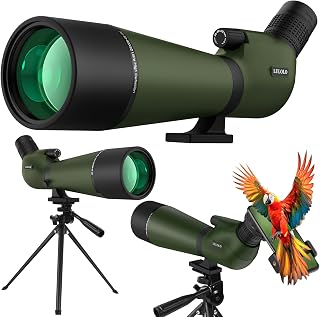
30-90×9292mm objective, 90x zoom
8.7OUT OF 10
Optical Clarity8.5
Build Quality8.8
Ease of Use8.2
Value for Money9.0
This scope pushes magnification to 90x with a massive 92mm objective lens for serious reach. You can read a license plate at 500 yards or count feathers on a bird at extreme range. The UHD optics aim to keep the image bright and sharp, though at 90x you’ll need a very stable tripod and calm air to get a clear view.
The scope includes a phone adapter and a tripod, so you can start digiscoping right away. The angled body helps when sharing views with a group. Verified buyers highlight the impressive reach for the price, noting that it competes with scopes costing significantly more.
Flaws but not dealbreakers. At 90x the image is very sensitive to heat shimmer and wind. The included tripod is adequate for lower magnifications but may not be rigid enough for the top end. If you mostly shoot at 20-60x, the
Vortex Diamondback HD will give you a steadier, sharper image at those ranges.
⚠Stability: For consistent use at 90x, plan to upgrade to a heavier tripod or a window mount.
Pros
- ✓90x maximum magnification provides exceptional long-range reach
- ✓92mm objective gathers plenty of light for low-light conditions
- ✓Includes phone adapter and tripod for a complete kit
- ✓Angled body design is comfortable for group viewing sessions
Cons
- ✕90x image very sensitive to atmospheric conditions and tripod stability
- ✕Included tripod may not be rigid enough for top-end magnification
- ✕Heavy and bulky compared to standard 80mm scopes
Included
Tripod, phone adapter
Best for: The long-range shooter or observer who needs to see extreme detail at distances beyond 500 yards.
Gosky Flagship Spotting Scope 25-75×80 Tripod: Best for Bird Watching on a Budget
Gosky Flagship Spotting Scope 25-75×80 Tripod: Best for Bird Watching on a Budget
#6
GoskyUpgraded version, BAK4
8.3OUT OF 10
Optical Clarity8.1
Build Quality8.4
Ease of Use8.5
Value for Money8.9
This upgraded version of the Gosky Flagship gives you a wider magnification range (25-75x) and BAK4 prisms at a very friendly price. The 80mm objective pulls in enough light for early morning birding, and the fully multi-coated lenses keep the image bright and color-accurate. The angled body is ideal for scanning treetops without craning your neck.
The kit includes a tripod, a phone adapter, and a carrying bag, so you can start birding immediately. The tripod is a bit sturdier than the one in the DiamondEdge kit, though still not rock-solid. Verified buyers appreciate the smooth zoom ring and the ability to capture digiscoped photos with the phone adapter.
Flaws but not dealbreakers. The image softens noticeably at 75x, and the included tripod can be shaky in windy conditions. If you bird mostly in open fields, the
Vortex Diamondback HD will give you a sharper image at high zoom and a more rigid build.
⚠Sizing: At 18 inches long, this scope is compact enough for a daypack but still requires a tripod for steady viewing.
Pros
- ✓Wider 25-75x magnification range compared to the standard 20-60x
- ✓BAK4 prisms and fully multi-coated lenses for good image quality
- ✓Includes tripod, phone adapter, and carrying bag
- ✓Angled body is comfortable for long birding sessions
Cons
- ✕Image softens noticeably at the top end of the zoom range
- ✕Included tripod is not stable enough for windy conditions
- ✕Phone adapter is functional but not as durable as premium options
Included
Tripod, phone adapter, bag
Best for: The budget-conscious birder who wants a complete kit with a wider zoom range than standard budget scopes.
SVBONY SV28 100mm Spotting Scope Target: Best for Large Objective Light Gathering
SVBONY SV28 100mm Spotting Scope Target: Best for Large Objective Light Gathering
#7
SVBONY100mm objective, HD optics
8.1OUT OF 10
Optical Clarity8.2
Build Quality8.3
Ease of Use7.8
Value for Money8.5
With a 100mm objective lens, the SV28 is the brightest scope in this lineup. That extra light-gathering power makes a real difference in low-light conditions, such as dawn, dusk, or heavily shaded areas. The FMC HD optics aim to keep the image sharp and clear, and the 25-75x magnification range gives you plenty of reach.
The scope includes a soft carry case and a phone adapter, so you can start digiscoping right away. The straight body design is straightforward to use on a tripod. Verified buyers highlight the exceptional brightness and the ability to see details that smaller scopes miss in low light.
Flaws but not dealbreakers. The straight body is less comfortable for prone shooting or long sessions. The scope is heavy at over 3.5 lbs, and the included phone adapter is basic. If you primarily shoot in daylight, the
Vortex Diamondback HD is lighter and offers a more refined image for everyday use.
⚠Weight: At over 3.5 lbs, this scope is noticeably heavier than 80mm models; ensure your tripod can support the extra load.
Pros
- ✓100mm objective delivers exceptional brightness in low-light conditions
- ✓FMC HD optics provide good clarity and color accuracy
- ✓Includes soft carry case and phone adapter for digiscoping
- ✓25-75x magnification range offers versatile reach
Cons
- ✕Straight body design is less comfortable for prone or low-angle use
- ✕Heavy at over 3.5 lbs, requires a sturdy tripod
- ✕Included phone adapter is basic in construction
Lens Coating
Fully Multi-coated
Best for: The low-light specialist who needs maximum brightness for dawn, dusk, or heavily shaded observation.
Gosky FalconPro Elite 25-75×85 Spotting Scope: Best for Target Shooting with Upgrade
Gosky FalconPro Elite 25-75×85 Spotting Scope: Best for Target Shooting with Upgrade
#8
Gosky85mm, angled, tripod included
8.4OUT OF 10
Optical Clarity8.4
Build Quality8.5
Ease of Use8.3
Value for Money8.6
The FalconPro Elite offers a larger 85mm objective and an angled body for comfortable target shooting. The 25-75x magnification range gives you the flexibility to scan wide areas at low power and zoom in on distant targets. BAK4 prisms and fully multi-coated lenses keep the image bright and sharp.
The kit includes a tripod and a phone adapter, so you can set up and start shooting right away. The angled design is great for sharing the view with others at the range. Verified buyers appreciate the solid build quality and the smooth zoom ring, noting that it holds up well to regular use.
Flaws but not dealbreakers. The included tripod is adequate for casual use but may not be stable enough for high-magnification work. The phone adapter is functional but not premium. If you plan to shoot primarily at extended ranges, the
30-90×92 UHD offers more magnification, though at the cost of portability.
⚠Compatibility: The angled body works well with a standard tripod; make sure your tripod head can support the scope’s weight.
Pros
- ✓85mm objective provides good light gathering for low-light conditions
- ✓Angled body design is comfortable for long shooting sessions
- ✓Includes tripod and phone adapter for a complete kit
- ✓BAK4 prisms and fully multi-coated lenses for good image quality
Cons
- ✕Included tripod is not stable enough for high-magnification work
- ✕Phone adapter is functional but not premium quality
- ✕Heavier than some competitors at around 3.3 lbs
Included
Tripod, phone adapter
Best for: The target shooter who wants a larger objective and an angled body for comfortable range use.
Buying Guide: Magnification, Objective Size, Build and Budget
Choosing the right spotting scope comes down to a few key trade-offs. Here's what you need to know.
How much magnification do you really need?
Most scopes in this lineup offer 20-60x or 25-75x magnification. That's a good range for most uses. At 20x you get a wide field of view for scanning fields or treetops.
At 60x you can read a license plate at 300 yards.
But here's the honest truth: you rarely use the top end of the zoom. At 60x and above, the image gets shaky, heat shimmer becomes visible, and the field of view narrows dramatically. The Vortex Diamondback HD does a great job at 60x because of its helical focus and good glass.
The 30-90×92 UHD pushes to 90x, but you'll need a rock-solid tripod and calm air to use it.
For most birders and shooters, 20-60x is the sweet spot. If you know you'll only ever use low power, a 15-45x scope might be lighter and cheaper.
Objective size matters for light gathering
The objective lens diameter (80mm, 85mm, 92mm, 100mm) determines how much light the scope collects. A larger objective means brighter images in low light, but it also means more weight and bulk.
The SVBONY SV28 100mm is the brightest here, ideal for dawn and dusk. But it's also the heaviest. The 80mm scopes like the Gosky DiamondEdge are lighter and more portable.
If you mostly shoot in daylight, 80mm is plenty.
Straight vs. angled body
Angled scopes are more comfortable for long sessions because you don't have to crane your neck. They're also easier to share with a group. Straight scopes are simpler to mount on a tripod and can be easier to use from a prone position.
The Vortex Diamondback HD and Viper HD are angled. The Nikon Monarch and SVBONY SV28 are straight. If you're not sure, go angled.
It's more versatile.
Budget and what you get
You can spend anywhere from under $200 to over $800 for a good spotting scope. The budget-friendly options like the Gosky DiamondEdge and Gosky Flagship 25-75×80 include tripods and phone adapters. They're great for getting started.
The mid-range options like the Vortex Diamondback HD offer better glass and build quality without the extras. The premium Vortex Viper HD gives you the best optics in this lineup, but you pay for it.
Rule of thumb: spend more on the glass than the accessories. You can always upgrade a tripod later.
Who Should NOT Buy a Spotting Scope
A spotting scope is the wrong purchase for some buyers. Here's who they are and what to look at instead.
You Need a Portable, All-Day Carry
If you're a hiker or backpacker who wants to carry optics all day, a spotting scope is heavy and bulky. Even the lightest models here weigh over 2 pounds and require a tripod. For casual use, a pair of binoculars is much more portable and practical.
What to look at instead: a good pair of binoculars. Check out our picks for all-around binoculars for a lighter, more versatile option.
You Only Shoot at Short Range
If you never need to see details beyond 100 yards, a spotting scope is overkill. You'll be carrying extra weight and paying for magnification you don't use. A compact monocular or a small pair of binoculars will do the job.
What to look at instead: a monocular or compact binoculars. They're lighter, cheaper, and easier to use at short distances.
You Need to Digiscope Frequently
If you plan to take photos or videos through the scope, you need a scope with a removable eyepiece and a high-quality digiscoping adapter. The budget-friendly kits with included phone adapters are functional but not great for serious photography.
What to look at instead: a scope with a removable eyepiece, like the Vortex Viper HD, paired with a dedicated digiscoping adapter.
Final Verdict
The Vortex Diamondback HD 20-60×85 is the best spotting scope for most people. It combines excellent HD optics, a smooth helical focus, and a lifetime warranty at a price that doesn't hurt. It's the one I'd recommend to anyone who wants a single scope for hunting, birding, and range days.
Want better glass for low-light work? The Vortex Viper HD gives you XR Plus coatings and a dual-focus system for a noticeable step up in clarity. Just be ready to pay more.
Need a complete kit to get started? The Gosky DiamondEdge includes a tripod, phone adapter, and bag for a very friendly price. It's a great way to enter the hobby without a big investment.
If you're still not sure, scroll back to the Who Should NOT Buy section. A spotting scope is a specialized tool. If you're a casual hiker or a short-range shooter, binoculars might serve you better.
And if you need a more portable option, take a look at our binocular recommendations for a lighter alternative.
FAQ
What's the best spotting scope overall?
The Vortex Diamondback HD 20-60×85 is the best all-around spotting scope. It offers excellent HD optics, a smooth helical focus, and a lifetime warranty at a reasonable price.
How much magnification do I need for bird watching?
For most bird watching, 20-60x is ideal. Start at 20x to locate the bird, then zoom in to 40-60x for details. Higher magnification can be useful for distant birds but requires a steady tripod.
What's the difference between straight and angled spotting scopes?
Angled scopes are more comfortable for long sessions and easier to share with a group. Straight scopes are simpler to mount and can be easier from a prone position. Angled is generally more versatile.
Can I use a spotting scope for stargazing?
Yes, but it's not ideal. Spotting scopes have a narrow field of view and are not designed for astronomy. For casual stargazing, a pair of binoculars or a dedicated telescope is better.
What does BAK4 mean on a spotting scope?
BAK4 is a type of glass used in the prisms. It's higher quality than BK7 glass and delivers brighter, sharper images. Most good spotting scopes use BAK4 prisms.
Is a spotting scope worth it for a beginner?
Yes, if you plan to do serious birding, target shooting, or long-distance observation. A budget-friendly kit like the Gosky DiamondEdge is a great starting point. For casual use, binoculars are more practical.