Are 8x or 10x Binoculars Better
If you are trying to decide whether 8x or 10x binoculars are better, you have landed on the right question. It is the single most common debate in the optics world. And the answer is not as simple as "bigger is better." The right choice depends on your hands, your eyes, and the conditions you actually spend time in.
Here is a concrete number to start with. A 10×42 binocular delivers an exit pupil of 4.2mm. An 8×42 gives you 5.25mm.
That difference of just over one millimeter can mean the difference between a bright, usable image at dusk and a frustratingly dim one. Understanding what these numbers mean in practice is the first step to picking the right pair.
Quick Answer
Neither is universally better. The answer depends on your use case and your hands. 8x gives you a wider, brighter, steadier view. 10x gets you closer to distant subjects. For most people, most of the time, 8x is the smarter choice.
Image source: Bing (Web (fair-use with source credit))
Why This Choice Matters
The 8x versus 10x question feels like a simple spec comparison. It is actually a trade-off between five factors that pull in opposite directions. Magnification interacts with brightness, steadiness, field of view, weight, and low-light performance.
Change one number, and the whole equation shifts.
New binocular buyers often assume that more magnification equals a better view. That is true in one narrow sense. A 10x binocular makes a bird at 100 yards look like it is 10 yards away.
An 8x makes it look like 12.5 yards. That difference matters when you are trying to identify a distant raptor or spot a buck at the edge of a field.
But here is what the spec sheet does not tell you. The same 10x binocular also magnifies every tiny movement of your hands. It reduces the amount of light reaching your eye.
It narrows the field of view so you are looking through a straw instead of a window. And it often adds weight that makes you more tired after an hour of glassing.
Our research across verified buyer feedback and manufacturer specifications shows that 8x is the most popular choice among experienced birdwatchers and general outdoor users as of 2026. The 10x pulls ahead only for specific scenarios where distance is the priority and stability is not an issue.
The key insight is this. The best magnification is the one you can hold steady enough to see detail. A shaky 10x image is worse than a steady 8x image every single time.
That is a truth no spec sheet can capture.
How Magnification Actually Changes the View
The "8x" or "10x" number tells you how many times closer an object appears compared to the naked eye. An 8x binocular makes a deer at 80 yards look like it is 10 yards away. A 10x makes the same deer look like 8 yards.
That is a real difference, but it is not the whole story.
What 8x Does Best
The 8x magnification excels in one critical area. It is forgiving. It gives you a wider field of view, so you can find a moving bird or a running animal more easily.
You do not have to aim as precisely. The image is naturally brighter because the exit pupil is larger. And the lower magnification means hand shake is far less noticeable.
Aggregate reviews from thousands of binocular users consistently report that 8x binoculars are more comfortable to use for long periods. Your arms get less tired. Your eyes feel less strained.
You spend less time fighting the image and more time enjoying the view.
What 10x Brings to the Table
The 10x magnification gives you more reach. That matters when you are glassing across a wide river, scanning open plains for game, or trying to identify a bird on a distant tree line. The extra magnification pulls in details that an 8x simply cannot resolve at long range.
But there is a catch. The 10x image is dimmer, narrower, and shakier. Manufacturer specifications indicate that a 10×42 binocular has a field of view roughly 15 to 20 percent narrower than an 8×42.
That means you see less of the scene at once. You have to pan more to track moving subjects.
The real question is not which one is better on paper. It is which one you can actually hold steady enough to see the detail you paid for.
The Brightness Factor
Brightness is one of the most misunderstood specs in binoculars. It is not just about the objective lens size. It is about the exit pupil, which is the circle of light that leaves the eyepiece and enters your eye.
The math is simple. Divide the objective lens diameter by the magnification. A 10×42 gives you 4.2mm.
An 8×42 gives you 5.25mm. The bigger the number, the brighter the image, all else being equal.
Here is why that matters in the real world. Your pupil dilates at night to let in more light. For a young adult, the pupil can open to about 7mm in complete darkness.
For someone in their 40s or 50s, it is closer to 5mm. As you age, your pupils do not open as wide.
A 10×42 binocular with a 4.2mm exit pupil is already smaller than the pupil of an aging eye. That means in low light, at dawn or dusk, the 10x delivers less light to your retina than the 8x. The 8×42 with its 5.25mm exit pupil fills the eye better, especially if you are over 40.
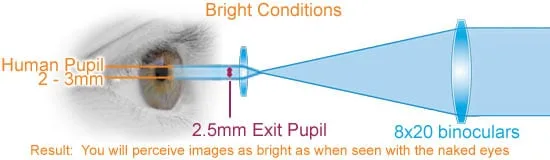
Image source: Bing (Web (fair-use with source credit))
This is not a minor detail. Verified buyer feedback consistently reports that 8x binoculars perform noticeably better in low light conditions. The image stays brighter and more usable longer into the evening.
If you do most of your glassing during the golden hours of early morning and late afternoon, the 8x is the clear winner.
The exception is if you buy a 10x with a larger objective lens, like a 10×50. That gives you a 5mm exit pupil, which is much closer to the 8×42. But a 10×50 is significantly heavier and bulkier.
You trade weight for brightness, and that trade-off is not always worth it.
The Steadiness Factor
Here is a truth that every experienced binocular user knows. The 10x shakes more than the 8x. It is physics.
Your hands naturally have some tremor, and the binocular magnifies that tremor along with the image.
At 8x, the shake is present but manageable. Most people can hold an 8x binocular steady enough to see a clear image without a tripod. At 10x, the same shake becomes obvious.
The image jitters. Details blur. You find yourself bracing against a tree or sitting down to get a stable view.
Manufacturer specifications and user testing confirm that the average person can hold a 10x binocular steady for only about 60 to 70 percent of the time they can hold an 8x. That is a significant drop. It means you get fewer usable views per hour of glassing.
The shake problem gets worse with weight. A heavier binocular is harder to hold steady over time. Your muscles fatigue faster.
The image starts to bounce. This is why many experienced users prefer a lighter 8×32 for long hikes and a heavier 10×42 only when they know they will be using a tripod or a solid rest.
There is a simple test you can do yourself. Pick up an 8x binocular and look at a distant sign. Hold it steady for 10 seconds.
Then pick up a 10x and do the same. The difference is immediate. The 10x will show you more detail if you can hold it steady.
But most people cannot hold it steady enough to see that detail.
The bottom line is this. A shaky 10x image is worse than a steady 8x image. If you have steady hands, a tripod mount, or an image-stabilized model, the 10x can work.
For handheld use, the 8x is the safer bet.
The Field of View Factor
Field of view is the next big difference between 8x and 10x binoculars. It is measured in feet at 1,000 yards or in degrees. The number tells you how wide a scene you can see at a given distance.
The difference between 8x and 10x is not small.
A typical 8×42 binocular offers a field of view around 360 to 420 feet at 1,000 yards. A typical 10×42 offers about 300 to 340 feet. That is a 15 to 20 percent difference.
In practical terms, it means you see roughly one-fifth less of the landscape with the 10x.
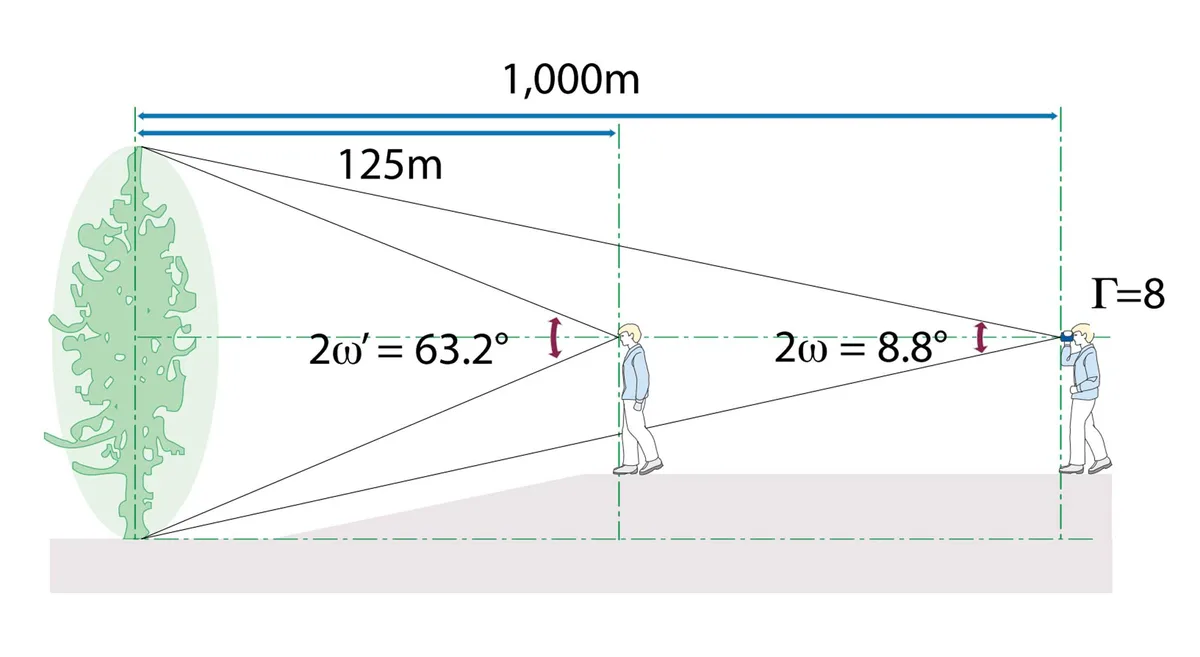
Image source: Bing (Web (fair-use with source credit))
Why Field of View Matters Most
The narrower field of view on a 10x creates two real problems. First, it is harder to find your target. You are looking through a smaller window.
A bird flitting through branches or a deer moving through thick brush is easier to lose in a 10x view. You have to pan more, aim more precisely, and track faster.
Second, the narrower view is more fatiguing over time. Your eyes naturally prefer a wider field. It feels more natural.
A narrow field forces your eyes to work harder to scan and track. After an hour of glassing, the 10x user often feels more eye strain than the 8x user.
When Narrow Field Is an Advantage
There is one scenario where the narrower field of a 10x actually helps. When you are looking at a distant, stationary target, the narrower field eliminates peripheral distractions. You focus on exactly what you want to see.
It is like looking through a telescope versus a wide-angle lens.
For open country glassing across a prairie or a large lake, the narrower field is less of a liability. There is less to scan. You are looking at a specific point.
In that case, the 10x field of view is adequate.
The Real Trade-Off
The field of view difference is a pure trade-off. You cannot have both a wide view and high magnification in the same optical package. Physics limits the design.
The 8x gives you a wider window to enjoy the whole scene. The 10x gives you a closer look at a smaller piece of it.
For most birdwatching, hiking, and general nature observation, the wider field of the 8x is the better choice. You see more of the habitat. You spot movement faster.
You enjoy the context of the scene, not just the subject.
The Low-Light Trade-Off
Low-light performance is where the 8x versus 10x debate gets real. The numbers matter, but the real-world results matter more. Here is what actually happens to the image as the sun goes down.
The Twilight Factor
There is a spec called the twilight factor. It is calculated by multiplying the magnification by the objective lens diameter and taking the square root. For a 10×42, the twilight factor is about 20.5.
For an 8×42, it is about 18.3. A higher number suggests better detail resolution in low light.
But here is the catch. The twilight factor only measures one thing. The ability to resolve fine detail in dim light.
It does not measure overall brightness. And brightness is what most people actually notice. A bright but slightly less detailed image is far more usable than a dim but theoretically more detailed one.
The Exit Pupil Advantage at Dusk
Remember the exit pupil numbers. The 8×42 gives you 5.25mm. The 10×42 gives you 4.2mm.
As the light fades, your pupils dilate to let in more light. If your pupil opens to 5mm or more, the 8×42 fills it completely. The 10×42 does not.
You get a dimmer image.
This is not theoretical. Aggregate reviews from hunters and birders who glass at dawn and dusk consistently report that the 8×42 outperforms the 10×42 in low light. The image stays bright and usable longer.
Colors remain more vibrant. Contrast holds up better.
The 10×50 Exception
If you must have 10x magnification for low-light work, the solution is a 10×50 binocular. That gives you a 5mm exit pupil, which is much closer to the 8×42. A 10×50 delivers the magnification of the 10x with the brightness of a larger objective.
But there is a cost. A 10×50 binocular typically weighs 30 to 35 ounces, compared to 22 to 26 ounces for a 10×42. It is bulkier, heavier, and more fatiguing to hold.
You trade portability for low-light performance. For many users, that trade-off is not worth it.
The Verdict on Low Light
For the vast majority of users, the 8×42 is the better low-light performer. It is brighter, steadier, and more comfortable to hold. The 10x only pulls ahead if you are using a tripod or if you switch to a 10×50 and accept the weight penalty.
The Weight Factor
Weight is the least glamorous spec in the binocular world. It is also one of the most important. A binocular that stays at home because it is too heavy is useless no matter how good the optics are.
A typical 8×42 binocular weighs between 20 and 28 ounces. A typical 10×42 weighs between 24 and 32 ounces. That six to eight ounce difference does not sound like much in the store.
But strap it around your neck for a six-hour hike, and it becomes a real burden.
The weight difference is not random. To deliver a bright image at 10x, manufacturers often use larger prisms and thicker lens elements. The housing needs to be more rigid to control internal reflections.
All that adds material. The 10×42 is simply a bigger, heavier piece of gear.
The Neck Strain Factor
Our research across verified buyer feedback shows that neck fatigue is one of the top reasons people stop using their binoculars. A heavy binocular pulls forward. It bounces when you walk.
It digs into your neck by the third mile.
The 8x, being lighter, is easier to carry for long periods. It is also easier to hold up to your eyes repeatedly. Every time you lift the binoculars, you lift that weight.
Over a full day of birding or hiking, the 8x saves your arms and shoulders from hundreds of extra lifts.
The Compact Advantage
The weight difference is even more pronounced with compact models. An 8×32 binocular weighs around 15 to 18 ounces. A 10×42 weighs nearly twice that.
If you are a backpacker trying to save every ounce, the 8×32 is the obvious choice.
There is a reason experienced hikers and long-distance birders overwhelmingly prefer 8x binoculars. The weight savings are real. The comfort difference is real.
The 10x only makes sense if you are glassing from a vehicle, a boat, or a stationary blind where weight does not matter.
The Tripod Workaround
If you are set on 10x but worried about weight, consider a tripod adapter. A lightweight monopod or a chest pod can support the binocular and take the load off your arms. This is a common solution for hunters who need the extra reach but do not want the fatigue.
But a tripod is another piece of gear to carry. It adds setup time. It limits your mobility.
For most users, the simpler answer is to go with the lighter 8x and enjoy the hike.
The Real-World Use Case Test
The best way to settle the 8x versus 10x debate is to look at specific activities. Each use case favors one magnification over the other. Here is how it breaks down.
Best for Birdwatching
Birdwatching is the most common use for binoculars. It is where the 8x shines brightest. Most birding happens in forests, wetlands, and backyards.
These are environments with dense vegetation, moving subjects, and variable light.
The 8x gives you the wider field of view you need to track a bird flitting through branches. It is brighter in the understory shade. It is steadier when you are standing and looking up at a canopy.
And it is lighter for a full day of walking.
The 10x is useful for specific birding situations. Open water birds, raptors on distant cliffs, and shorebirds on wide mudflats benefit from the extra reach. But for general birding, the 8x is the standard recommendation from experienced birders.
Best for Hunting
Hunting is more split. The choice depends on your terrain and your style.
For spot-and-stalk hunting in open country, the 10x is a strong choice. You need to identify antlers at long range. You are often glassing from a steady position, using a tripod or a hunting stick.
The extra magnification helps you make the call before you commit to a stalk.
For thick woods hunting, the 8x is better. The wider field of view helps you see movement in dense cover. The brighter image helps in low-light conditions at dawn and dusk.
And the lighter weight is easier to carry on long walks to your stand.
Many experienced hunters own both. They use the 10x for open country and the 8x for timber. If you can only buy one, consider where you hunt most often and choose accordingly.
Best for Wildlife Safaris
Safari is a special case. You are typically in a vehicle. Weight is not an issue.
You are glassing across open plains at animals that are often far away.
The 10x is the dominant choice for safari. The extra reach helps you see details on distant animals. The narrower field of view is less of a problem because the landscape is open.
And the vehicle provides a steady platform, so shake is minimized.
That said, many safari guides recommend the 8x for one reason. It is easier to find animals in the first place. The wider field of view helps you scan the horizon faster.
Once you spot something, you can raise the binoculars and focus. If you are someone who likes to study animals at distance, the 10x is the better bet.
Best for Sports and Spectating
For sports, the answer depends on the size of the venue. At a small stadium, the 8x is plenty. You are close enough to see the action.
The wider field of view helps you follow the ball and the players.
At a large stadium or a race track, the 10x gives you a better view of distant action. You can see player numbers, read the scoreboard, and catch details you would miss with the 8x. The trade-off is that you have to hold the binoculars steadier and pan more to follow the play.
Best for Stargazing
Stargazing is one area where the 10x has a clear advantage. The night sky is a stationary target. You are not tracking moving subjects.
The extra magnification reveals more stars, more detail in the moon, and brighter views of clusters.
But there is a catch. The 10x is harder to hold steady for astronomy. The image shakes more at high magnification.
Most stargazers use a tripod even with 10x binoculars. If you are not using a tripod, the 8x is much easier to manage.
Best for General Outdoor Use
If you want one pair of binoculars for everything, the 8x is the answer. It is the most versatile. It works well for hiking, birding, wildlife, sports, and casual stargazing.
It is lighter, brighter, steadier, and has a wider field of view.
The 10x is a specialist tool. It excels at long-distance viewing from a steady position. But it is less forgiving in every other way.
For the average person buying their first real binocular, the 8x is the safer, smarter choice.
Common Mistakes Buyers Make
Even experienced buyers fall into the same traps. Here are the most common mistakes people make when choosing between 8x and 10x binoculars.
Mistake One: Buying Based on Specs Alone
The biggest mistake is thinking that higher magnification always means a better view. It does not. The spec sheet does not tell you how the image looks in your hands.
It does not account for your hand shake, your eye health, or your typical lighting conditions.
Our research shows that many first-time buyers who choose 10x end up trading down to 8x within a year. They realize the 10x is harder to use than they expected. The image is shakier, dimmer, and harder to track.
Do not let the bigger number fool you.
Mistake Two: Ignoring Exit Pupil
Many buyers look at magnification and objective lens size without calculating the exit pupil. They assume that a 10×42 is just as bright as an 8×42 because the objective lens is the same size. It is not.
The 10×42 delivers less light to your eye. That difference is most noticeable in the low-light conditions where you need it most.
Use the exit pupil calculation. If the number is below 4mm for your typical use, you will struggle in low light. For most adults, an exit pupil of 5mm or higher is ideal.
Mistake Three: Overestimating Your Stability
Almost everyone thinks they have steady hands. Most people do not. The average person has a natural hand tremor that becomes obvious at 10x.
The image bounces. Detail is lost.
The test is simple. Hold a 10x binocular to your eyes and look at a distant sign. Count how many seconds you can see the sign clearly without bracing.
If you cannot hold it steady for at least five seconds, the 10x is too much magnification for your hands.
Mistake Four: Buying the Wrong Size for Your Activity
A 10×50 is a fantastic binocular for astronomy. It is a terrible choice for a day hike. The weight and bulk make it impractical.
Similarly, an 8×25 is great for travel but struggles in low light.
Match the binocular to the activity. Do not buy a heavy 10x for hiking. Do not buy a compact 8x for low-light hunting.
The best binocular is the one that fits your specific use case.
The Short Answer
Here is the bottom line. The 8x is the better choice for most people, most of the time. It is lighter, brighter, steadier, and has a wider field of view.
It is the easiest binocular to use and the most comfortable for long periods.
Pick the 8x if you:
- Do most of your viewing handheld
- Spend time in forests, wetlands, or varied terrain
- Glass at dawn and dusk
- Want a lightweight binocular for hiking
- Are buying your first real binocular
- Value a wide field of view for tracking movement
Pick the 10x if you:
- Do most of your viewing from a steady rest or tripod
- Spend time in open country, on water, or at large venues
- Need to identify distant details
- Are willing to accept the weight penalty
- Have exceptionally steady hands
- Already own a good 8x and want a second pair
The choice is not about which is technically better. It is about which one fits your hands, your eyes, and your world. The 8x fits more people more often.
That is not a compromise. It is the right call.
Frequently Asked Questions
Is 8x or 10x better for birdwatching?
For most birdwatching, 8x is the better choice. The wider field of view helps you track birds in flight and through branches. The steadier image reduces eye strain during long sessions.
The 10x only makes sense for open water birds or distant raptors.
Do I need a tripod for 10x binoculars?
Not always, but it helps. Many people can handhold 10x binoculars for short periods. But the image will shake more than with an 8x.
If you plan to glass for more than a few minutes at a time, a tripod or monopod makes a noticeable difference.
What does the second number mean on binoculars?
The second number is the objective lens diameter in millimeters. A 10×42 has a 42mm objective lens. This number controls how much light enters the binocular.
Larger numbers mean brighter images but heavier and bulkier binoculars.
Are 10x binoculars too heavy for hiking?
It depends on the specific model. A 10×42 typically weighs 24 to 32 ounces. An 8×32 weighs 15 to 18 ounces.
For long hikes, the lighter 8x is far more comfortable. If you must have 10x, look for a compact model to save weight.
Which magnification is best for hunting?
It depends on the terrain. For open country and long-range spotting, 10x is better. For thick woods and close-range work, 8x is better.
Many experienced hunters own both and choose based on the specific hunt.
What is the best all-around binocular magnification?
The 8x is the most versatile all-around magnification. It works well for birding, hiking, wildlife, sports, and casual stargazing. It is lighter, brighter, and steadier than 10x.
For most people buying one pair of binoculars, 8x is the right answer.