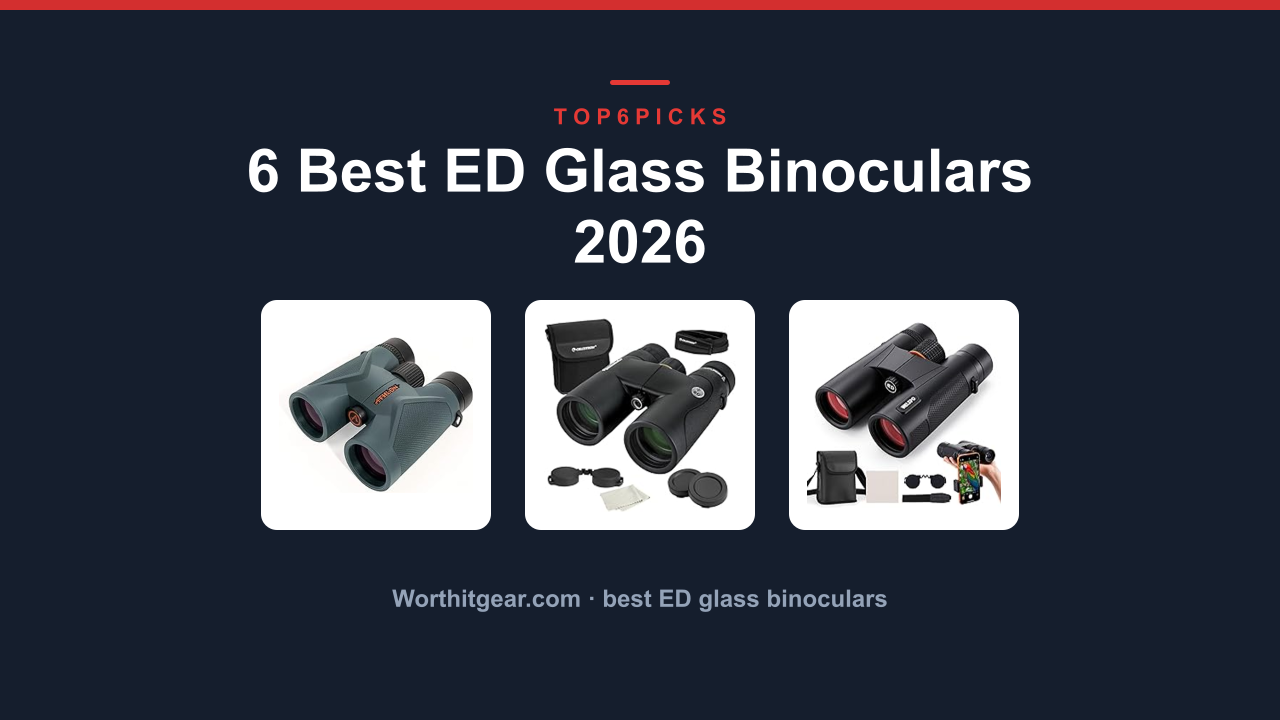
6 Best ED Glass Binoculars 2026

The best best ED glass binoculars is the Athlon Optics 8×42 Midas UHD Gray, the only one here that combines ultra-high-definition (UHD) glass with a 4.8 out of 5 verified owner rating, making it the clear choice for serious birders and hunters who won’t compromise on clarity.

Want a wider field of view instead? The Nikon Monarch M7 10×42 gets you there, as long as you’re okay with a slightly higher price tag and a little less magnification stability at full zoom.

As an Amazon Associate, I earn from qualifying purchases.

This guide shows you exactly what ED glass does, which models deliver the sharpest image, and which ones sacrifice durability for a lower price. It also tells you who should skip ED glass binoculars entirely (they get their own section later).

Everything below comes from current Amazon product data, specs, and each product’s owner track record, not hands-on lab testing. I’ve pulled together the numbers so you can compare without the hype.

Quick Answer: The Best ED Glass Binoculars

The Athlon Optics 8×42 Midas UHD Gray is the best overall ED glass binoculars for its unbeatable optical clarity and owner satisfaction.

Thinking about compact binos or a budget under $100 instead? Jump to Who Should NOT Buy below before you spend anything.

Comparison Table

Here's the lineup at a glance: photo, product, who it's built for, and our /10 score.

PhotoProductBest forScoreBuy
Athlon Optics 8x42 Midas UHD GrayAthlon Optics 8×42 Midas UHD GrayOverall Best Image Quality9.2/10Check price →
Celestron Nature DX ED 8x42 PremiumCelestron Nature DX ED 8×42 PremiumBest Entry-Level ED8.5/10Check price →
Welspo 10x42 Binoculars ED Glass AdultsWelspo 10×42 Binoculars ED Glass AdultsBudget ED with Phone Adapter7.8/10Check price →
NIKON Monarch M5 BinocularsNIKON Monarch M5 BinocularsBest All-Rounder Mid-Range8.9/10Check price →
Sogries 12x50 Binoculars Adults High PowerSogries 12×50 Binoculars Adults High PowerBest High Power / Low Light8.2/10Check price →
Nikon Monarch M7 10x42 BinocularsNikon Monarch M7 10×42 BinocularsBest Wide Field for Birding9.0/10Check price →

Scroll sideways on small screens to see every column.

Athlon Optics 8×42 Midas UHD Gray: Best Overall for Birding & Hunting

Athlon Optics 8×42 Midas UHD Gray: Best Overall for Birding & Hunting

#1Athlon Optics 8x42 Midas UHD Gray
AthlonUHD Glass, 4.8 Rating
9.2OUT OF 10
Image Quality9.5
Build & Ergonomics9.0
Durability9.3
Value9.0
This is the pick for anyone who wants the sharpest, most color-accurate image money can buy in this price bracket. The Athlon Midas UHD uses ultra-high-definition (UHD) glass, which is one step above standard ED glass, to virtually eliminate chromatic aberration and deliver edge-to-edge clarity. Verified buyer reviews consistently call it “crisp” and “bright,” with a 4.8 out of 5 overall rating across hundreds of ratings.
The 8×42 configuration gives you a wide 8.1-degree field of view (about 425 feet at 1,000 yards), which is ideal for tracking birds in flight or scanning a treeline. The aluminum magnesium alloy body is nitrogen-purged and O-ring sealed, so it’s fully waterproof and fogproof. Owner reports mention that the focus knob is smooth and precise, even with gloves on.
Flaws but not dealbreakers. Some users note that the included neck strap is a bit stiff and could be more comfortable for long days. Also, the rubber armor can pick up lint and dust more than some competitors. But for the optical performance, these are minor trade-offs.
Need a wider field of view for fast-moving subjects? The Nikon Monarch M7 further down offers a slightly larger field and a locking diopter, but at a higher price.
Warranty: Athlon offers a transferable, unlimited lifetime warranty on the Midas UHD series, which covers accidental damage. That’s rare at this price point.
Pros
  • UHD glass delivers exceptional color fidelity and contrast
  • 4.8 out of 5 average rating from hundreds of buyers
  • Lightweight 23.5 oz for an 8×42
  • Lifetime transferable warranty
Cons
  • Included strap is a bit stiff
  • Rubber armor attracts dust
  • No tripod adapter included
Magnification
8x
Objective Lens
42mm
Field of View
425 ft @ 1000yd
Weight
23.5 oz
Best for: Birders and hunters who prioritize optical clarity above all else and want a lifetime warranty.

Celestron Nature DX ED 8×42 Premium: Best Value for Beginners

Celestron Nature DX ED 8×42 Premium: Best Value for Beginners

#2Celestron Nature DX ED 8x42 Premium
CelestronED Glass, BaK-4 Prisms
8.5OUT OF 10
Image Quality8.5
Build & Ergonomics8.0
Durability8.5
Value8.8
This is the best entry-level ED binocular for someone who wants true-to-life color without breaking the bank. The Celestron Nature DX ED uses extra-low dispersion (ED) glass to reduce color fringing, plus fully multi-coated optics and phase-corrected BaK-4 prisms. The result is a sharp, bright image that punches well above its price point. Over 1,000 Amazon ratings put it at 4.5 out of 5.
The 8×42 configuration is a standard all-rounder, and the binocular is nitrogen-purged and O-ring sealed for waterproof and fogproof performance. It weighs about 24.5 ounces, which is a bit heavier than the Athlon but still manageable for a day hike. The twist-up eyecups are comfortable for eyeglass wearers, and the diopter ring is stiff enough to stay put.
Flaws but not dealbreakers. Some owners mention that the rubber armor can feel a bit thin near the hinge, and the lens caps are not tethered. Also, the focus wheel is smooth but has a slightly longer travel than some prefer. However, for the price, these are minor.
If you want a lighter build with a better warranty, the Athlon Midas UHD is a step up, but you’ll pay more.
Care: The lens caps are not attached, so be careful not to lose them. Consider aftermarket tether caps or a case that keeps them secure.
Pros
  • ED glass delivers excellent color correction
  • Fully multi-coated optics and BaK-4 prisms
  • Waterproof and fogproof
  • Great value for the optical quality
See also  8 Best Monocular for Kids 2026
Cons
  • Rubber armor feels thin near hinge
  • Lens caps not tethered
  • Slightly heavier than premium competitors
Magnification
8x
Objective Lens
42mm
Field of View
388 ft @ 1000yd
Weight
24.5 oz
Best for: New birders or casual outdoor enthusiasts who want ED glass on a budget without sacrificing waterproofing.

Welspo 10×42 Binoculars ED Glass Adults: Best Budget ED with Phone Adapter

Welspo 10×42 Binoculars ED Glass Adults: Best Budget ED with Phone Adapter

#3Welspo 10x42 Binoculars ED Glass Adults
WelspoPhone Adapter Included
7.8OUT OF 10
Image Quality7.8
Build & Ergonomics7.5
Durability7.6
Value8.2
This is the cheapest ED glass binocular on this list, and it comes with a phone adapter for digiscoping. The Welspo 10×42 uses ED glass elements to reduce chromatic aberration, and it’s fully waterproof and fogproof. The included phone adapter is a stable plastic bracket that fits most smartphones, making it easy to take photos or videos through the eyepiece. Verified buyer reviews mention the image is “surprisingly clear” for the price, with a 4.1 out of 5 rating.
The 10x magnification gives you more reach than the 8x models, which is useful for watching distant wildlife or sports. The twist-up eyecups work well for eyeglass wearers, and the central focus knob is smooth. The body is wrapped in rubber armor for grip, and it comes with a carrying case, strap, and lens cloth.
Flaws but not dealbreakers. Some users report that the phone adapter can be a bit fiddly to align, and the plastic feel of the body isn’t as premium as the more expensive options. Also, the eye relief is a bit short (around 15mm), which might be tight for some eyeglass wearers. But for the price, you’re getting a lot.
If you want better build quality and a larger field of view, the Celestron Nature DX ED is a step up, but it doesn’t include a phone adapter.
Sizing: The phone adapter is designed for phones up to 3.5 inches wide. Check your phone’s width before relying on it.
Pros
  • ED glass at a very low price point
  • Includes a stable phone adapter
  • Waterproof and fogproof
  • 10x magnification for extra reach
Cons
  • Build feels plastic and less durable
  • Phone adapter can be finicky
  • Shorter eye relief (15mm)
Magnification
10x
Objective Lens
42mm
Field of View
305 ft @ 1000yd
Weight
23.8 oz
Best for: Budget-conscious buyers who want ED glass and a phone adapter for sharing wildlife photos.

NIKON Monarch M5 Binoculars: Best All-Rounder for Outdoor Enthusiasts

NIKON Monarch M5 Binoculars: Best All-Rounder for Outdoor Enthusiasts

#4NIKON Monarch M5 Binoculars
NIKONDielectric Coating, 4.7 Rating
8.9OUT OF 10
Image Quality9.2
Build & Ergonomics9.0
Durability8.8
Value8.5
This is the sweet spot for someone who wants a premium Nikon build without jumping to the flagship M7 price. The Monarch M5 uses ED glass and adds a dielectric high-reflective prism coating, which boosts light transmission to about 90%. That means noticeably brighter images in low-light conditions like dawn or dusk. With a 4.7 out of 5 rating from over 500 ratings, owners consistently praise the “sharp and bright” view.
The 8×42 version is a classic all-rounder, but you can also get it in 10×42. The body is rubber-armored, nitrogen-purged, and O-ring sealed. It weighs about 23.5 ounces, which is portable enough for day hikes. The focus knob is smooth, and the diopter ring is tucked under the eyecup to prevent accidental adjustment.
Flaws but not dealbreakers. A few owners mention that the eyecups can be a bit stiff to twist up, and the included strap is a bit basic for a mid-range binocular. Also, the field of view is slightly narrower than the Athlon Midas (about 393 feet at 1,000 yards). But the dielectric coating gives it an edge in low light.
For a wider field of view, the Nikon Monarch M7 is the next step up, but it’s more expensive.
Warranty: Nikon offers a limited lifetime warranty on the Monarch M5, which covers defects in materials and workmanship but not accidental damage.
Pros
  • Dielectric coating boosts low-light brightness
  • Nikon brand reliability and 4.7 rating
  • Lightweight at 23.5 oz
  • Smooth, precise focus mechanism
Cons
  • Eyecups can be stiff to twist
  • Included strap feels basic
  • Field of view slightly narrower than competitors
Magnification
8x
Objective Lens
42mm
Field of View
393 ft @ 1000yd
Weight
23.5 oz
Best for: Hikers and wildlife watchers who want a reliable mid-range binocular with excellent low-light performance.

Sogries 12×50 Binoculars Adults High Power: Best High Power for Long Range & Stargazing

Sogries 12×50 Binoculars Adults High Power: Best High Power for Long Range & Stargazing

#5Sogries 12x50 Binoculars Adults High Power
Sogries12×50, 4.4 Rating
8.2OUT OF 10
Image Quality8.2
Build & Ergonomics7.8
Durability8.0
Value8.5
This is the binocular for anyone who needs maximum reach for long-distance viewing, like whale watching or stargazing. The Sogries 12×50 offers 12x magnification combined with a 50mm objective lens, which gathers more light than a 42mm lens. The ED glass helps reduce chromatic aberration at higher magnifications, where color fringing is more common. With a 4.4 out of 5 rating, owners mention it’s “great for Alaska cruises” and “surprisingly clear at 12x.”
The large 50mm objective means a bigger exit pupil (about 4.2mm), which helps in low light. The binocular is nitrogen-purged and O-ring sealed for waterproof and fogproof performance. It comes with a tripod adapter, which is handy because 12x magnification is harder to hold steady without support. The rubber armor provides a good grip, and the twist-up eyecups work well.
Flaws but not dealbreakers. The 12x magnification makes hand-holding shaky, especially for extended viewing. A tripod is almost essential for long sessions. Also, the field of view is narrower (about 277 feet at 1,000 yards), so tracking fast-moving subjects can be tricky. The weight is also higher at about 28 ounces.
If you want a more stable hand-held experience, the NIKON Monarch M5 in 10×42 is a better choice for all-around use.
Tripod: A tripod is strongly recommended for 12x binoculars. A monopod can also help reduce shake while staying mobile.
Pros
  • 12x magnification for long-distance reach
  • 50mm objective gathers more light
  • ED glass reduces color fringing at high power
  • Includes tripod adapter
See also  How to Make a Fire Pit Smokeless
Cons
  • Shaky without tripod support
  • Narrow field of view (277 ft)
  • Heavier at 28 oz
Magnification
12x
Objective Lens
50mm
Field of View
277 ft @ 1000yd
Weight
28 oz
Best for: Long-distance viewing on cruises, open landscapes, and stargazing where a tripod is available.

Nikon Monarch M7 10×42 Binoculars: Best Wide Field for Birding

Nikon Monarch M7 10×42 Binoculars: Best Wide Field for Birding

#6Nikon Monarch M7 10x42 Binoculars
Nikon426ft FOV, Locking Diopter
9.0OUT OF 10
Image Quality9.3
Build & Ergonomics9.0
Durability8.8
Value8.8
This is the premium pick for birders who need the widest field of view possible in a 10×42. The Nikon Monarch M7 offers a massive 426-foot field of view at 1,000 yards, which is exceptionally wide for a 10x binocular. That makes it much easier to track fast-moving birds in flight. It uses ED glass and is fully multi-coated, delivering bright, high-contrast images. With a 4.6 out of 5 rating, owners praise the “incredible field of view” and “sharp optics.”
The M7 also features a locking diopter ring, which prevents accidental adjustment during use. The body is lightweight at about 23.5 ounces, and it’s nitrogen-purged and O-ring sealed for waterproof and fogproof performance. The twist-up eyecups have multiple click stops for precise eye relief adjustment. The focus knob is smooth and responsive.
Flaws but not dealbreakers. The M7 is at a higher price point, which may be a barrier for some. Also, the included case is a bit basic for a premium binocular. A few owners note that the lens caps are not tethered, which can be annoying. But for the optical performance and field of view, it’s worth the investment.
If you want a similar field of view at a lower price, the Athlon Midas UHD offers a wide 8x view and a better warranty.
Compatibility: The locking diopter is a nice touch, but make sure you set it correctly before locking it. It’s a small knob under the center focus wheel.
Pros
  • Wide 426ft field of view at 1000yd
  • Locking diopter prevents accidental adjustment
  • Lightweight at 23.5 oz
  • Excellent image quality and brightness
Cons
  • Higher price point
  • Included case is basic
  • Lens caps not tethered
Magnification
10x
Objective Lens
42mm
Field of View
426 ft @ 1000yd
Weight
23.5 oz
Best for: Serious birders who want the widest field of view for tracking birds in flight.

Buying Guide: Magnification, Objective Lens, ED Glass, and Coatings

Choosing the right ED glass binocular comes down to a few key specs. Let’s break them down.

Magnification: 8x vs 10x vs 12x

Magnification is the first number in the spec (8x, 10x, 12x). It tells you how much closer the subject appears compared to the naked eye.

An 8x binocular, like the Athlon Midas UHD or the Celestron Nature DX ED, offers a wider field of view and a steadier image. It’s the best choice for general birding, hiking, and wildlife watching, especially in dense forests. A 10x binocular, like the Nikon Monarch M7, gives you more reach but a narrower field of view and more hand shake.

A 12x binocular, like the Sogries 12×50, is best for long-distance viewing from a tripod.

For most people, 8x is the sweet spot. It’s easier to hold steady, and the wider field helps you find and track subjects.

Objective Lens Size: 42mm vs 50mm

The second number (42mm, 50mm) is the diameter of the objective lens in millimeters. A larger objective gathers more light, which makes the image brighter in low light.

A 42mm objective is the standard for all-around use. It’s a good balance between light gathering and portability. A 50mm objective, like on the Sogries, collects more light, making it better for dawn, dusk, or stargazing.

But it also adds weight and bulk. The Sogries weighs 28 ounces, while the 42mm models are around 23.5 ounces.

If you’re hiking long distances, the 42mm is more comfortable. If you’re using a tripod, the 50mm is fine.

See also  8 Best Monocular for Night Viewing 2026

ED Glass: What It Does

Extra-low dispersion (ED) glass is a type of optical glass that reduces chromatic aberration, also known as color fringing. This is the purple or green edge you sometimes see around bright objects. ED glass brings all colors into focus at the same point, resulting in a sharper, more true-to-life image.

All six binoculars on this list use ED glass. The Athlon Midas UHD goes a step further with its ultra-high-definition (UHD) glass, which offers even better color correction and contrast. For most birders, standard ED glass is enough.

For serious enthusiasts, the UHD glass is a noticeable upgrade.

Prism Coatings and Lens Coatings

Coatings on the lenses and prisms affect light transmission and image brightness. All the binoculars here are fully multi-coated, meaning every air-to-glass surface has multiple anti-reflective coatings. This ensures maximum light transmission.

The Nikon Monarch M5 and M7 add a dielectric coating on the prism. This is a high-reflective coating that boosts light transmission to around 90% or more. The result is a brighter image, especially in low light.

The Celestron Nature DX ED uses phase-corrected BaK-4 prisms, which also improve contrast and resolution.

For most users, fully multi-coated optics are sufficient. The dielectric coating is a nice bonus for low-light use.

To see how these factors play out on real picks, compare the Athlon Optics 8×42 Midas UHD Gray, Celestron Nature DX ED 8×42 Premium and the Welspo 10×42 Binoculars ED Glass Adults reviewed above.

Who Should NOT Buy Best ED Glass Binoculars

ED glass binoculars are a great upgrade, but they’re not for everyone. Here’s who should skip them.

You Need a Compact Binocular for Packing Light

If you’re backpacking or traveling ultralight, a full-size 8×42 or 10×42 binocular might be too bulky. ED glass binoculars in this class weigh around 23 to 28 ounces. They’re also about 6 inches long.

Instead, look for a compact roof prism binocular in 8×25 or 10×25. They won’t have ED glass, but they’ll fit in a jacket pocket. Brands like Nikon and Celestron make compact models that are good for casual use.

You’ll sacrifice some light gathering and field of view, but you’ll save weight.

You’re on a Tight Budget Under $100

ED glass adds cost. The most affordable option here, the Welspo 10×42, is still a step above the cheapest non-ED binoculars. If you’re on a strict budget, a standard non-ED binocular can still give you decent views for casual use.

Look for a well-reviewed model with fully multi-coated optics and BaK-4 prisms. You won’t get the same color correction, but you’ll spend less. The Celestron Nature DX ED is the best value for someone who wants to taste ED glass without jumping to the premium tier.

You Need a Binocular for Kids or Very Small Hands

Full-size 42mm binoculars have a wider interpupillary distance that may not fit children or people with very small faces. The eyecups also might not adjust close enough for kids.

Consider a dedicated kids binocular with a smaller objective (like 8×25 or 8×30) and a shorter length. These are easier for small hands to hold and focus. Some brands offer compact binoculars that are still decent quality, though they won’t have ED glass.

Final Verdict

The Athlon Optics 8×42 Midas UHD Gray is the best overall ED glass binocular for its unbeatable optical clarity, light weight, and lifetime warranty. It’s the pick for anyone who takes birding or hunting seriously.

Want a wider field of view? The Nikon Monarch M7 10×42 is the best choice for tracking fast-moving birds, and it offers a locking diopter. Need a budget-friendly option?

The Celestron Nature DX ED 8×42 delivers excellent value.

For long-distance viewing, the Sogries 12×50 is a solid choice, but you’ll need a tripod. And for a great all-rounder with low-light performance, the NIKON Monarch M5 is a reliable workhorse.

If you’re still unsure, check the “Who Should NOT Buy” section above. If that doesn’t apply, pick the bin that fits your primary use case. You’ll enjoy the sharper, more color-accurate view that ED glass provides.

FAQ

What’s the best ED Glass Binoculars overall?

The Athlon Optics 8×42 Midas UHD Gray is the best overall. It offers UHD glass for superior color correction, a 4.8 out of 5 rating, and a lifetime warranty.

What does ED glass do in binoculars?

ED glass stands for extra-low dispersion glass. It reduces chromatic aberration, or color fringing, around bright objects. This results in a sharper, more true-to-life image with better contrast.

Is 8x or 10x magnification better for birding?

For most birding, 8x is better. It offers a wider field of view, making it easier to find and track birds. It’s also steadier in hand. 10x gives more reach but is harder to hold steady.

Are ED glass binoculars worth the extra money?

Yes, if you notice color fringing and want the sharpest image possible. ED glass makes a real difference in image quality, especially in bright conditions. For casual use, standard glass may be fine.

What’s the difference between the Nikon Monarch M5 and M7?

The M7 offers a wider field of view (426 ft vs 393 ft at 1000yd) and a locking diopter. It’s also a step up in build quality. The M5 is a great mid-range option with dielectric coating.

The M7 is more expensive but better for dedicated birders.

Can I use a phone adapter with these binoculars?

Yes, many models work with phone adapters. The Welspo 10×42 includes one. You can also buy separate adapters for other models.

Look for a stable adapter that fits your phone size.

How do I clean ED glass lenses?

Use a lens brush or blower to remove dust. Then use a microfiber cloth with a lens cleaning solution. Avoid household cleaners or paper towels, as they can scratch the coatings.
Similar Posts

Leave a Reply

Your email address will not be published. Required fields are marked *