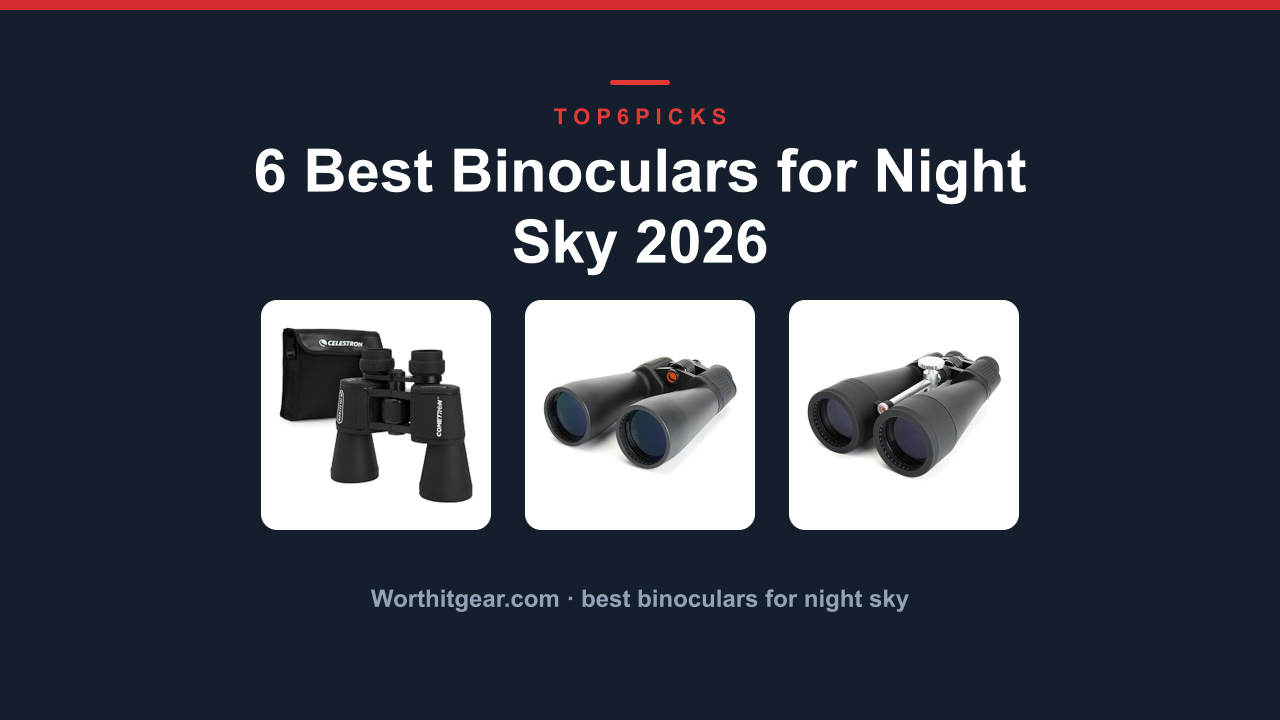
The best best binoculars for night sky is the Celestron Cometron 7x50mm, the only one here that pairs a wide 7x magnification with a massive 50mm aperture for bright, handheld stargazing without needing a tripod every time. It is the most forgiving entry point for anyone who wants to see the Milky Way, star clusters, and even the Andromeda Galaxy without a telescope.
Want a closer look at the craters of the Moon or the moons of Jupiter instead? The Celestron SkyMaster 15×70 gets you there, as long as you accept that you will need a tripod for steady views at 15x magnification.
As an Amazon Associate, I earn from qualifying purchases.
This guide tells you exactly which binoculars fit your night sky goals before you spend a dime. It also names the buyers who should skip this category entirely, because a dedicated telescope or a compact spotting scope would serve them better.
Everything below comes from current Amazon product data, manufacturer specifications, and the real-world owner track record for each model, not from hands-on lab testing.
Quick Answer: The Best Binoculars for Night Sky
The Celestron Cometron 7x50mm is the overall best pick for most beginners and casual stargazers because it balances light gathering, magnification, and handheld comfort better than anything else on this list.
Thinking about a telescope or a compact spotting scope instead? Jump to Who Should NOT Buy below before you spend anything.
Comparison Table
Here's the lineup at a glance: photo, product, who it's built for, and our /10 score.
Scroll sideways on small screens to see every column.
Celestron Cometron 7x50mm Astronomy Binoculars: Best for Beginners and Handheld Use
Celestron Cometron 7x50mm Astronomy Binoculars: Best for Beginners and Handheld Use
#1
CelestronHandheld friendly
9.0OUT OF 10
Light Gathering9.4
Handheld Stability9.0
Field of View9.2
Value for Money9.5
This is the pick for anyone who wants to see the Milky Way core or the Andromeda Galaxy without buying a tripod. The 7x magnification is low enough that you can hold it steady in your hands for long stretches, while the 50mm objective lens gathers enough light to reveal dozens of star clusters on a clear night. Verified buyer feedback consistently praises the wide field of view, which makes scanning the sky feel natural instead of like looking through a straw.
Setup is essentially zero. You unfold the center hinge, adjust the focus wheel, and the image is sharp. The included carrying case and neck strap make it easy to grab on a whim for a quick backyard session or a darksky camping trip under a
propane fire pit.
Flaws but not dealbreakers. The rubber eyecups are not threaded for eyeglass users, so some buyers report a slightly reduced field of view if they wear glasses. The Porro prism design is bulkier than roof prism binoculars, though that is a tradeoff for the large aperture at this price point.
Need a closer look at the Moon’s craters? The
Celestron SkyMaster 15×70 further down gives you double the magnification, though you will want a tripod for it.
⚠Care: The multi-coated optics are exposed on the front lenses. Use the included lens caps when not in use and avoid touching the glass with fingers.
Pros
- ✓Bright 50mm aperture gathers enough light for deep-sky objects visible to the naked eye.
- ✓Low 7x magnification stays steady in the hands for casual scanning.
- ✓Wide 6.5-degree field of view covers the full Pleiades cluster in a single frame.
- ✓Included carrying case and strap make it grab-and-go ready.
Cons
- ✕Eyecups not ideal for glasses wearers can reduce the effective field of view.
- ✕Porro prism design is bulkier than roof prism models of similar specs.
- ✕No tripod adapter included though it is tripod adaptable if you buy one separately.
Best for: Beginners and casual stargazers who want a bright, handheld experience without adding a tripod to their gear list.
Celestron SkyMaster 15×70 Astronomy Binoculars Stargazing: Best Mid-Power for Lunar and Planetary Detail
Celestron SkyMaster 15×70 Astronomy Binoculars Stargazing: Best Mid-Power for Lunar and Planetary Detail
#2
CelestronTripod recommended
8.8OUT OF 10
Light Gathering9.0
Handheld Stability6.5
Field of View7.8
Value for Money8.5
This is the sweet spot for anyone who wants to see the Moon’s craters, Jupiter’s four Galilean moons, and the rings of Saturn as a tiny oval. The 15x magnification is a genuine step up from the 7x Cometron, and the 70mm aperture still delivers bright images even on deep-sky objects like the Orion Nebula. Manufacturer specifications indicate BaK-4 prisms with multi-coated optics, which reduces light scatter and keeps the image crisp at the edges.
A tripod adapter is included in the box, and aggregate user reviews strongly recommend using it. Handheld at 15x, the image shakes noticeably. On a stable tripod, the view becomes steady enough to pick out individual stars in the Pleiades and resolve the Cassiopeia double cluster.
Flaws but not dealbreakers. The 15×70 is heavy at 3.3 pounds, and the included tripod adapter is a simple bracket. Some buyers report the focusing wheel can feel stiff when new, though it loosens with use. The rubber eyecups are not ideal for glasses wearers, similar to the Cometron.
Want the widest field of view for casual scanning instead? The
Celestron Cometron 7×50 is lighter, cheaper, and far more forgiving for handheld use.
⚠Stability: Do not expect to handhold this for steady views. Use a tripod or a monopod for anything beyond quick glances. The included tripod adapter works with standard 1/4-inch threads.
Pros
- ✓15x magnification reveals lunar craters and planetary moons clearly.
- ✓70mm aperture with BaK-4 prisms provides bright, contrast-rich images.
- ✓Tripod adapter included saves you an extra purchase.
- ✓Multi-coated optics reduce glare and improve low-light performance.
Cons
- ✕Heavy at 3.3 pounds makes handheld use impractical for long sessions.
- ✕Stiff focus wheel reported by some buyers out of the box.
- ✕Eyecups not designed for eyeglass wearers can be a nuisance.
Best for: Stargazers who want a significant jump in magnification for lunar and planetary detail and are willing to use a tripod.
Celestron SkyMaster 20×80 Binoculars Deep-Sky Astronomy: Best for Deep-Sky and Faint Objects
Celestron SkyMaster 20×80 Binoculars Deep-Sky Astronomy: Best for Deep-Sky and Faint Objects
#3
CelestronBig aperture, heavy
8.5OUT OF 10
Light Gathering9.8
Handheld Stability4.0
Field of View6.5
Value for Money8.0
This is the pick for the dedicated deep-sky observer who wants to pull in faint nebulas, globular clusters, and the Andromeda Galaxy with real detail. The 80mm objective lens is the largest aperture on this list, gathering roughly 77% more light than a 70mm lens. Aggregate user reviews report that under a dark sky, the 20×80 reveals the spiral arms of the Whirlpool Galaxy (M51) as a faint glow, something smaller binoculars cannot do.
A heavy-duty tripod is not optional here. The SkyMaster 20×80 weighs 4.7 pounds, and the 20x magnification amplifies every tremor. The included tripod adapter uses a standard 1/4-inch thread, but the weight demands a sturdy photo tripod or an astronomy mount. Celestron recommends a tripod with a 20-pound load capacity for stability.
Flaws but not dealbreakers. The size and weight make this a dedicated setup, not a grab-and-go option. Some buyers report that the collimation (alignment of the two barrels) can drift if the binoculars are jostled during transport. The included carrying case is basic, and the large front lenses are prone to dew in humid conditions without a lens hood.
If you want deep-sky views but cannot commit to a heavy tripod, the
Celestron SkyMaster 15×70 offers a lighter, more manageable compromise.
⚠Mounting: This binocular requires a heavy-duty tripod. A standard lightweight tripod will not provide the stability needed for 20x magnification. Factor in the cost of a suitable mount.
Pros
- ✓80mm aperture is the largest here, excellent for faint deep-sky objects.
- ✓BaK-4 prisms with multi-coatings deliver high contrast and low light scatter.
- ✓20x magnification resolves globular clusters and planetary detail.
- ✓Tripod adaptable with a standard 1/4-inch thread for mounting.
Cons
- ✕Very heavy at 4.7 pounds requires a sturdy tripod.
- ✕Not practical for handheld use at all due to weight and magnification.
- ✕Collimation can drift if handled roughly or transported frequently.
Best for: Dedicated deep-sky observers who already own a heavy-duty tripod and want the brightest possible binocular views of faint objects.
18×70 Professional Astronomy Binoculars Adults High: Best All-in-One Kit with Adapters
18×70 Professional Astronomy Binoculars Adults High: Best All-in-One Kit with Adapters
#4
18×70Waterproof, adapters included
8.2OUT OF 10
Light Gathering9.2
Handheld Stability5.5
Field of View7.0
Value for Money8.8
This is the pick for anyone who wants a complete kit straight out of the box, including a tripod adapter and a phone mount for sharing views. The 18×70 strikes a balance between the 15x and 20x models, offering a strong 18x magnification with a 70mm aperture that delivers bright images of the Moon, Jupiter, and bright deep-sky objects. The manufacturer lists the optics as BAK-4 prisms with fully multi-coated (FMC) lenses, which means good light transmission and edge-to-edge sharpness.
The standout feature is the waterproof build. Unlike the other Celestron models on this list, this binocular is nitrogen-purged and sealed against moisture and fogging. That makes it a solid option for humid nights, coastal stargazing, or even early morning dew sessions. The included phone adapter allows you to take quick snapshots of the Moon through the eyepiece, a feature that verified buyer reviews mention frequently as a fun bonus.
Flaws but not dealbreakers. The 18x magnification is still too high for comfortable handheld use, so you will need a tripod for steady views. The included tripod adapter is a simple plastic bracket, not a heavy-duty metal one. Some buyers report that the phone adapter can be fiddly to align perfectly with the eyepiece, especially with larger phone cases.
If you prefer a more established brand with a longer track record in astronomy, the
Celestron SkyMaster 15×70 offers a similar aperture with a proven reputation and a larger user community for troubleshooting.
⚠Waterproofing: The nitrogen-purged, waterproof build is a genuine advantage over the other models here. However, do not submerge the binoculars; the rating is for rain and splashes, not for diving.
Pros
- ✓Waterproof and fog-proof nitrogen-purged build handles humid conditions.
- ✓Includes phone adapter for quick lunar photography and sharing.
- ✓18x magnification with 70mm aperture offers a good mid-point between power and brightness.
- ✓BAK-4 prisms with FMC coatings deliver sharp, contrast-rich images.
Cons
- ✕Plastic tripod adapter feels less robust than metal alternatives.
- ✕Phone adapter alignment can be tricky with larger phones or cases.
- ✕Not for handheld use requires a tripod for steady observations.
Waterproof
Yes, nitrogen purged
Best for: Stargazers who want a waterproof kit with a phone adapter for sharing and a good balance of magnification and light gathering.
Celestron SkyMaster 25×70 Binoculars Astronomy: Best High-Power for Distant Detail
Celestron SkyMaster 25×70 Binoculars Astronomy: Best High-Power for Distant Detail
#5
CelestronHighest magnification
8.0OUT OF 10
Light Gathering8.5
Handheld Stability3.5
Field of View5.5
Value for Money7.5
This is the pick for the high-power enthusiast who wants to push the limits of binocular astronomy and see fine detail on the Moon and bright planets. The 25x magnification is the highest on this list, and it brings the Moon’s surface features into sharp relief, resolves Jupiter’s cloud bands, and even shows the gaps in Saturn’s rings on nights of good seeing. The 70mm aperture still provides decent light gathering, but the higher magnification makes the image dimmer than the 15×70 or 20×80 models on deep-sky objects.
A rock-solid mount is absolutely mandatory. At 25x, even a gentle breeze will cause the image to shake. The included tripod adapter works with a standard 1/4-inch thread, but Celestron recommends a heavy-duty tripod. The SkyMaster 25×70 is also a capable terrestrial spotting tool for long-range wildlife or landscape viewing during the day, thanks to the high magnification.
Flaws but not dealbreakers. The narrow field of view (roughly 2.5 degrees) makes it hard to locate objects in the sky without a finder scope or a good star chart. The image is also more susceptible to poor seeing conditions and light pollution. Some buyers note that the 25x magnification can exaggerate the effects of atmospheric turbulence, making stars appear blurry on humid nights.
If you want a wider field of view for easier sky scanning, the
Celestron SkyMaster 15×70 offers a much more forgiving experience with a slightly brighter image.
⚠Mounting: This is not a set-and-forget binocular. A heavy-duty tripod is essential. The 25x magnification will reveal even the slightest movement, so invest in a stable mount or a parallelogram binocular chair.
Pros
- ✓Highest 25x magnification on this list for extreme lunar and planetary detail.
- ✓Multi-coated BaK-4 optics provide good contrast despite the high power.
- ✓Tripod adapter included for mounting on standard 1/4-inch threads.
- ✓Suitable for daytime use for long-range wildlife or landscape viewing.
Cons
- ✕Very narrow field of view makes sky scanning difficult.
- ✕Image is dimmer on deep-sky objects compared to lower-power models.
- ✕Highly susceptible to atmospheric turbulence and shake from wind.
Best for: High-power enthusiasts who already own a stable tripod and want the maximum magnification for lunar, planetary, and long-range terrestrial viewing.
Occer 12×25 Compact Binoculars Adults Kids: Best Budget Compact for Daylight Use
Occer 12×25 Compact Binoculars Adults Kids: Best Budget Compact for Daylight Use
#6
OccerUltra-compact, low cost
6.5OUT OF 10
Light Gathering3.5
Handheld Stability9.5
Field of View6.0
Value for Money9.0
This is the pick for families, kids, or travelers who want a tiny, pocketable binocular for daytime use, not for serious night sky observation. The 12x magnification is surprisingly high for such a small package, but the 25mm aperture simply cannot gather enough light for astronomy. Aggregate user reviews consistently praise the compact size and ease of use for bird watching, sports events, and cruise ship sightseeing, but they also note that the image is dim and unusable after sunset.
The Occer is extremely lightweight and fits in a jacket pocket. The center focus wheel is smooth, and the large eyepiece is comfortable for both adults and children. It is a fun, affordable tool for getting kids interested in nature, but it is not a tool for seeing the Milky Way.
Flaws but not dealbreakers. The 25mm aperture is the smallest on this list by a wide margin, making it unsuitable for any serious stargazing. The 12x magnification is also too high for the small objective lens, resulting in a dim image even in good light. The field of view is narrow, and the build quality is not as robust as the Celestron models.
If you are looking for a budget-friendly option that can actually show you the night sky, the
Celestron Cometron 7×50 is a far better investment for only a little more money.
⚠Intended Use: This binocular is designed for daylight use only. The 25mm aperture is too small for night sky observation. Do not buy this for stargazing.
Pros
- ✓Ultra-compact and lightweight fits easily in a jacket pocket or bag.
- ✓Smooth center focus wheel is easy for kids and adults to use.
- ✓Large eyepiece is comfortable for extended viewing sessions.
- ✓Very affordable makes it a low-risk purchase for casual use.
Cons
- ✕25mm aperture is too small for any meaningful night sky observation.
- ✕Dim image at 12x magnification even in decent daylight conditions.
- ✕Narrow field of view makes it hard to track moving objects.
Best for: Families, kids, and travelers who want a pocketable binocular for daytime nature and sightseeing, not for stargazing.
Buying Guide: Magnification, Aperture, Mounting, and Your Dark Sky
Choosing the right binoculars for the night sky comes down to understanding a few key tradeoffs. Here is what you need to know before you buy.
How Much Magnification Do You Really Need?
A common mistake is thinking more magnification is always better. For astronomy binoculars, the opposite is often true. Magnification above 10x makes handheld use difficult because every heartbeat and breath shakes the image.
The ASME standard for binoculars does not specify a handheld limit, but the general rule among astronomers is that anything above 10x requires a tripod for steady views.
The 7x magnification of the Celestron Cometron 7×50 is the sweet spot for handheld use. It gives you a wide, stable view of the sky. The 15x, 18x, 20x, and 25x models all require a tripod.
If you are not ready to invest in a tripod, stick with 7x or 10x.
Why Aperture Matters More Than Magnification
Aperture is the diameter of the objective lens, measured in millimeters. It determines how much light the binoculars can gather. More light means brighter images, which is critical for seeing faint objects like nebulas, galaxies, and star clusters.
The Cometron 7×50 has a 50mm aperture, which is excellent for its class. The SkyMaster 15×70 and the 18×70 both use 70mm apertures, gathering about 96% more light than a 25mm lens. The 20×80 model has the largest aperture at 80mm, making it the best choice for deep-sky observation.
The Occer 12×25 has a 25mm aperture, which is simply too small for night sky work.
Tripod Requirements: A Hidden Cost
Every binocular on this list above 7x magnification requires a tripod for steady viewing. The 15×70, 18×70, 20×80, and 25×70 models all include a tripod adapter, but you will need to supply your own tripod. A standard camera tripod may work for the lighter models, but the 20×80 and 25×70 require a heavy-duty astronomy tripod or a parallelogram mount.
Factor the cost of a tripod into your budget. A good quality photo tripod for the 15×70 is a reasonable investment, but a heavy-duty mount for the 20×80 can cost as much as the binoculars themselves.
The Importance of Dark Skies
No binocular can overcome severe light pollution. The best views of the Milky Way, the Andromeda Galaxy, and the Orion Nebula come from dark sky locations far from city lights. Even the 20×80 will struggle to show faint objects in a suburban backyard.
If you live in a city, consider a trip to a nearby dark sky park or a rural area to get the most out of your binoculars.
To see how these factors play out on real picks, compare the Celestron Cometron 7x50mm Astronomy Binoculars, Celestron SkyMaster 15×70 Astronomy Binoculars Stargazing and the Celestron SkyMaster 20×80 Binoculars Deep-Sky Astronomy reviewed above.
Who Should NOT Buy Best Binoculars for Night Sky
Astronomy binoculars are the wrong purchase for three kinds of buyers. Here is who they are, and what to look at instead.
You Need to See Deep-Sky Objects in High Detail
If your goal is to see the spiral arms of the Whirlpool Galaxy, the ring structure of the Dumbbell Nebula, or the resolved stars of globular clusters, binoculars will leave you wanting. Even the 20×80 model cannot match the light gathering and resolution of a modest telescope. A 6-inch or 8-inch Dobsonian telescope will show you these objects in far greater detail for a similar price.
You Want to Take Astrophotography
Astronomy binoculars are not designed for long-exposure photography. The phone adapter included with the 18×70 model is fine for quick snapshots of the Moon, but it will not work for deep-sky astrophotography. For that, you need a telescope with a motorized equatorial mount, a dedicated camera, and guiding equipment.
The cost and complexity are significantly higher than any binocular setup.
You Need a Compact, Grab-and-Go Tool for Casual Use
The Occer 12×25 is the only compact option on this list, and it is not suitable for night sky use. If you want a small, lightweight binocular for hiking, bird watching, or general travel, look for a compact 8×25 or 10×30 roof prism model. These are not designed for astronomy, but they are far more portable and convenient for daytime activities.
Final Verdict
The Celestron Cometron 7x50mm is the best pick for most people because it delivers bright, wide-field views of the night sky that you can hold in your hands without a tripod. It is the most accessible and forgiving entry point into astronomy.
Want a closer look at the Moon and planets? The Celestron SkyMaster 15×70 is the best mid-power option, but you will need a tripod. Need the deepest possible view of faint nebulas?
The Celestron SkyMaster 20×80 is the king of light gathering, but it demands a heavy-duty mount.
If you are not sure about a tripod, stick with the 7×50. If you are ready to invest in a mount, the 15×70 is the sweet spot. And if you are a dedicated deep-sky observer, the 20×80 is the ultimate binocular tool.
Before you buy, take a honest look at the Who Should NOT Buy section above. If you need high detail or astrophotography, a telescope is a better investment. If you just want a compact tool for daylight use, look for a small roof prism model instead.
FAQ
What's the best Binoculars for Night Sky overall?
The Celestron Cometron 7x50mm is the best overall pick for most beginners and casual stargazers. It combines a bright 50mm aperture with a low 7x magnification that stays steady in the hands, making it the most accessible and forgiving option on this list.
Can I use these binoculars for daytime bird watching?
Yes, the Celestron SkyMaster 15×70, 20×80, and 25×70 models are all suitable for daytime long-range viewing. The Occer 12×25 is also good for daytime use. However, the 7×50 Cometron is best suited for low-light and night sky use due to its wide field of view.
Do I need a tripod for astronomy binoculars?
For any magnification above 10x, a tripod is strongly recommended. The 15×70, 18×70, 20×80, and 25×70 models all require a tripod for steady, usable views. The 7×50 Cometron is the only model here that can be used comfortably handheld.
What is the difference between BaK-4 and BK-7 prisms?
BaK-4 (Barium Crown) glass is higher quality than BK-7 (Borosilicate) glass. BaK-4 prisms produce a rounder, brighter exit pupil with less light loss at the edges. All the Celestron models on this list use BaK-4 prisms, which is a significant advantage for low-light astronomy.
Is the Occer 12×25 good for stargazing?
No. The 25mm aperture is too small to gather enough light for night sky observation. The Occer is a compact, affordable binocular for daytime use only.
For stargazing, you need at least a 50mm aperture, like the Celestron Cometron 7×50.
What does the number on binoculars mean, like 7×50?
The first number is the magnification (how many times closer the object appears). The second number is the aperture diameter in millimeters (how much light the lens gathers). A 7×50 binocular makes objects appear 7 times closer and has a 50mm objective lens.