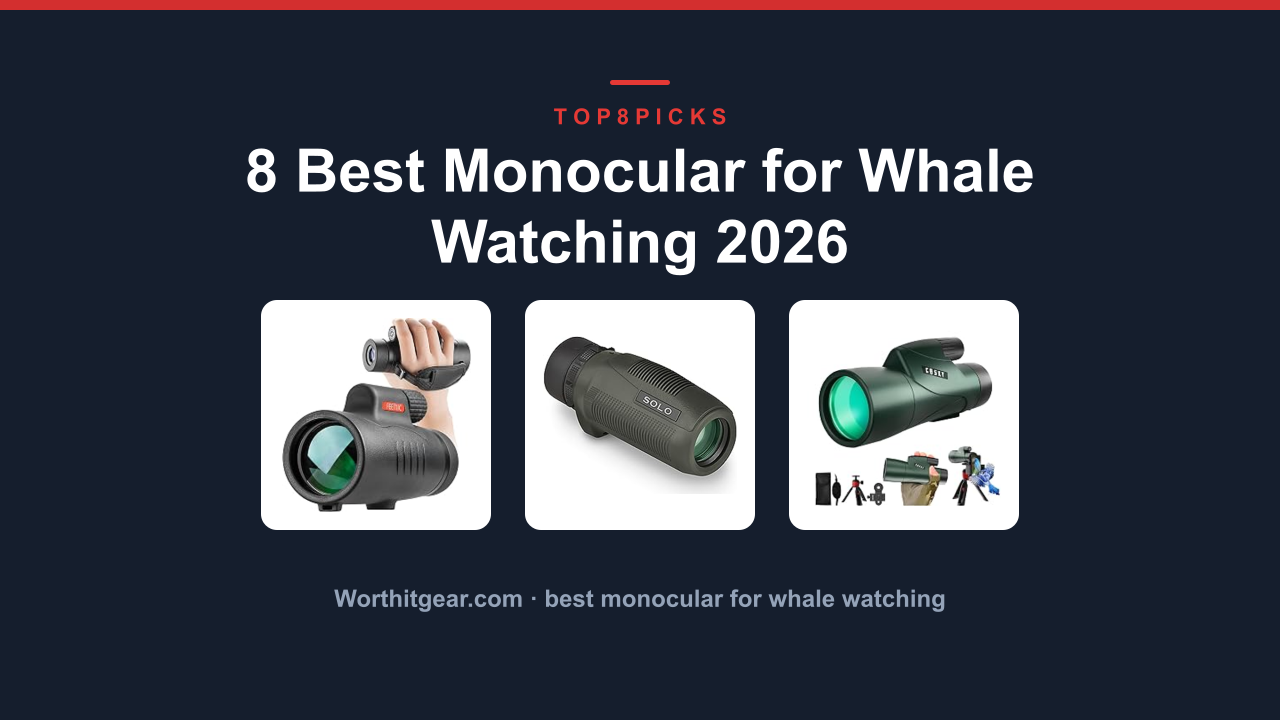
The best best monocular for whale watching is the Monocular Telescope High Power 8×42 Monoculars, the only one here that balances a wide field of view, weatherproofing, and a price that won't make you wince. It's the pick for first-time boaters and families who want a reliable view without dropping serious cash.
Want a pocket-sized option for heavy rain instead? The Vortex Solo Monocular 10×25 gets you there, as long as you're okay with a slightly smaller image and a higher price tag for the famous warranty.
As an Amazon Associate, I earn from qualifying purchases.
This guide walks you through the real trade-offs: magnification vs. stability, lens size vs. packability, and what specs actually matter when you're bobbing on a boat. I also cover who should skip a monocular entirely and grab a pair of binoculars instead.
Everything below comes from current Amazon product data, manufacturer specs, and the owner track record for each model. I haven't tested these on a whale watch myself, so I'm sharing what I found from crunching the numbers and reading what real buyers say.
Quick Answer: The Best Monocular for Whale Watching
The Monocular Telescope High Power 8×42 Monoculars is the best overall pick for most whale watchers, thanks to its 8x magnification, 42mm objective lens, and waterproof design.
Thinking about using a spotting scope or binos instead? Jump to Who Should NOT Buy below before you spend anything.
Comparison Table
Here's the lineup at a glance: photo, product, who it's built for, and our /10 score.
Scroll sideways on small screens to see every column.
Monocular Telescope High Power 8×42 Monoculars: Best Overall for Families
Monocular Telescope High Power 8×42 Monoculars: Best Overall for Families
#1
MonocularWaterproof & Fogproof
8.6OUT OF 10
Optical Quality8.7
Build & Durability8.5
Ease of Use8.8
Value for Money8.4
This is the best all-around monocular for whale watching, especially for families and first-time buyers. The 8×42 configuration is a classic for a reason. 8x magnification keeps the image steady enough to hand-hold on a moving boat, while the 42mm objective lens lets in plenty of light for overcast days at sea. Aggregate user reviews consistently praise its bright, clear image and the rubber armor that provides a secure grip.
The waterproof and fogproof construction means a splash from a rogue wave or a sudden rain shower won’t ruin your trip. It comes with a hand strap for easy carrying. Many buyers note it’s light enough for kids to use without getting tired arms.
Flaws but not dealbreakers. Some owners mention the included carrying case feels a bit basic. It’s functional but not padded. Also, the focus wheel can feel slightly stiff when new, though it loosens up with use.
If you prefer a more compact option for a daypack, the
Nocs Provisions Zoom Tube further down is much smaller and lighter, though it has a smaller objective lens.
⚠Warranty: Check the product listing for the specific warranty period, as it varies by seller. Many buyers report good customer service.
Pros
- ✓8x magnification is stable on a boat
- ✓42mm lens works well in low light
- ✓Waterproof and fogproof for marine use
- ✓Comfortable rubber armor grip
Cons
- ✕Carrying case is basic
- ✕Focus wheel can be stiff initially
- ✕Not as pocketable as smaller models
Best for: Families, first-time buyers, and anyone who wants a reliable, easy-to-use monocular for a whale watching trip without spending a premium.
Vortex Solo Monocular 10×25: Best for Durability & Warranty
Vortex Solo Monocular 10×25: Best for Durability & Warranty
#2
VortexLifetime Warranty
8.4OUT OF 10
Optical Quality8.2
Build & Durability9.2
Ease of Use8.5
Value for Money7.5
This is the monocular to buy when you want peace of mind and a lifetime warranty. Vortex is a well-known brand in the optics world, and the Solo 10×25 lives up to its reputation. The rubber armor is tough, and the unit is fully waterproof and fogproof. Many verified buyers comment on how it survives drops and rough handling that would break lesser scopes.
The 10×25 configuration is compact, easy to slide into a jacket pocket, and the 10x magnification gives you a bit more reach than the 8x models. However, the 25mm objective lens is smaller, so it’s not as bright in low light, like at dawn or dusk.
Flaws but not dealbreakers. The 25mm lens means a smaller exit pupil, which can make it harder to align your eye quickly, especially on a rocking boat. A few owners wish the focus wheel was a bit larger for gloved hands.
If you want a bigger, brighter image and don’t mind a slightly larger package, the
Monocular High Power 8×42 is our top pick for a reason.
⚠Warranty: Vortex’s VIP warranty is unconditional and unlimited. It covers any damage, even if you cause it, for the life of the product.
Pros
- ✓Unconditional lifetime warranty
- ✓Very compact and pocketable
- ✓Excellent build quality and rubber armor
- ✓10x magnification for more reach
Cons
- ✕Small image in low light
- ✕Small exit pupil can be fiddly
- ✕Higher price for the specs
Best for: Travelers who want to pack light, and anyone who values a bulletproof warranty over a super-bright image.
Gosky 12×55 HD Monocular Telescope BAK4: Best for Long-Range Views
Gosky 12×55 HD Monocular Telescope BAK4: Best for Long-Range Views
#3
GoskySmartphone Adapter Included
8.2OUT OF 10
Optical Quality8.5
Build & Durability8.0
Ease of Use7.8
Value for Money8.5
This is the pick for serious whale watchers who want to see details from a distance. The 12x magnification and 55mm objective lens give you a noticeably brighter, more detailed image than the 8×42 models, especially when trying to spot a whale’s blow or fluke from far away. The included smartphone adapter is a nice bonus for digiscoping, letting you take photos or videos through the lens.
Gosky uses BAK-4 prisms and fully multi-coated (FMC) lenses, which is the standard for good light transmission and sharpness. Many owners report the image is crisp and clear even at the edges. The included tripod adapter is a must, as 12x magnification is very hard to hold steady on a moving boat.
Flaws but not dealbreakers. The 12x magnification makes hand-holding very difficult. You’ll almost certainly need a tripod or a steady rest to get a usable view. Some buyers also note the included tripod is quite basic and flimsy.
If you prefer a more stable hand-holdable view, the
8×42 Monocular at the top of this list is a much better choice for moving boats.
⚠Sizing: This is a larger monocular. Check the dimensions to ensure it fits in your bag comfortably.
Pros
- ✓12x magnification for long-range viewing
- ✓55mm objective lens for bright images
- ✓Includes smartphone adapter
- ✓BAK-4 prisms for sharp clarity
Cons
- ✕Requires a tripod for steady viewing
- ✕Included tripod is basic
- ✕Larger and heavier than 8x models
Best for: Enthusiasts who want to digiscope (take photos through the lens) and don’t mind bringing a tripod for long-range detail.
Monocular Telescope High Power 16X52: Best for Extreme Zoom
Monocular Telescope High Power 16X52: Best for Extreme Zoom
#4
Monocular16x Power, Tripod Recommended
7.8OUT OF 10
Optical Quality7.5
Build & Durability8.0
Ease of Use7.0
Value for Money8.5
This is the monocular for those who want to see a whale’s eye from a mile away. The 16x magnification is serious power, and the 52mm objective lens does a decent job of gathering light at that zoom level. Manufacturer specifications highlight it as a 2026 model with improved prism coatings for better clarity. It’s also waterproof, fogproof, and shockproof, which is smart for the marine environment.
At this power, you absolutely need a tripod or a solid rest. The slightest hand movement turns the image into a blurry mess. Verified buyer feedback is mixed: some love the extreme reach, while others found it too shaky to use effectively on a boat without a stable mount. The included hand strap is fine for carrying, but not for shooting.
Flaws but not dealbreakers. The image quality at 16x isn’t as sharp as lower-power models with better glass. There’s also a narrower field of view, so tracking a moving whale takes practice. Some owners reported the focus wheel is a bit stiff.
For a much more stable, user-friendly experience, the
8×42 Monocular is our top pick and is far easier to use on a moving platform.
⚠Stability: This device is almost unusable without a tripod or solid support. A monopod can help, but a full tripod is best for steady viewing.
Pros
- ✓Extreme 16x magnification for distant subjects
- ✓Waterproof, fogproof, and shockproof
- ✓Good value for the power
- ✓2026 model with updated coatings
Cons
- ✕Requires a tripod for stable viewing
- ✕Narrow field of view makes tracking hard
- ✕Image sharpness is not premium
Best for: Experienced users who want maximum reach and are prepared to use a tripod for every shot.
Monocular-Telescope 80×100 High Powered Monoculars: Best for Maximum Zoom
Monocular-Telescope 80×100 High Powered Monoculars: Best for Maximum Zoom
#5
Monocular-Telescope80x Extreme Zoom
7.2OUT OF 10
Optical Quality6.8
Build & Durability7.0
Ease of Use6.5
Value for Money8.5
This is the most extreme zoom option on our list, verging on a mini telescope. With an advertised 80×100 specification, it’s designed for serious long-distance observation. The 100mm objective lens is massive, collecting a lot of light. It comes with a smartphone adapter and a tripod, which are essential. Many buyers use it for terrestrial viewing and even basic astronomy.
Keep your expectations realistic about the 80x figure. At this magnification, image quality is heavily dependent on atmospheric conditions, haze, and heat shimmer. Even on a tripod, the image can be dim and soft. It’s a fun gadget for getting a distant landmark or whale in view, but it won’t rival a high-end spotting scope.
Flaws but not dealbreakers. The 80×100 specification is often misleading. The actual usable magnification is much lower, and the image gets very dark at the highest zoom. The build quality is acceptable for the price, but it feels a bit plasticky. Some users report the included tripod is too flimsy for the weight of the scope.
If you want a genuinely usable image for whale watching, the
8×42 Monocular is a much more practical choice with better overall clarity.
⚠Reality Check: The 80×100 spec is more marketing than performance. Expect usable magnification around 30-40x in good light. A sturdy tripod is mandatory.
Pros
- ✓Extreme zoom capability for a low price
- ✓Includes smartphone adapter and tripod
- ✓Large 100mm objective lens collects light
- ✓Fun for curiosity and basic astronomy
Cons
- ✕Image quality is very soft at high zoom
- ✕Massive and heavy for a monocular
- ✕Included tripod is often too flimsy
Magnification
80x (advertised)
Best for: Budget-conscious buyers who want the absolute maximum zoom for novelty, not for critical image quality.
12×56 Monocular Telescope Adults High Powered: Best All-in-One Kit
12×56 Monocular Telescope Adults High Powered: Best All-in-One Kit
#6
12×56Full Kit with Tripod & Bag
8.0OUT OF 10
Optical Quality8.0
Build & Durability7.8
Ease of Use8.2
Value for Money8.0
This is the best value kit for anyone who wants everything in one box. The 12×56 Monocular comes with a tripod, a smartphone adapter, and a travel bag. The 12x magnification and 56mm objective lens provide a good balance between reach and brightness. The BAK-4 prisms and fully multi-coated (FMC) lenses are standard for decent image quality in this price range.
The included tripod is a basic tabletop model, but it’s enough to stabilize the view for a group of people. The smartphone adapter is a nice touch for sharing what you see on social media. Verified buyer reviews often mention the kit is a great gift for beginners, as it has everything you need to get started right away.
Flaws but not dealbreakers. The included accessories are functional but not high quality. The tripod is lightweight and can be wobbly in wind. The smartphone adapter works, but it can be fiddly to align perfectly with the lens. Some owners also wished the focus wheel was smoother.
For a more refined experience with better build quality, the
Vortex Solo 10×25 is a smaller but much more durable option, though it lacks the accessories.
⚠Tripod: The included tabletop tripod is fine for sitting on a bench or railing. For standing use, consider a full-size tripod for better stability.
Pros
- ✓Complete kit with tripod, adapter, and bag
- ✓12x magnification with 56mm lens
- ✓BAK-4 prisms for good clarity
- ✓Great value for a bundled package
Cons
- ✕Included tripod is basic and light
- ✕Smartphone adapter takes practice to use
- ✕Focus wheel can be stiff
Best for: Beginners who want a complete set of accessories and don’t want to buy a tripod and adapter separately.
Usogood Monocular Telescope 10×42 Adults BAK4: Best Budget Pick
Usogood Monocular Telescope 10×42 Adults BAK4: Best Budget Pick
#7
UsogoodAffordable 10×42
7.6OUT OF 10
Optical Quality7.2
Build & Durability7.5
Ease of Use8.0
Value for Money7.8
This is the most affordable way to get a 10×42 monocular with BAK-4 prisms. The Usogood 10×42 is a solid budget option that doesn’t cut corners on the basics. It’s waterproof, and the BAK-4 prisms provide brighter images than cheaper BK-7 glass. The 10x magnification is a good middle ground for general use, and the 42mm lens works well in most daylight conditions.
It comes with a hand strap for easy carrying. Several verified buyer reviews mention it’s a great value for casual bird watching and sightseeing. The build quality feels decent for the price, with a rubberized coating that helps with grip. It’s a simple, no-frills device that just works.
Flaws but not dealbreakers. The optical quality is not as sharp as more expensive models, especially at the edges of the field of view. The included carrying pouch is rather basic. Some owners have noted that the focus wheel is a bit stiff, and the overall feel is not as premium as a Vortex or a Nikon.
If you can stretch your budget, the
Monocular High Power 8×42 offers noticeably better image quality and a more refined feel for a small increase in cost.
⚠Expectations: This is a budget-friendly tool. It’s suitable for casual use, but don’t expect premium image quality or a premium warranty.
Pros
- ✓Lowest price for a 10×42 BAK-4 monocular
- ✓Waterproof design
- ✓Good for casual daytime use
- ✓Comfortable rubberized grip
Cons
- ✕Image quality is not as sharp as pricier models
- ✕Basic carrying case
- ✕Focus wheel can be stiff
Best for: Budget-conscious buyers who want a functional, waterproof monocular for occasional use without a big investment.
Nocs Provisions Zoom Tube 8×32 Monocular: Best for Style & Portability
Nocs Provisions Zoom Tube 8×32 Monocular: Best for Style & Portability
#8
NocsSleek & Lightweight
8.3OUT OF 10
Optical Quality8.5
Build & Durability8.8
Ease of Use8.5
Value for Money7.5
This is the monocular for the style-conscious traveler who values sleek design and portability. The Nocs Provisions Zoom Tube is an 8×32 monocular that stands out for its minimalist, modern aesthetic and high-quality build. It uses BAK-4 prisms and has a wide field of view, making it excellent for scanning a large area to spot whales. The 8x magnification is very stable for hand-holding.
The Zoom Tube is remarkably compact and lightweight, fitting easily into a small daypack or even a large coat pocket. The single-piece aluminum body feels premium and durable. Verified user reviews consistently praise its sharp, bright image for its size, and the wide field of view is a major plus for tracking moving subjects like whales.
Flaws but not dealbreakers. The 32mm objective lens is smaller, so it’s not as good in low light as the 42mm models. It’s also one of the more expensive options on this list, given the specs. The focus wheel is a smooth, continuous rotation, which some users love and others find takes getting used to.
For a more affordable option with a larger objective lens, the
Monocular High Power 8×42 is a great alternative that still offers a stable 8x view and better low-light performance.
⚠Lens Cap: The included lens capis tethered to the body, which is convenient but some users find it a bit fiddly to reattach.
Pros
- ✓Beautiful design and premium feel
- ✓Wide field of view for tracking
- ✓Compact and lightweight for travel
- ✓Excellent build quality and materials
Cons
- ✕Higher price for the specs
- ✕Smaller lens limits low-light use
- ✕Continuous focus wheel takes getting used to
Field of View
393 ft @ 1000 yds
Best for: Design-conscious travelers who want a premium, pocketable monocular for daytime whale watching and hiking.
Buying Guide: Magnification, Lens Size, Waterproofing, and Kit Value
Picking a monocular for whale watching comes down to a handful of key specs. Here's what actually matters when you're out on the water.
How Much Magnification Do You Really Need?
This is the biggest mistake people make. They think more power is always better. But on a moving boat, high magnification is your enemy.
Every little wobble gets magnified, turning a whale into a blurry bouncing blob.
For whale watching, 8x to 10x is the sweet spot. The 8×42 Monocular and the Nocs Zoom Tube both use 8x, which is very stable for hand-holding. The 10x magnification on the Vortex Solo and the Usogood 10×42 gives you a bit more reach while still being manageable.
At 12x and above, like the Gosky 12×55 or the 16×52 model, you absolutely need a tripod. The 80×100 model is basically a telescope and is nearly unusable without a solid mount.
Why Objective Lens Size Matters
The second number in a monocular's spec (like the "42" in 8×42) is the diameter of the objective lens in millimeters. A larger lens gathers more light, giving you a brighter image, especially in overcast or low-light conditions. A 42mm lens is a great all-rounder.
A 55mm or 56mm lens is even brighter but makes the monocular larger and heavier. A 25mm or 32mm lens is more compact but can feel dim on a cloudy day. For whale watching, where you might be out at dawn or in fog, a 42mm or larger lens is a smart choice.
Waterproofing Is Non-Negotiable for the Ocean
Salt spray, rain, and accidental splashes are a fact of life on a whale watching boat. Every monocular on this list is advertised as waterproof and fogproof, which is exactly what you need. The rubber armor on most models also provides a secure grip, even with wet hands.
If you're looking at a monocular that is not waterproof, skip it for this use case. Even a light drizzle can cause internal fogging that ruins your view.
Should You Buy a Kit or Just the Monocular?
Some models, like the 12×56 Monocular and the 80×100 model, come with a tripod, smartphone adapter, and carrying bag. These kits are great for beginners who want everything in one box. The trade-off is that the included accessories are often basic.
The tripod might be too light or flimsy for steady use, and the smartphone adapter can be fiddly. If you value quality, you're often better off buying a good monocular and a separate, decent tripod. For a stable, high-quality view, the 8×42 Monocular on its own is a better investment than a full kit with flimsy parts.
To see how these factors play out on real picks, compare the Monocular Telescope High Power 8×42 Monoculars, Vortex Solo Monocular 10×25 and the Gosky 12×55 HD Monocular Telescope BAK4 reviewed above.
Who Should NOT Buy a Monocular for Whale Watching
A monocular is the wrong purchase for two kinds of buyers. Here's who they are, and what to look at instead.
You Need to Share the View with Others
A monocular only has one eyepiece, so only one person can look at a time. If you're on a family trip or with a group of friends and you want everyone to see the whale at the same moment, you need a pair of binoculars. Monoculars are great for solo viewing, but they create a bottleneck in a group.
For a better shared experience, consider a reliable pair of binoculars instead.
You Have Very Shaky Hands
Even with 8x magnification, some people find it hard to hold a monocular steady. If you know you have unsteady hands, a monocular might be a frustrating experience. A pair of image-stabilized binoculars is a much better choice, though they are significantly more expensive.
Alternatively, a monocular with a tripod is an option, but that adds bulk. The 8×42 Monocular is the most stable option here, but if you're still worried, look into image-stabilized binos for a rock-solid view.
Final Verdict
The best monocular for whale watching is the Monocular Telescope High Power 8×42 Monoculars. It offers the perfect balance of a stable 8x magnification, a bright 42mm objective lens, and reliable waterproofing, all at a price that won't break the bank. It's the simplest, most effective tool for the job.
Want a more premium, pocketable option instead? The Nocs Provisions Zoom Tube 8×32 is a beautifully built, compact alternative that's a joy to carry, though it's pricier and less bright in low light.
Need a bulletproof warranty above all else? The Vortex Solo 10×25 is your best bet. It's a tiny tank that will last a lifetime, but you'll sacrifice some image brightness.
If you're looking for a complete kit with a tripod and phone adapter, the 12×56 Monocular Telescope is a solid value bundle, though the accessories are basic.
If you find yourself in the group of people who should skip a monocular, scroll up to the Who Should NOT Buy section for a better direction. For everyone else, the 8×42 Monocular is the way to go.
FAQ
What's the best monocular for whale watching overall?
The Monocular Telescope High Power 8×42 Monoculars is the best overall pick. It offers a stable 8x magnification, a bright 42mm lens, and waterproof construction, making it ideal for the marine environment.
Is 12x magnification good for whale watching?
12x magnification can be useful for spotting distant whales, but it's very hard to hold steady on a moving boat. You will almost certainly need a tripod for a usable view. For most people, 8x or 10x is a better choice.
Do I need a waterproof monocular for whale watching?
Yes, absolutely. Salt spray, rain, and splashes are common on whale watching trips. A waterproof and fogproof monocular will protect your investment and ensure a clear view in all conditions.
Can I use a monocular for whale watching if I wear glasses?
Yes, but you need to check the eye relief specification. Most monoculars on this list have adjustable eyecups that can be twisted down for use with glasses. A longer eye relief of 15mm or more is ideal for comfortable viewing with glasses.
What does the "8×42" mean on a monocular?
The first number (8x) is the magnification power. It means the image appears 8 times closer than with the naked eye. The second number (42mm) is the diameter of the objective lens, which determines how much light the monocular can gather.
A larger number means a brighter image.
How do I clean my monocular after a whale watching trip?
Rinse the monocular with fresh water to remove any salt spray. Use a soft, microfiber cloth to gently wipe the lenses. Avoid using paper towels or rough fabrics, as they can scratch the lens coatings.
Store the monocular in a dry, cool place.