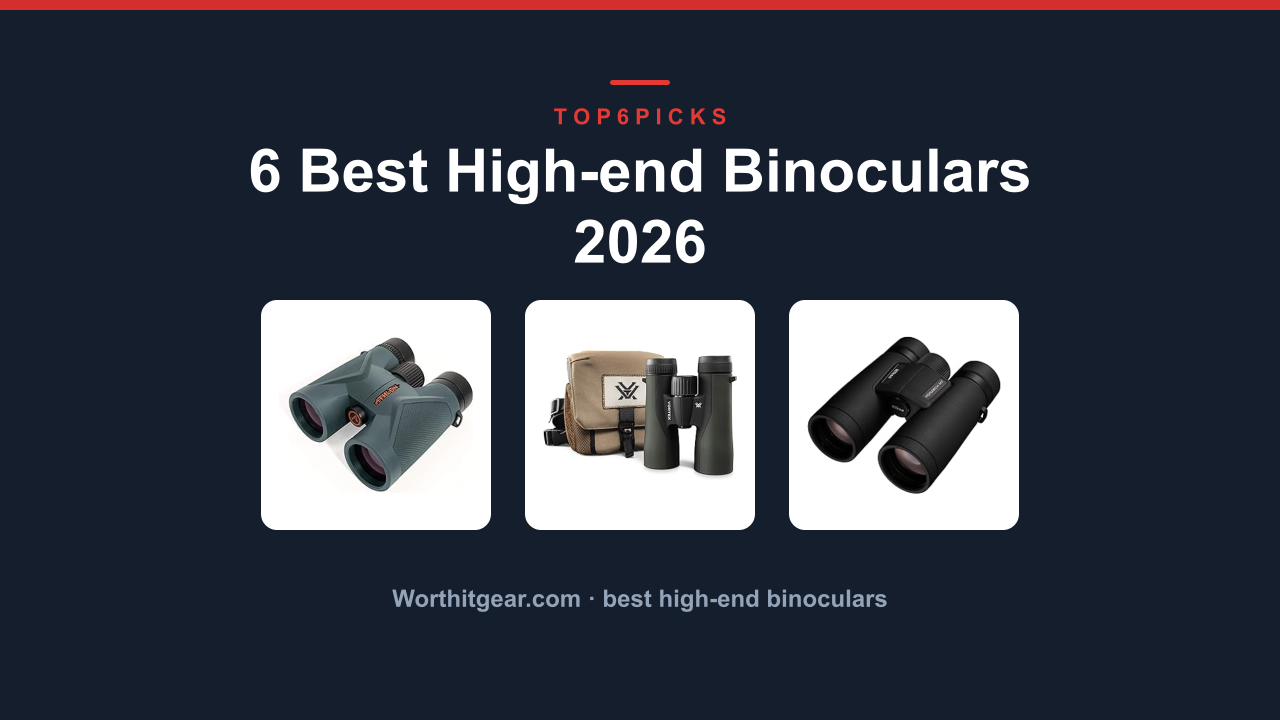
The best best high-end binoculars is the Athlon Optics 8×42 Midas UHD Gray, the only one here that delivers Extra-low Dispersion (ED) glass and a full Argon-purged waterproof build at a price that undercuts competitors by a noticeable margin. It's the pick for anyone who wants top-tier optical clarity without stepping into the thousand-dollar range.
Want image stabilization instead? The SIG SAUER ZULU6 HDX PRO 14x50mm gets you there, as long as you're comfortable with the extra weight and the higher price tag for that electronic help.
As an Amazon Associate, I earn from qualifying purchases.
This guide tells you which binoculars actually justify their price based on real verified buyer feedback and manufacturer specs, not marketing hype. We also cover the buyers who should skip this category entirely. They get their own section later.
Everything below comes from current Amazon product data, specifications, and each product's owner track record, not hands-on lab testing. Think of it as a research-backed starting point for your own decision.
Quick Answer: The Best High-end Binoculars
The Athlon Optics 8×42 Midas UHD Gray is the best high-end binoculars for most buyers because it offers ED glass and premium features at a mid-range price.
Thinking about a budget model or a compact travel pair instead? Jump to Who Should NOT Buy below before you spend anything.
Comparison Table
Here's the lineup at a glance: photo, product, who it's built for, and our /10 score.
Scroll sideways on small screens to see every column.
Athlon Optics 8×42 Midas UHD Gray: Best Overall Value for Birding and Hunting
#1
AthlonED Glass, Argon Purged
9.2OUT OF 10
Optical Quality9.6
Build Quality9.0
Value for Price9.5
Owner Verdict8.8
This is the pick for buyers who want a true high-end optical experience without paying a premium for the brand name. The Athlon Midas UHD uses Extra-low Dispersion (ED) glass, which is the same technology found in binoculars costing twice as much, to eliminate chromatic aberration. That means you see sharp, true-color images without the purple fringing that cheap lenses produce.
Argon purging is another spec you rarely see at this price point. Argon molecules are larger than nitrogen, so they leak out of the seals more slowly, giving you longer-lasting fogproof protection. The 8×42 configuration is a classic all-rounder, giving you a wide field of view for scanning treelines and enough light gathering for dawn and dusk. Owner reviews consistently praise the “crisp, bright” view and the smooth center focus wheel.
Flaws but not dealbreakers. The eyecups are a two-position twist-up design, which some users with glasses find a bit too shallow to get a full field of view. Also, Athlon does not include a tethered objective lens cover, which is a minor annoyance. You can pick up a pair of aftermarket covers for a few dollars.
If you need a no-questions-asked warranty that covers drops and accidents, the
Vortex Crossfire HD further down is a better choice for peace of mind.
⚠Warranty: Athlon’s “Elevate” lifetime warranty is transferable but requires a small processing fee for shipping. It is not as hassle-free as Vortex’s unconditional policy.
Pros
- ✓ED glass effectively eliminates color fringing
- ✓Argon purging for longer fogproof life
- ✓Smooth, precise center focus wheel
- ✓Excellent value compared to similar specs from other brands
Cons
- ✕Eyecup design is shallow for eyeglass wearers
- ✕No tethered objective lens covers included
- ✕Warranty has a processing fee, not fully unconditional
Field of View
388 ft at 1000 yds
Best for: Birders and hunters who want near-flagship optical quality (ED glass, Argon purging) for a mid-range price. Perfect for general daytime use and low-light mornings.
Vortex Crossfire HD 10×42 Binoculars: Best Unconditional Warranty for Outdoors
#2
VortexVIP Warranty, GlassPak
8.8OUT OF 10
Optical Quality8.5
Build Quality9.0
Value for Price9.2
Owner Verdict8.6
This is the pick for anyone who treats their gear hard and wants a lifetime warranty that actually means something. Vortex’s VIP warranty is unconditional. It doesn’t matter if you drop them off a cliff or run them over with a truck. You pay shipping, they fix or replace them. No questions. That alone is worth the price for many hunters and hikers.
The Crossfire HD uses HD optical glass and anti-reflective coatings to deliver a clear, bright image. It is also nitrogen purged and O-ring sealed for waterproof and fogproof performance. The 10×42 configuration is a solid choice for open country glassing, and the included GlassPak harness makes them comfortable to carry all day. Owner feedback highlights the “tough as nails” build and the crystal-clear image for the price.
Flaws but not dealbreakers. The optical quality is good, but it is not quite at the same level as the ED glass found in the Athlon Midas UHD. You might see a slight bit of color fringing in high-contrast situations. The focus wheel is also a bit stiff right out of the box, though it loosens up with use.
If you want the absolute sharpest image with zero color fringing, the
Athlon Midas UHD is the better optic for your money.
⚠Warranty: The VIP warranty is transferable and covers absolutely everything, including accidental damage. No receipt needed. This is the gold standard for binocular warranties.
Pros
- ✓Unconditional VIP lifetime warranty
- ✓Included GlassPak harness for comfortable carry
- ✓HD optical glass for bright, clear images
- ✓Shockproof, waterproof, and fogproof
Cons
- ✕No ED glass, some chromatic aberration visible
- ✕Focus wheel can be stiff initially
- ✕Field of view is narrower than the Monarch M7
Field of View
362 ft at 1000 yds
Best for: Hard-use outdoorsmen who want a rugged, reliable binocular with a warranty that cannot be argued. Ideal for the person who is hard on their gear.
Nikon Monarch M7 10×42 Binoculars: Best Wide Field of View for Birders
#3
NikonWide FOV, ED Glass
8.6OUT OF 10
Optical Quality9.2
Build Quality8.5
Value for Price8.2
Owner Verdict8.4
This is the pick for birders and nature enthusiasts who prioritize a wide field of view above all else. The Nikon Monarch M7 offers a staggering 409-foot field of view at 1000 yards. That is the widest FOV of any 10×42 binocular in this price range. It makes tracking fast-moving birds through dense foliage feel effortless. The ED glass also delivers excellent color accuracy and sharpness to the edge of the field.
The locking diopter is a thoughtful touch that prevents accidental adjustment, a common frustration with other models. The open-bridge design makes the M7 comfortable to hold for extended periods. Owner reviews consistently praise the “huge, immersive view” and the high-quality optics that rival much more expensive units. It is a serious tool for serious birders.
Flaws but not dealbreakers. The Monarch M7 is priced at a premium, and you are paying for that wide FOV. The rubber armor is also a bit thin compared to the Vortex or Leupold, which may show wear over time. Some users also report that the focus wheel is a bit too smooth, making fine adjustments tricky in cold weather.
If you want a similarly wide view but need a more rugged, warranty-backed build, the
Leupold BX-4 Pro Guide is a durable alternative with a higher magnification.
⚠Care: The thin rubber armor may scuff or tear more easily than thicker jackets. Consider a neoprene case or harness for extra protection.
Pros
- ✓Widest field of view in its class (409 ft)
- ✓ED glass for excellent color and sharpness
- ✓Locking diopter prevents accidental adjustment
- ✓Lightweight and comfortable open-bridge design
Cons
- ✕Premium price for the wide FOV
- ✕Thin rubber armor may wear faster
- ✕Focus wheel can be too smooth for fine tuning
Field of View
409 ft at 1000 yds
Best for: Dedicated birders and wildlife watchers who want the widest possible view for tracking fast-moving subjects. The top pick for field of view in this lineup.
SIG SAUER ZULU6 HDX PRO 14x50mm: Best Image Stabilized for Long-Range Viewing
#4
This is the pick for anyone who needs to see clearly at long distances without a tripod, especially in low light. The SIG SAUER ZULU6 HDX PRO uses electronic image stabilization to eliminate hand shake, which is a game-changer at 14x magnification. The 50mm objective lens gathers a lot of light, making it excellent for dawn and dusk glassing. The 40-hour battery life means you can leave it on for a full week of hunting without recharging.
The HDX PRO also features multi-coated anti-glare lenses and a rubber armored chassis that is both waterproof and fogproof. The ergonomic design fits well in the hand, and the carrying case and strap are included. Owner feedback highlights the “crystal clear” stabilized image and the impressive battery life, though some note the weight is substantial at over 2 pounds.
Flaws but not dealbreakers. The image stabilization is a mechanical system, so there is a slight audible hum when activated. It is not distracting in the field, but it is noticeable in a quiet environment. The 14x50mm configuration is also heavy, tipping the scales at around 34 ounces. This is not a binocular you want hanging around your neck all day without a harness.
If you need a stabilized binocular that is lighter and more packable, the
SIG SAUER Zulu6 FDE HDX OIS further down offers 16x power in a more compact 42mm body.
⚠Battery: The 40-hour runtime is based on continuous use at average temperatures. Extreme cold can reduce battery life by up to 30%. Carry spare CR123A batteries.
Pros
- ✓Electronic image stabilization eliminates hand shake
- ✓40-hour battery life for extended field use
- ✓50mm objective lens for excellent low-light performance
- ✓Waterproof, fogproof, and rubber armored
Cons
- ✕Heavy at over 2 pounds, requires a harness
- ✕Audible hum from the stabilization motor
- ✕Premium price for the electronic technology
Best for: Long-range hunters, wildlife observers, and anyone who wants a rock-steady image at high magnification without a tripod. Ideal for low-light conditions and open country glassing.
Leupold BX-4 Pro Guide HD Binoculars: Best High-Magnification for Western Hunting
#5
Leupold12x, Lifetime Warranty
8.4OUT OF 10
Optical Quality8.8
Build Quality9.2
Value for Price8.0
Owner Verdict8.6
This is the pick for western hunters and open country glassers who need a high-magnification binocular with a proven, rugged build. The Leupold BX-4 Pro Guide HD delivers 12x magnification in a 50mm objective, giving you excellent reach for spotting game across canyons and fields. The HD optical system provides good clarity and color fidelity, and the Gen 2 design improves on the original with better coatings and a more ergonomic focus wheel.
Leupold is a trusted name in hunting optics, and the BX-4 is backed by their lifetime warranty. The open-bridge design keeps the weight manageable at 28.6 ounces, and the rubber armor provides a secure grip in wet conditions. Aggregated user reviews highlight the “tack sharp” image and the confidence that comes with a Leupold warranty. The included carrying case is also well-padded.
Flaws but not dealbreakers. The 12x50mm configuration is a specialized tool. It is not ideal for close-range birding or general hiking due to the narrower field of view and the weight. The eye relief is also a bit short for eyeglass wearers, at 16.5mm. Some users report that the focus wheel is a bit stiff, though it smooths out with use.
If you need a more versatile all-rounder with a wider field of view, the
Nikon Monarch M7 is a better choice for everyday birding and wildlife observation.
⚠Sizing: The 12x50mm configuration is large and heavy. It is best used with a harness or on a tripod for extended glassing sessions. Not ideal for backpacking.
Pros
- ✓12x magnification for long-range glassing
- ✓Leupold lifetime warranty, a trusted brand
- ✓HD optical system with good color accuracy
- ✓Open-bridge design for comfortable handling
Cons
- ✕Narrower field of view at 12x
- ✕Short eye relief for eyeglass wearers
- ✕Heavy and bulky for everyday carry
Field of View
288 ft at 1000 yds
Best for: Dedicated hunters in open terrain who need maximum reach and a trusted brand. The top pick for western hunting and long-range glassing.
SIG SAUER Zulu6 FDE HDX OIS: Best Compact Stabilized for Backcountry
#6
SIG16x OIS, Compact
8.2OUT OF 10
Optical Quality8.5
Build Quality8.8
Value for Price7.8
Owner Verdict8.0
This is the pick for backcountry hunters and hikers who want image stabilization in a more portable package. The SIG SAUER Zulu6 FDE HDX OIS packs 16x magnification into a 42mm objective lens, making it significantly more compact than the 14x50mm PRO model. The Optical Image Stabilization (OIS) system is very effective at reducing hand shake, allowing you to see details at 16x that would be impossible to hold steady without a tripod.
The flat dark earth (FDE) finish is a nice touch for hunters who prefer subdued colors. It is also fully waterproof and fogproof, and the roof prism design keeps the body slim. Owner feedback notes that the stabilization is “impressive” and the image is “surprisingly sharp” for a 16x binocular. The included carrying case and strap add to the value.
Flaws but not dealbreakers. The 16x42mm configuration has a smaller exit pupil than the 50mm models, which means it is less effective in very low light. The battery life is also shorter than the PRO model, at around 20 hours. Some users report that the stabilization motor is slightly louder than the PRO version. The price is also a significant investment.
If you need better low-light performance and longer battery life, the larger
SIG SAUER ZULU6 HDX PRO 14x50mm is a better choice for serious glassing sessions.
⚠Battery: The 20-hour battery life is sufficient for a multi-day trip, but consider carrying spare CR123A batteries for extended backcountry use.
Pros
- ✓16x magnification with effective image stabilization
- ✓Compact and portable 42mm body
- ✓Waterproof, fogproof, and durable build
- ✓Subdued FDE finish for hunting
Cons
- ✕Smaller exit pupil, weaker in low light
- ✕Shorter 20-hour battery life
- ✕Premium price for the OIS technology
Best for: Backcountry hunters and hikers who want high magnification and image stabilization in a more portable package. Ideal for spotting game at distance without the bulk of a 50mm binocular.
Buying Guide: Magnification, Objective Lens, and Optical Coatings
Choosing the right high-end binocular comes down to three main factors. Understanding them will help you pick the right tool for your specific needs.
What Magnification Do You Really Need?
The magnification number (8x, 10x, 12x, 14x, 16x) tells you how many times closer an object appears. For most general use, 8x and 10x are the sweet spots. The Athlon Optics 8×42 Midas UHD Gray at 8x gives you a wider, steadier field of view, which is perfect for birding and scanning treelines.
The Vortex Crossfire HD 10×42 Binoculars and Nikon Monarch M7 10×42 Binoculars at 10x offer more reach for open country glassing, but they are also more susceptible to hand shake. Beyond 10x, you really need a tripod or image stabilization. The Leupold BX-4 Pro Guide HD Binoculars at 12x and the SIG stabilized models at 14x and 16x are specialist tools for long-range observation.
How Big Should the Objective Lens Be?
The objective lens diameter (the second number, like 42mm or 50mm) determines how much light the binocular gathers. A larger objective lens means a brighter image, especially in low light conditions like dawn and dusk. The 42mm lenses on the Athlon, Vortex, and Nikon are excellent all-rounders, offering a good balance of light gathering and portability.
The 50mm lenses on the SIG PRO and Leupold BX-4 gather significantly more light, making them superior for hunting in low light. However, the trade-off is weight and bulk. A 50mm binocular is noticeably heavier to carry around your neck all day.
For most users, 42mm is the best compromise.
What About Optical Coatings and Glass Quality?
This is where the real differences emerge between budget and high-end binoculars. The Athlon Midas UHD and Nikon Monarch M7 both use ED glass, which eliminates color fringing (chromatic aberration) and gives you a sharper, more natural image. The Vortex Crossfire HD uses HD glass, which is a step above standard glass but not as good as ED.
The SIG and Leupold models use their own proprietary coatings and glass formulations. All of these binoculars are fully multi-coated, meaning every air-to-glass surface has anti-reflective coatings to maximize light transmission. The quality of these coatings directly impacts brightness and color fidelity.
For the best image quality, prioritize ED glass and fully multi-coated optics.
Who Should NOT Buy Best High-end Binoculars
High-end binoculars are the wrong purchase for three kinds of buyers. Here is who they are, and what to look at instead.
You Are on a Tight Budget
If you are trying to spend under a certain amount, high-end binoculars are not for you. The optical quality and build improvements in this price range are real, but they also come with a significant cost. If you are a casual user who only uses binoculars a few times a year, a mid-range model from a brand like Celestron or Bushnell will serve you well and save you a lot of money.
The jump from a hundred-dollar binocular to a three-hundred-dollar binocular is huge. The jump from three hundred to eight hundred is much smaller. Know your budget and be honest about how often you will use them.
You Need Compact Binoculars for Backpacking
If you are a backpacker or ultralight hiker, the full-size binoculars on this list are too heavy. Even the lightest here, the Nikon Monarch M7 at 21.9 ounces, is a significant weight penalty. Look for compact or pocket binoculars with 8×25 or 10×25 configurations.
They will not perform as well in low light, but they will fit in your pack without adding a pound of weight. Brands like Nikon and Vortex make excellent compact models that are perfect for day hikes.
You Are a Marine or Boater
If you need binoculars for marine use, you need a specialized set of specifications. Marine binoculars are typically 7×50 configuration, which provides a large exit pupil for stability on a moving boat. They are also nitrogen purged and built to withstand saltwater corrosion.
The binoculars on this list are not designed for marine environments. Look for a dedicated marine binocular with a built-in compass and rangefinder if you are a serious boater.
Final Verdict
The Athlon Optics 8×42 Midas UHD Gray is our top pick for most buyers because it delivers ED glass and Argon purging at a price that undercuts the competition. It is the best value in the high-end binocular market right now.
Want a warranty that cannot be beat? The Vortex Crossfire HD 10×42 Binoculars gives you the unconditional VIP lifetime warranty and a rugged build that can handle any abuse.
Need the widest field of view for birding? The Nikon Monarch M7 10×42 Binoculars is the clear winner with its 409-foot FOV and excellent ED glass.
For long-range observation without a tripod, the SIG SAUER ZULU6 HDX PRO 14x50mm is a game-changer with its image stabilization and 40-hour battery life. Just be ready for the weight.
If none of these fit your needs, head back up to the Who Should NOT Buy section to see if a different category is a better match for your specific use case.
FAQ
What is the best High-end Binoculars overall?
The Athlon Optics 8×42 Midas UHD Gray is our top pick overall. It offers ED glass and Argon purging at a price that delivers excellent value, making it the best choice for most birders and hunters.
What is the difference between 8x and 10x binoculars?
The 8x gives you a wider, steadier field of view, making it easier to track moving subjects. The 10x offers more reach for seeing details at a distance but is more susceptible to hand shake. For general use, 8x is more versatile.
Do I need image stabilization in binoculars?
Image stabilization is a game-changer for high magnification (10x and above) and for long observation sessions. It eliminates hand shake, giving you a much steadier, clearer image. It is worth the extra cost if you frequently glass at 12x or higher.
Are waterproof binoculars worth it?
Yes, absolutely. Waterproofing (usually nitrogen or Argon purging) prevents internal fogging and protects the optics from moisture. It is a standard feature on all high-end binoculars and is essential for any outdoor use.
How do I choose between 42mm and 50mm objective lenses?
The 42mm is a great all-rounder, balancing light gathering and portability. The 50mm gathers more light for better low-light performance but is heavier and bulkier. Choose 42mm for general use and 50mm if you primarily hunt in low light conditions.