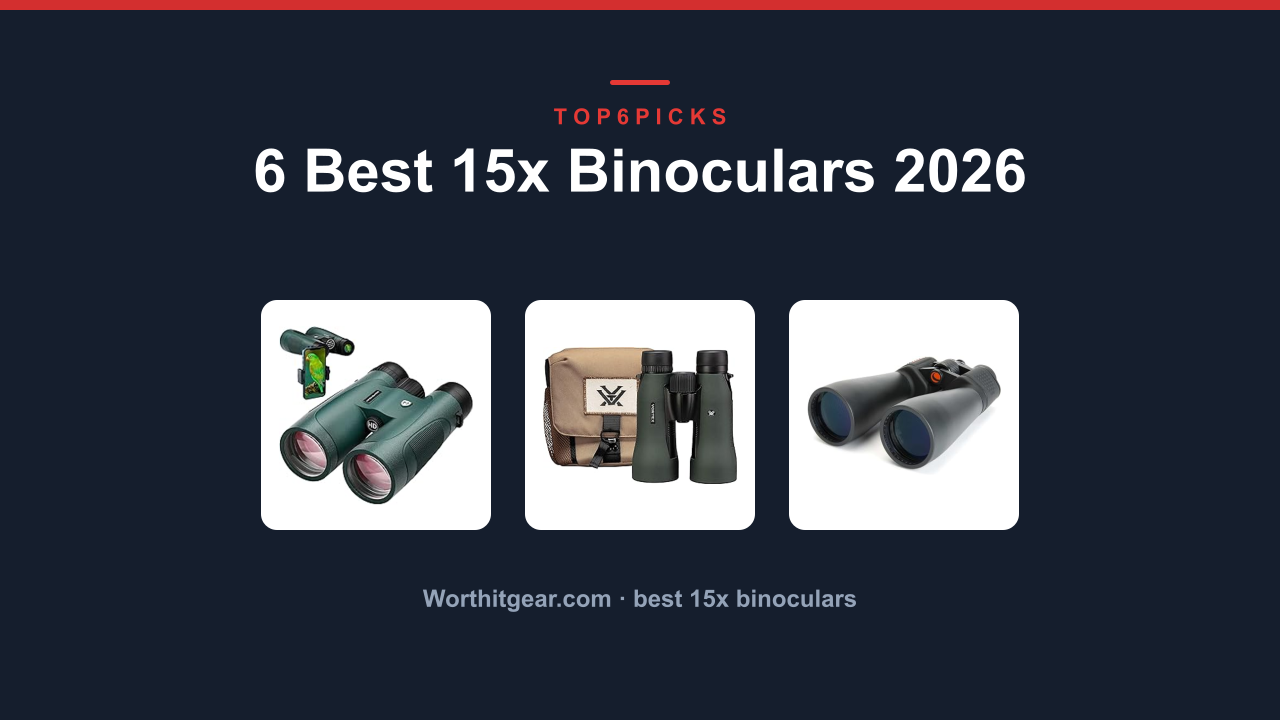
6 Best 15x Binoculars 2026
The best best 15x binoculars is the Vortex Diamondback HD 15×56, the only one here that combines premium HD optics with an unconditional lifetime warranty, making it the clear choice for serious outdoor enthusiasts.
Want a more budget-friendly option that still delivers great performance and includes a phone adapter? The 15×52 HD Binoculars is our top value pick, as long as you don't need the absolute best low-light performance.
As an Amazon Associate, I earn from qualifying purchases.
Before you buy, you should know that 15x binoculars aren't for everyone. The high magnification makes hand shake very noticeable, and these are generally heavier than standard binoculars. If you prioritize portability and a steady view, you might want to skip this category entirely (we have a dedicated section on that later).
Everything below comes from current Amazon product data, manufacturer specifications, and aggregate owner reviews, not hands-on lab testing. We're here to help you make an informed decision based on real-world feedback.
Quick Answer: The Best 15x Binoculars
The best overall 15x binocular is the Vortex Diamondback HD 15×56 for its unbeatable combination of optical clarity, rugged durability, and lifetime warranty.
- Vortex Diamondback HD 15×56 Binoculars (Best Overall): Unmatched optical clarity and lifetime warranty.
- 15×52 HD Binoculars Adults High Powered (Best Value): Great performance with included phone adapter.
- Celestron SkyMaster 15×70 Astronomy Binoculars Stargazing (Best for Astronomy): Massive 70mm lenses for deep-sky viewing.
- Vortex Optics Vulture HD Binoculars (Best Mid-Range): Rugged HD optics for serious field use.
- 15×55 UHD Binoculars Adults High Powered (Best Budget-Friendly): Affordable entry point to high-power viewing.
- Vortex Triumph HD 12×50 Binoculars (Best Lightweight Alternative): Easier to hold steady, same great warranty.
Thinking about portability or a steadier view instead? Jump to Who Should NOT Buy below before you spend anything.
Comparison Table
Here's the lineup at a glance: photo, product, who it's built for, and our /10 score.
| Photo | Product | Best for | Score | Buy |
|---|---|---|---|---|
 | 15×52 HD Binoculars Adults High Powered | Best Value All-Rounder | 8.8/10 | Check price → |
 | Vortex Diamondback HD 15×56 Binoculars | Best Overall Premium | 9.4/10 | Check price → |
 | Celestron SkyMaster 15×70 Astronomy Binoculars Stargazing | Best for Stargazing | 8.6/10 | Check price → |
 | Vortex Optics Vulture HD Binoculars | Best Mid-Range Workhorse | 8.9/10 | Check price → |
 | 15×55 UHD Binoculars Adults High Powered | Best Budget-Friendly | 8.2/10 | Check price → |
 | Vortex Triumph HD 12×50 Binoculars | Best Lightweight Pick | 8.7/10 | Check price → |
Scroll sideways on small screens to see every column.
15×52 HD Binoculars Adults High Powered: Best Value for Versatile Outdoor Use
Vortex Diamondback HD 15×56 Binoculars: Best Overall for Serious Outdoor Enthusiasts
Celestron SkyMaster 15×70 Astronomy Binoculars Stargazing: Best for Night Sky Observation
Vortex Optics Vulture HD Binoculars: Best Mid-Range Workhorse for Rugged Conditions
15×55 UHD Binoculars Adults High Powered: Best Budget-Friendly for Casual Viewing
Vortex Triumph HD 12×50 Binoculars: Best Lightweight Alternative for Steady Viewing
Buying Guide: Magnification, Objective Lens, Stability, and Your Budget
Shopping for a 15x binocular is different from picking up a standard 8x or 10x pair. The higher power brings a few trade-offs you need to understand before you click "buy." Here are the four most important factors.
Can you actually hand-hold a 15x binocular?
The short answer is: not very well. At 15x magnification, every tiny movement of your hands is amplified significantly. You'll see the image bounce and shake, especially at longer distances.
This is the single biggest challenge with this category.
A 15x binocular is best used with a tripod or at least braced against a solid object like a tree, a car window, or a fence post. The three Vortex models in this lineup are all tripod adaptable, and the Celestron SkyMaster is essentially unusable without one. If you plan to do a lot of scanning while walking, a 10x or 12x binocular might be a more practical choice.
The Vortex Triumph HD 12×50 is a great example of how a slightly lower magnification can be much more user-friendly.
What does the objective lens size mean for you?
The objective lens is the big lens at the front. The number after the "x" tells you its diameter in millimeters. A 15×56 binocular has a 56mm objective lens.
A 15×70 has a 70mm lens. The larger the lens, the more light it gathers, and the brighter the image will be, especially in low light conditions like dawn, dusk, or night sky viewing.
The Celestron SkyMaster 15×70 is the king of light gathering here, which is why it's the top pick for astronomy. The 15×52 and 15×55 models are more compact and lighter, but they will struggle in poor light. The 56mm lenses on the Vortex Diamondback and Vulture HD offer a great balance of brightness and portability.
What is the exit pupil and why does it matter?
The exit pupil is the small circle of light you see when you hold the binoculars at arm's length. You calculate it by dividing the objective lens size by the magnification. For a 15×56, the exit pupil is 3.7mm.
For a 15×70, it's 4.7mm.
A larger exit pupil means a brighter image, especially in low light. A human eye's pupil dilates to about 7mm in the dark, so a 4.7mm exit pupil is excellent for stargazing. A 3.7mm exit pupil is still good for daytime and twilight use but will be noticeably dimmer under a dark sky.
This is a key spec to understand if you plan to use the binoculars in varied lighting conditions.
How much should you spend on a 15x binocular?
The prices in this category vary widely. The budget-friendly options, like the 15×55 UHD, offer a great way to experience high magnification without a large financial risk. They are perfect for casual use, travel, and daytime activities.
The mid-range options, like the 15×52 HD, offer a significant jump in build quality, optics, and features like better waterproofing and included phone adapters. They are a smart choice for the regular user who wants reliable performance.
The premium options, like the Vortex Diamondback HD and Vulture HD, are an investment. They offer the best optical clarity, the most rugged construction, and the peace of mind of a lifetime warranty. If you are a serious hunter, birder, or guide who uses binoculars professionally or for many hours a week, the extra cost is well justified.
To see how these factors play out on real picks, compare the 15×52 HD Binoculars Adults High Powered, Vortex Diamondback HD 15×56 Binoculars and the Celestron SkyMaster 15×70 Astronomy Binoculars Stargazing reviewed above.
Who Should NOT Buy Best 15x Binoculars
15x binoculars are a fantastic tool, but they are not the right choice for everyone. Here are the kinds of buyers who should look at a different category.
You Need Maximum Portability
If you are a backpacker, a trail runner, or someone who hates carrying extra weight, a 15x binocular is going to be a burden. The lightest options here still weigh over 1.5 pounds, and the astronomy-grade models are over 3.5 pounds. They are also bulky, making them hard to fit in a small daypack.
Instead, consider a compact 8×25 or 10×25 binocular. These are much lighter and smaller, and while they don't have the same reach, they are far more likely to be with you when you need them. Some ultralight options weigh under 10 ounces.
You Want a Steady, Hand-Held Experience
The number one complaint from first-time 15x users is the shaky image. If you prioritize a crisp, stable view without having to set up a tripod, you will be frustrated with a 15x binocular. The high magnification is simply too much for the human body to hold still.
A 10×42 or 8×42 binocular is the classic choice for a reason. It offers a much steadier, more comfortable view, and it's far more versatile for general wildlife viewing, birding, and sports. You can also look at a 12×50 binocular, like the Vortex Triumph HD 12×50, which is a great middle ground between reach and stability.
You Are a Casual Viewer for Sports or Events
If you just want a pair of binoculars for the occasional concert, football game, or sightseeing trip, a 15x binocular is overkill. The narrow field of view makes it hard to follow fast-moving action, and the shaky image will be a nuisance.
A standard 8×40 or 10×42 is much better suited for these scenarios. They offer a wider field of view, a steadier image, and are generally more comfortable to use for long periods.
Final Verdict
The best 15x binocular for most people is the Vortex Diamondback HD 15×56. It's the complete package: brilliant HD optics, a rugged build that can handle the elements, and the unbeatable security of a lifetime, no-questions-asked warranty. If you're serious about your outdoor observation, this is the one to get.
Want the same rock-solid build and warranty but need something easier to hand-hold? The Vortex Triumph HD 12×50 is a fantastic alternative that trades a little reach for a much steadier view.
Need to save some money without sacrificing the essentials? The 15×52 HD Binoculars offers excellent value and even throws in a phone adapter, making it a great choice for the budget-conscious traveler or wildlife watcher.
And if you're only interested in the night sky, the Celestron SkyMaster 15×70 is the dedicated tool for the job. Just remember, a good tripod is mandatory for that one.
If you find yourself thinking you might not want to deal with a tripod or the weight, head back up to the Who Should NOT Buy section. It's better to get the right tool for your needs from the start.
FAQ
What's the best 15x Binoculars overall?
The Vortex Diamondback HD 15×56 is the best overall for its exceptional optical clarity, rugged build, and unconditional lifetime warranty.
What is the difference between 15×56 and 15×70 binoculars?
The key difference is the objective lens size. A 15×70 has a 70mm lens, which gathers significantly more light than the 56mm lens on a 15×56. This makes the 15×70 much better for astronomy and low-light viewing, but also much heavier and bulkier.
The 15×56 is a better all-rounder for daytime use.
Do I need a tripod for 15x binoculars?
Yes, it is highly recommended. At 15x magnification, hand shake is very noticeable. A tripod will give you a much steadier, more enjoyable image.
The Celestron SkyMaster 15×70 is virtually unusable without one. The lighter models, like the 15×52 HD, can be used handheld for short bursts, but a tripod is always better.
Can I use 15x binoculars for stargazing?
Yes, especially models with large objective lenses like the Celestron SkyMaster 15×70. The high magnification and large light-gathering lenses make them excellent for viewing star clusters, the moon, and some deep-sky objects. A tripod is essential for this use.
What does the HD in binoculars mean?
HD stands for High Definition. In the context of binoculars, it usually refers to the use of special glass elements (like ED or extra-low dispersion glass) that reduce chromatic aberration, which is the color fringing you see around objects. HD optics typically produce a sharper, clearer, and more color-accurate image.
How do I choose between 15x and 12x binoculars?
Choose 15x if your absolute priority is maximum reach and you are willing to use a tripod. Choose 12x if you want a high magnification that is still comfortable to hand-hold for extended periods. The Vortex Triumph HD 12×50 is a great example of a 12x that offers a much more stable view.