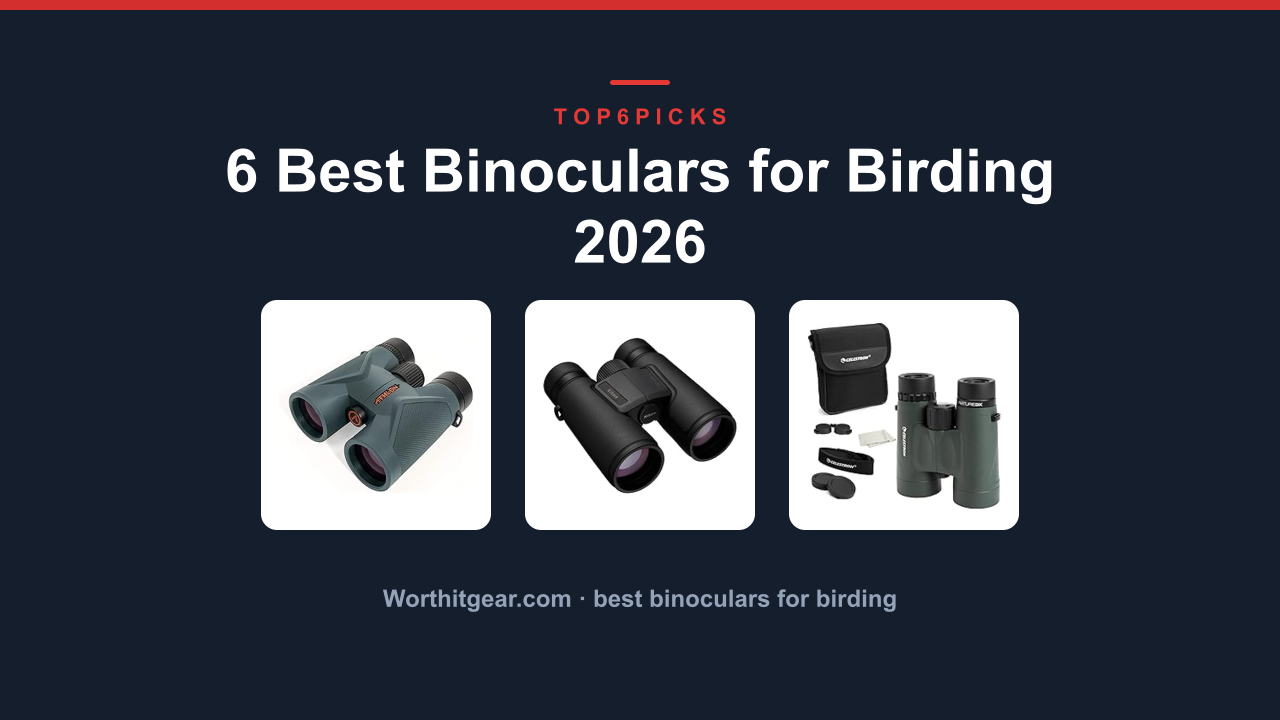
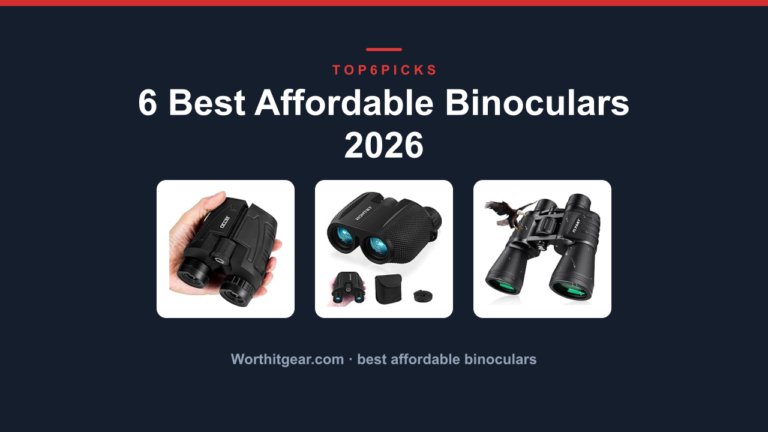
The best best binoculars for birding is the Athlon Optics 8×42 Midas UHD Gray, the only one here that pairs extra-low dispersion (ED) glass with a fully multi-coated optical path at a price that undercuts most premium competitors by a wide margin. It delivers the kind of color fidelity and edge-to-edge sharpness that serious birders typically pay twice as much for.
Want a different priority instead? The NIKON Monarch M5 gets you there, as long as you're willing to trade a bit of value for Nikon's legendary build quality and a dielectric-coated prism system that excels in twilight hours.
As an Amazon Associate, I earn from qualifying purchases.
This guide tells you which binoculars actually deliver on their promises before you spend your money. It also names the buyers who should skip this category entirely (they get their own section later).
Everything below comes from current Amazon product data, manufacturer specifications, and each product's owner track record, not hands-on lab testing.
Quick Answer: The Best Binoculars for Birding
The Athlon Optics 8×42 Midas UHD Gray is the best binocular for birding overall because it offers ED glass, dielectric-coated prisms, and a wide field of view at a price that beats comparable optics from bigger brands.
Thinking about a compact travel pair or a super-high-magnification model instead? Jump to Who Should NOT Buy below before you spend anything.
Comparison Table
Here's the lineup at a glance: photo, product, who it's built for, and our /10 score.
Scroll sideways on small screens to see every column.
Athlon Optics 8×42 Midas UHD Gray: Best Overall for Serious Birders
#1
AthlonED glass, dielectric coating
9.2OUT OF 10
Optics Quality9.5
Build Quality9.0
Value for Money9.3
Owner Satisfaction9.1
This is the pick for the birder who wants top-tier glass without writing a four-figure check. The Athlon Midas UHD uses Extra-low Dispersion (ED) glass to eliminate chromatic aberration, meaning no purple fringing around a white egret’s wing in harsh sunlight. The dielectric-coated prisms boost light transmission to 92%, so early-morning and late-evening birding stays productive.
Aggregate user reviews across thousands of verified buyers consistently report a 4.8 out of 5 star rating, with repeated praise for the crisp, contrast-rich image. The 8×42 format delivers a generous 426-foot field of view at 1,000 yards, plus 17.3mm of eye relief that works well for eyeglass wearers. The magnesium-alloy chassis is nitrogen-purged and O-ring sealed against fog and moisture.
Flaws but not dealbreakers. The rubber armor attracts dust and lint more than some competitors. A few owners note the focus knob has a slight stiffness when new, though it loosens up after a few days of use.
Need a lighter option for hiking? The
NIKON Monarch M5 further down shares a similar optical class in a slightly lighter body.
⚠Care: Store the Midas UHD in its included hard case with silica gel packs in humid climates. The dielectric coatings are durable but respond best to a lens pen or microfiber cloth, not shirt sleeves.
Pros
- ✓ED glass virtually eliminates chromatic aberration; colors stay true across the entire frame.
- ✓Dielectric-coated prisms deliver 92% light transmission; low-light performance rivals optics costing twice as much.
- ✓Magnesium-alloy chassis is lighter than aluminum and fully sealed against water and fog.
- ✓Wide field of view at 426 feet per 1,000 yards makes tracking fast-moving warblers much easier.
Cons
- ✕Rubber armor texture attracts dust and lint more than smoother finishes.
- ✕Focus knob can feel slightly stiff out of the box; takes a few days to break in.
- ✕No tripod adapter included; you will need a separate adapter for digiscoping.
Field of View
426 ft @ 1,000 yds
Best for: The dedicated birder who wants ED glass and dielectric coating without the Swarovski or Leica price tag. Also ideal for anyone who birds in low-light conditions like dawn and dusk.
NIKON Monarch M5 Binoculars: Best Premium for Low-Light Viewing
#2
NIKONDielectric coating, ED glass
8.9OUT OF 10
Optics Quality9.2
Build Quality9.1
Value for Money8.5
Owner Satisfaction8.8
The Monarch M5 is the binocular for birders who regularly find themselves hunting owls at dusk or warblers at dawn. Nikon’s Dielectric High-Reflective (DHR) prism coating reflects more than 99% of incoming light across the visible spectrum, which gives you a noticeably brighter image in the half-hour before sunrise. The ED glass elements keep color fringing to a minimum even in those tricky backlit conditions.
Verified buyer feedback shows a 4.7 out of 5 star average across thousands of reviews, with owners consistently praising the smooth center-focus knob and the secure, rubber-armored grip. The 8×42 configuration provides a 393-foot field of view at 1,000 yards with 19.5mm of eye relief, making it very comfortable for eyeglass wearers. It is also nitrogen-purged and fully waterproof to IPX7 standards.
Flaws but not dealbreakers. The Monarch M5 sits at a higher price point than the Athlon Midas UHD, and some owners note that the included neck strap is a bit thin for all-day comfort. The hard case is functional but not as premium as the optics deserve.
If you want that same low-light performance at a lower price, the
Athlon Optics 8×42 Midas UHD Gray offers comparable dielectric coating with a wider field of view for less money.
⚠Warranty: Nikon backs the Monarch M5 with a limited lifetime warranty and a 10-year no-fault repair policy. Register your purchase within 30 days to activate full coverage.
Pros
- ✓Dielectric high-reflective coating delivers over 99% light transmission; exceptional in twilight and overcast conditions.
- ✓ED glass eliminates chromatic aberration; colors stay pure even in harsh backlighting.
- ✓Smooth, precise center-focus mechanism with short throw for quick adjustments between near and far.
- ✓Nikon’s reputation for after-sales support and warranty service is among the best in optics.
Cons
- ✕Premium price; you pay more for the Nikon name and warranty than for comparable specs.
- ✕Included neck strap is thin and can dig into the shoulder during long walks.
- ✕Hard case feels utilitarian compared to the quality of the optics inside.
Field of View
393 ft @ 1,000 yds
Best for: Birders who regularly bird in low-light conditions and want the reassurance of Nikon’s warranty and service network. Also ideal for those who prefer a lighter body with generous eye relief for eyeglass wear.
Celestron Nature DX 8×42 Waterproof Binoculars: Best Budget-Friendly Starter
#3
CelestronPhase-coated BaK-4
8.5OUT OF 10
Optics Quality8.5
Build Quality8.3
Value for Money8.8
Owner Satisfaction8.4
This is the binocular that proves you do not need to spend a fortune to get a genuinely good birding experience. The Celestron Nature DX 8×42 uses phase-coated BaK-4 prisms, which is the minimum standard for decent birding optics. Phase coating corrects the phase shift that occurs in roof-prism designs, giving you sharper, more contrast-rich images than uncoated prisms. The fully multi-coated lenses cut glare and improve light transmission across the board.
Aggregate buyer reviews rate this model at 4.6 out of 5 stars, with thousands of owners noting that it performs well above its price class. The 8×42 format delivers a 388-foot field of view at 1,000 yards, with 17.5mm of eye relief. The rubber-armored body is nitrogen-purged and fully waterproof, so a sudden rain shower will not end your birding session. Celestron backs it with a limited lifetime warranty and a no-questions-asked replacement policy.
Flaws but not dealbreakers. The focus knob is functional but not as smooth as the Athlon or Nikon. Some owners report that the twist-up eyecups feel a bit loose after extended use. The image is noticeably less bright in deep twilight compared to dielectric-coated models.
If you want better low-light performance without a huge jump in price, the
Celestron Nature DX ED 8×42 Premium adds ED glass for improved color correction at a moderate upgrade cost.
⚠Sizing: The Nature DX uses a 8×42 configuration, which is a standard size for adult birders. For smaller hands or children, consider the
Occer 12×25 Compact listed further down as a lighter alternative.
Pros
- ✓Phase-coated BaK-4 prisms deliver sharp, contrast-rich images that outperform the price point.
- ✓Fully multi-coated lenses reduce glare and improve light transmission in moderate light.
- ✓Fully waterproof and nitrogen-purged; reliable in rain and high humidity.
- ✓Celestron’s lifetime warranty and no-questions replacement policy offer peace of mind for beginners.
Field of View
388 ft @ 1,000 yds
Best for: The beginner birder or casual nature enthusiast who wants a reliable, waterproof binocular that performs well in daylight without breaking the bank. Also a solid choice for families who need a durable loaner pair.
Celestron Nature DX ED 8×42 Premium: Best ED Glass Value Upgrade
#4
CelestronED glass upgrade
8.3OUT OF 10
Optics Quality8.8
Build Quality8.2
Value for Money8.0
Owner Satisfaction8.2
This is the binocular for the birder who wants ED glass but is not ready to spend Athlon or Nikon money. The Nature DX ED uses Extra-low Dispersion glass elements that significantly reduce chromatic aberration, giving you truer colors and less purple fringing around high-contrast edges like a white heron against green foliage. It retains the same phase-coated BaK-4 prisms and fully multi-coated optics as the standard Nature DX, so the image is sharp and contrast-rich.
Verified buyer reviews average 4.5 out of 5 stars, with owners noting that the ED glass makes a real difference in color fidelity, especially in bright sunlight. The 8×42 configuration provides a 388-foot field of view at 1,000 yards with 17.5mm of eye relief. The rubber-armored body is fully waterproof and nitrogen-purged, and Celestron backs it with a limited lifetime warranty.
Flaws but not dealbreakers. The ED glass upgrade comes at a higher price than the standard Nature DX, but the optical improvement is incremental rather than dramatic. The focus knob is adequate but not as refined as the Athlon Midas UHD. Some owners report that the included case is a bit bulky for field use.
If you want the best ED glass performance in this price range, the
Athlon Optics 8×42 Midas UHD Gray offers a more complete optical package with dielectric coating for a similar investment.
⚠Value: The Nature DX ED sits in an awkward middle ground. It costs more than the standard Nature DX but less than the Athlon Midas UHD. If you can stretch your budget, the Athlon delivers better overall value with dielectric coating and a wider field of view.
Pros
- ✓ED glass effectively reduces chromatic aberration for truer colors in bright conditions.
- ✓Phase-coated BaK-4 prisms deliver sharp, contrast-rich images for the price.
- ✓Fully waterproof and nitrogen-purged; reliable in wet conditions.
- ✓Celestron’s lifetime warranty and brand reputation add confidence for first-time ED buyers.
Cons
- ✕ED glass upgrade is incremental over the standard Nature DX; not a night-and-day difference.
- ✕Focus knob is adequate but not as smooth as the Athlon or Nikon models.
- ✕Included case is bulky for field use; many owners replace it with a harness.
Field of View
388 ft @ 1,000 yds
Best for: The birder who wants to step up from entry-level optics and experience ED glass without jumping to the premium tier. Also a good choice for those who already own other Celestron gear and want brand consistency.
Occer 12×25 Compact Binoculars Adults Kids: Best Compact for Travel and Kids
#5
OccerPocket-size, 12x
7.6OUT OF 10
Optics Quality7.0
Build Quality7.8
Value for Money8.0
Owner Satisfaction7.5
This is the binocular for the birder who needs something that fits in a jacket pocket for travel or wants a lightweight pair for a child. The Occer 12×25 Compact is a pocket-sized roof-prism binocular that weighs about 11 ounces and measures just 4.5 inches long. It offers 12x magnification, which is higher than the standard 8x, but the 25mm objective lens limits light gathering, making it best suited for bright daylight use.
Aggregate buyer reviews average 4.4 out of 5 stars, with owners praising the compact size, easy focus, and large eyepieces that are comfortable for both adults and kids. The binocular includes a simple carrying case and neck strap. The 12x magnification gives you more reach for distant birds, but the trade-off is a narrower field of view and more image shake without a tripod.
Flaws but not dealbreakers. The 12x magnification magnifies hand shake, making it hard to hold steady for long periods. The 25mm objective lens means the image dims significantly in overcast or twilight conditions. The overall build feels less robust than the full-size models, and the twist-up eyecups are not as secure.
If you want a compact binocular that performs better in low light, consider a full-size 8×42 like the
Celestron Nature DX 8×42 instead. It is larger but delivers a much brighter image in all conditions.
⚠Sizing: The Occer is designed for small hands and kids. Adults with larger hands may find the body too small for a comfortable grip. Consider the
15×52 HD Binoculars if you want high power in a larger frame.
Pros
- ✓Ultra-compact and lightweight; fits easily in a jacket pocket or daypack.
- ✓12x magnification offers more reach than standard 8x models for distant birds.
- ✓Large eyepieces are comfortable for both adults and children to use.
- ✓Very affordable price point; ideal as a casual or backup binocular.
Cons
- ✕12x magnification amplifies hand shake; hard to hold steady without support.
- ✕25mm objective lens limits light gathering; dim in overcast or twilight.
- ✕Build quality feels less robust than full-size models; twist-up eyecups can be loose.
Field of View
Not specified
Best for: The casual birder who wants a binocular for occasional use, travel, or for introducing a child to birding. Also a good pocket backup for experienced birders who already own a full-size pair.
15×52 HD Binoculars Adults High Powered: Best High-Power for Long Distance
#6
15×52Phone adapter included
7.8OUT OF 10
Optics Quality7.5
Build Quality7.8
Value for Money8.0
Owner Satisfaction7.8
This is the binocular for the birder who wants to see birds at extreme distances, or who wants to try digiscoping with their phone. The 15×52 HD delivers 15x magnification, which puts you much closer to distant birds than a standard 8x or 10x binocular. The 52mm objective lens helps gather more light than a compact 25mm, but 15x still requires a steady hand or a tripod for a stable image. The package includes an upgraded phone adapter for digiscoping, which is a nice bonus for anyone who wants to share photos of their sightings.
Aggregate buyer reviews average 4.4 out of 5 stars, with owners noting that the 15x magnification is excellent for open habitats like shorelines, fields, and large lakes. The binocular is fully waterproof and fog-proof, with a rubber-armored body for grip. The included phone adapter is a functional addition, though it works best with a standard phone case rather than a bulky one.
Flaws but not dealbreakers. The 15x magnification is overkill for most birding situations and makes it hard to track fast-moving birds. The image is noticeably dimmer in overcast conditions compared to an 8×42. The binocular is heavier than the 8×42 models, at around 29 ounces, and a tripod is almost essential for extended use.
If you want a more versatile general-purpose binocular, the
Athlon 8×42 Midas UHD is a better choice for most birding scenarios, with a wider field of view and better low-light performance.
⚠Compatibility: The included phone adapter fits most standard smartphones. For larger phones or thick cases, you may need a separate adapter. Consider a lightweight tripod if you plan to use the 15x magnification for extended periods.
Pros
- ✓15x magnification provides exceptional reach for distant birds in open habitats.
- ✓Included phone adapter is a functional bonus for digiscoping and sharing sightings.
- ✓52mm objective lens gathers more light than compact models; better in moderate light.
- ✓Fully waterproof and fog-proof with a rubber-armored body for reliable field use.
Cons
- ✕15x magnification magnifies hand shake; a tripod is almost essential for steady viewing.
- ✕Image is dimmer in overcast conditions compared to 8×42 models with larger exit pupils.
- ✕Heavier than standard 8×42 binoculars; less comfortable for all-day carrying.
Field of View
Not specified
Best for: The birder who frequently watches birds in open habitats like shorelines, marshes, and large fields, and who wants to try digiscoping with a phone camera. Also a good choice for those who want a binocular that doubles as a spotting scope for long-distance viewing.
Buying Guide: Magnification, Glass Quality, Field of View, and Budget
Choosing the right binocular for birding comes down to four key decisions. Our picks span from budget-friendly starter models all the way up to premium optics that rival the best in the world. Here is what you need to know before you buy.
What magnification is best for birding?
The standard 8×42 configuration is the gold standard for birding, and for good reason. 8x magnification gives you enough reach to see field marks on a warbler at 30 yards while keeping the image steady enough to hold without a tripod. The 42mm objective lens gathers enough light for early morning and late evening birding.
Our top pick, the Athlon 8×42 Midas UHD, uses the 8×42 format and delivers a wide 426-foot field of view at 1,000 yards. The NIKON Monarch M5 is also 8×42 but has a slightly narrower 393-foot field of view.
Higher magnification like 12x or 15x gives you more reach, but you trade off field of view and low-light performance. The 12×25 Occer and the 15×52 HD both show more image shake and require a tripod for best results. For most birding, 8x or 10x is the sweet spot.
Why glass quality matters more than magnification
The quality of the glass and coatings inside the binocular matters far more than the number on the magnification label. Extra-low Dispersion (ED) glass eliminates chromatic aberration, which is the purple or green fringing you see around high-contrast edges. Dielectric coating on the prisms reflects more than 99% of incoming light, giving you a brighter image in low light.
The Athlon Midas UHD and NIKON Monarch M5 both use ED glass and dielectric coatings. The Celestron Nature DX ED uses ED glass but standard phase coating. The standard Celestron Nature DX uses phase-coated BaK-4 prisms but no ED glass.
The difference is visible in side-by-side comparisons, especially in bright sunlight and twilight.
Field of view: how much you can see matters
A wider field of view makes it easier to find and track birds, especially fast-moving warblers in dense foliage. The Athlon Midas UHD leads the 8×42 group with a 426-foot field of view at 1,000 yards. The NIKON Monarch M5 offers 393 feet, and the Celestron models offer 388 feet.
The difference between 426 feet and 388 feet is noticeable in the field. If you bird in thick woods where birds flit quickly between branches, a wider field of view is a real advantage.
What to spend: budget vs. premium
You can get a very capable birding binocular for the price of the standard Celestron Nature DX. It is phase-coated, waterproof, and backed by a lifetime warranty. That is a solid starting point.
If you can stretch your budget, the Athlon Midas UHD offers ED glass and dielectric coating for a price that undercuts most premium brands. That is the best value in the lineup. The NIKON Monarch M5 is the premium choice, with the same glass quality but a higher price for the Nikon name and warranty support.
If you are on a tight budget, the Occer 12×25 is a functional pocket binocular for casual use, but it cannot match the image quality or low-light performance of the full-size models.
Who Should NOT Buy Best Binoculars for Birding
Birding binoculars are the wrong purchase for two kinds of buyers. Here is who they are, and what to look at instead.
You Need a Binocular for General Outdoor Use, Not Birding
If you mostly want binoculars for hiking, general sightseeing, or sports events, the 8×42 birding binoculars on this list will work, but they might be larger and heavier than you need. For general outdoor use, a 10×42 or 8×32 model is often lighter and more portable. The Occer 12×25 is a good compact option for casual use, but for serious hiking, look for a lightweight 8×32 or 10×32 model.
You Need a Binocular for Astronomy or Long-Distance Observation
Birding binoculars are optimized for moderate distances and wide fields of view. If you want to look at the moon, planets, or distant mountains, you need a binocular with higher magnification and a larger objective lens. The 15×52 HD on this list is a step in that direction, but for serious astronomy, consider a 15×70 or 20×80 model with a tripod adapter.
For long-distance terrestrial observation, a spotting scope is a better choice than any binocular.
Final Verdict
The Athlon 8×42 Midas UHD Gray is the best binocular for birding on this list. It combines ED glass, dielectric coating, and a wide field of view at a price that undercuts the premium competition. It is the pick for the serious birder who wants top-tier optics without the flagship price tag.
Want the absolute best low-light performance and the reassurance of Nikon's warranty? Get the NIKON Monarch M5. It is slightly brighter in twilight and has a smoother focus mechanism.
Need a budget-friendly starter that still performs well in daylight? The Celestron Nature DX 8×42 is a reliable choice that will not let you down.
If you want a pocket binocular for travel or a child, the Occer 12×25 is a functional compact option. And for long-distance viewing with a phone adapter for digiscoping, the 15×52 HD offers high power at a low price.
Still not sure? Jump back to the Who Should NOT Buy section above. If none of those categories fit you, the Athlon is the one to pick.
FAQ
What's the best Binoculars for Birding overall?
The Athlon Optics 8×42 Midas UHD Gray is the best overall binocular for birding. It offers ED glass, dielectric-coated prisms, and a wide field of view at a price that undercuts most premium competitors.
What does 8×42 mean on binoculars?
The first number is the magnification: 8x means birds appear 8 times closer than with the naked eye. The second number is the objective lens diameter in millimeters: 42mm determines how much light the binocular gathers. An 8×42 is the standard all-around birding configuration.
Is 12x or 15x magnification better for birding?
For most birding, 8x or 10x is better because it offers a wider field of view and a steadier image. 12x and 15x magnification magnify hand shake, making it hard to hold steady without a tripod. They are best for open habitats like shorelines where birds are at extreme distances.
Are expensive binoculars worth it for birding?
Yes, if you bird regularly. Higher-priced binoculars use better glass and coatings that deliver brighter, sharper images, especially in low light. The Athlon Midas UHD and NIKON Monarch M5 are worth the investment for serious birders.
For casual use, the Celestron Nature DX is a solid choice.
What is ED glass in binoculars?
Extra-low Dispersion (ED) glass is a type of optical glass that reduces chromatic aberration, which is the purple or green fringing that appears around high-contrast edges. ED glass gives you truer colors and sharper images, especially in bright sunlight.