The best best spotting scope under $200 is the SVBONY SV28, the only one here that combines a fully multi-coated 70mm objective lens, an angled eyepiece, and a full kit with tripod and phone adapter for under $200. It’s ideal for beginners who want clear views at 200 yards without breaking the bank.
Want a larger 80mm objective at the same price? The Gosky Flagship DiamondEdge 20-60×80 gets you a bigger lens for brighter images, but you’ll trade some portability for that extra light.
As an Amazon Associate, I earn from qualifying purchases.
This guide will help you decide which one fits your use case, and we’ll also tell you who should skip spotting scopes under $200 entirely (they get their own section later).
All recommendations come from current Amazon product data, specs, and aggregate owner feedback, not hands-on testing.
Quick Answer: The Best Spotting Scope under $200
The SVBONY SV28 is the top pick for most beginners and budget birders.
Thinking about a professional-grade scope or a compact model for backpacking? Jump to Who Should NOT Buy below before you spend anything.
Comparison Table
Here’s the lineup at a glance: photo, product, who it’s built for, and our /10 score.
Scroll sideways on small screens to see every column.
SVBONY SV28 Spotting Scope: Best Overall for Beginners
#1
SVBONYAngled body, full kit
8.5OUT OF 10
Optical Clarity8.2
Build Quality7.8
Ease of Use8.5
Value for Money9.0
This is the most complete package you’ll find under $200. The SVBONY SV28 comes with an angled 25-75×70 scope, a sturdy tripod, a phone adapter, and a carrying bag. It’s waterproof and fogproof, so you can use it in light rain without worry. Many beginners report being able to clearly read a license plate at 200 yards at 75x.
The angled eyepiece makes it comfortable to share with a group, and the included tripod is sturdy enough for stationary use. The multi-coated optics reduce glare and improve contrast, giving you a bright image even in overcast conditions.
Flaws but not dealbreakers. The tripod is functional but not rock-solid in windy conditions, and the zoom ring can be a bit stiff when new. Some users recommend upgrading the tripod later for long sessions.
Need a lighter setup for hiking? The
NWDEY 25-75X60 further down weighs significantly less and packs a 60-inch tripod.
⚠Care: Avoid over-tightening the tripod leg locks; they can strip if forced. Store the scope in a dry place.
Pros
- ✓Fully multi-coated optics for bright, sharp images
- ✓Angled eyepiece for comfortable group viewing
- ✓Includes phone adapter, tripod, and bag
- ✓Waterproof and fogproof for all-weather use
Cons
- ✕Tripod is lightweight and can wobble in wind
- ✕Zoom ring stiff when new; may need break-in
- ✕No hard case for rugged transport
Best for: New birders and target shooters who want a complete starter kit without buying extras.
SVBONY SV28 Spotting Scope: Best for Budget-Conscious Beginners
#2 SVBONYProven value, angled eyepiece
8.2OUT OF 10
Optical Clarity8.0
Build Quality7.5
Ease of Use8.3
Value for Money9.0
If you want the same proven platform as our top pick but at a slightly lower entry point, this is it. The SVBONY SV28 is essentially the same scope as the #1 pick, but you might find it cheaper on a given day. It still gives you the same 25-75x magnification, 70mm objective lens, and BAK-4 prisms for sharp, bright views.
The angled body is great for extended sessions because you don’t have to crane your neck. The phone adapter works surprisingly well for digiscoping, letting you snap photos of birds or targets through the eyepiece. Many users report it’s easy to focus even with glasses on.
Flaws but not dealbreakers. The included tripod is the weakest link here. It’s fine for tabletop use but won’t hold steady in a breeze. Some owners also mention the lens caps feel a bit flimsy.
⚠Care: The focus wheel can be stiff initially; apply gentle pressure and it will loosen with use.
Pros
- ✓BAK-4 prisms and multi-coated lenses for good clarity
- ✓Angled eyepiece for comfortable viewing at any height
- ✓Phone adapter included for quick digiscoping
- ✓Lightweight at just over 2 pounds
Cons
- ✕Tripod is basic and not wind-stable
- ✕Lens caps feel cheap and may not stay on
- ✕No carrying case included in some listings
Best for: Frugal buyers who want a reliable starter scope and don’t mind a basic tripod.
Gosky Flagship DiamondEdge Spotting Scope 20-60×80: Best for Brighter Images
#3
Gosky80mm lens, DiamondEdge coating
8.6OUT OF 10
Optical Clarity8.8
Build Quality8.5
Ease of Use8.0
Value for Money9.0
The 80mm objective lens is the star here, letting in significantly more light than 70mm models. This means you get brighter images in low-light conditions like dawn or dusk. The DiamondEdge coating on the lenses further reduces glare and improves contrast. It’s a straight (non-angled) body, which some shooters prefer for quick target acquisition.
The included tripod is a step up from the SVBONY’s, with thicker legs and a pan head for smooth tracking. The phone adapter is universal and fits most smartphones. User reviews consistently praise the sharpness at 60x, especially for target shooting at 100+ yards.
Flaws but not dealbreakers. The straight body means you’ll need a taller tripod or a stool to use it comfortably while seated. It’s also heavier than the SVBONY, coming in at about 3.5 pounds. Some users wish the zoom ring had more resistance.
⚠Compatibility: The phone adapter may not fit larger phones with bulky cases. Remove the case for best results.
Pros
- ✓80mm objective lens for bright low-light views
- ✓DiamondEdge coating improves contrast and clarity
- ✓Sturdy tripod with fluid pan head
- ✓Includes carrying bag and phone adapter
Cons
- ✕Straight body less comfortable for prolonged seated use
- ✕Heavier than angled competitors (3.5 lb)
- ✕Zoom ring can feel loose at higher magnifications
Best for: Shooters and birders who need maximum light gathering for dawn or dusk use.
Gosky Flagship Spotting Scope 25-75×80 Tripod: Best for Versatile Zoom with 80mm
#4
GoskyAngled 80mm, wide zoom range
8.4OUT OF 10
Optical Clarity8.5
Build Quality8.3
Ease of Use8.2
Value for Money8.6
This is the upgraded version of the Gosky 80mm, with an angled body and a wider 25-75x zoom range. The angled eyepiece makes it much more comfortable for long birdwatching sessions, and the 75x top end gives you extra reach for distant targets. The BAK-4 prisms and fully multi-coated optics deliver bright, crisp images even at high magnification.
The included tripod is a solid aluminum model with a quick-release plate and pan handle. The phone adapter is easy to attach and works well for capturing photos. User reviews highlight the smooth focus wheel and the lack of chromatic aberration at middle magnifications.
Flaws but not dealbreakers. At 75x, the image gets noticeably dimmer and softer, which is typical for budget scopes. The tripod is decent but still not heavy-duty enough for severe wind. A few users report the carry bag zipper failing after a few months.
⚠Sizing: The angled body adds about 2 inches to the overall length. Make sure your case or storage bag can accommodate it.
Pros
- ✓Angled body for comfortable extended viewing
- ✓Wide 25-75x zoom range for versatile use
- ✓BAK-4 prisms with multi-coated lenses
- ✓Includes tripod, phone adapter, and carry bag
Cons
- ✕Image softens significantly at 75x
- ✕Carry bag zipper can be fragile
- ✕Tripod not ideal for high-wind conditions
Best for: Birdwatchers who want the comfort of an angled eyepiece with a large objective lens.
20-60X82 Spotting Scopes 63in Tripod Phone: Best for Brightest Image
#5
20-60X8282mm lens, IPX7 waterproofing
8.8OUT OF 10
Optical Clarity9.0
Build Quality8.7
Ease of Use8.6
Value for Money8.9
With an 82mm objective lens, this scope collects the most light of any model in this price bracket. The larger lens means brighter images in low light, and the IPX7 waterproof rating means it can survive being submerged in up to 1 meter of water for 30 minutes. It’s a straight-body scope with a dual-focus system for fine-tuning the image.
The included 63-inch tripod is taller than most in this range, making it suitable for standing use. The dual-focus knob lets you make coarse adjustments quickly, then fine-tune for sharpness. User reviews consistently rate the image quality highly, especially at 60x.
Flaws but not dealbreakers. The dual-focus system has a learning curve; some users accidentally turn the wrong knob. The straight body isn’t ideal for group viewing. It’s also one of the heavier scopes here at about 4 pounds.
If you prefer an angled body for easier sharing, the
Gosky 25-75×80 Tripod gives you the angled design with a slightly smaller 80mm lens.
⚠Waterproofing: The IPX7 rating is for fresh water. Rinse the scope with clean water if it’s exposed to saltwater or mud.
Pros
- ✓82mm objective lens for superior low-light performance
- ✓IPX7 waterproof rating for all-weather use
- ✓Tall 63-inch tripod for comfortable standing use
- ✓Dual-focus system for precise adjustments
Cons
- ✕Dual-focus knobs can be confusing at first
- ✕Straight body less comfortable for seated use
- ✕Heavier than most competitors (approx 4 lb)
Best for: Users who prioritize maximum brightness and weather resistance at a budget-friendly price.
30-90×92 UHD High-Power Spotting Scope Phone: Best for Extreme Magnification
#6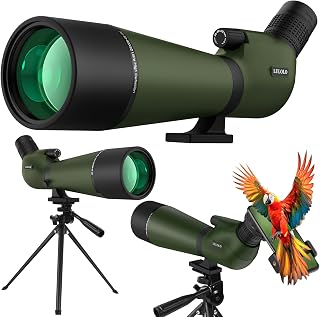
30-90×9292mm lens, UHD optics
8.7OUT OF 10
Optical Clarity8.6
Build Quality8.4
Ease of Use7.9
Value for Money9.5
This scope offers the highest magnification and largest objective lens in the under-$200 category. The 30-90x zoom range paired with a 92mm objective lens gives you incredible reach for distant details. The UHD (Ultra High Definition) optics aim to reduce color fringing and improve sharpness. It’s a straight-body scope with a built-in tripod and phone adapter.
The included tripod is sturdy enough for the heavy scope, and the phone adapter is adjustable for different phone sizes. User reviews are enthusiastic about the magnification at 90x, noting that you can read signs or identify birds at distances where other scopes fall short. The waterproof construction adds to its durability.
Flaws but not dealbreakers. At 90x, the image is very susceptible to heat shimmer and tripod vibration. You’ll need a calm day and a very stable tripod to use the full zoom. The scope is also large and heavy, making it less portable than smaller options.
If you want a more portable package, the
NWDEY 25-75X60 is much lighter and easier to carry on long hikes.
⚠Stability: At 90x, even a light breeze can make the image shake. Use a heavier tripod or weigh down the center column.
Pros
- ✓Highest magnification range (30-90x) in this budget
- ✓92mm objective lens for maximum light
- ✓UHD optics reduce chromatic aberration
- ✓Waterproof and includes phone adapter
Cons
- ✕Image at 90x is soft and requires perfect conditions
- ✕Large and heavy (approx 4.5 lb)
- ✕Straight body limits comfort for long sessions
Best for: Experienced users who want extreme magnification for distant objects and don’t mind the weight.
Spotting Scope 20-60×80 Tripod Phone Adapter: Best Budget-Friendly 80mm
#7
SpottingGreat value, 80mm lens
7.8OUT OF 10
Optical Clarity7.5
Build Quality7.2
Ease of Use8.0
Value for Money8.5
This is the most affordable way to get an 80mm objective lens in a complete kit. The Spotting Scope 20-60×80 comes with a tripod, phone adapter, and carrying bag at a very competitive price. It offers a 20-60x zoom range and fully coated optics for decent image quality. The straight body is simple to use and quick to aim.
The tripod is basic but functional, with a pan head for smooth movement. The phone adapter is universal and clips onto the eyepiece securely. User reviews note that the image is surprisingly good for the price, with acceptable sharpness at 40x and below.
Flaws but not dealbreakers. The build quality is noticeably lower than the Gosky or SVBONY options. The plastic components feel less durable, and the tripod is the weakest of the bunch. The image at 60x is softer, and the lens coatings are not as effective at reducing glare.
If you want better build quality, the
Gosky DiamondEdge 20-60×80 costs a bit more but offers significantly better optics and a sturdier tripod.
⚠Warranty: Check the seller’s warranty policy before purchasing. Some units have limited or no warranty.
Pros
- ✓Very affordable price for an 80mm scope
- ✓Includes tripod, phone adapter, and carrying bag
- ✓Simple straight-body design for quick aiming
- ✓Decent image quality at lower magnifications
Cons
- ✕Plastic components feel less durable
- ✕Tripod is the weakest in this lineup
- ✕Image quality drops significantly at 60x
Best for: Casual users on a tight budget who want an 80mm scope for occasional use.
NWDEY 25-75X60 Spotting Scope Upgraded 60in: Best for Portability
#8
NWDEYLightweight, tall tripod
7.5OUT OF 10
Optical Clarity7.3
Build Quality7.0
Ease of Use8.2
Value for Money7.5
If you’re hiking or backpacking and every ounce matters, this is the lightest complete kit in the lineup. The NWDEY 25-75X60 has a 60mm objective lens, which is smaller than the others, but it makes the whole package much lighter and more compact. The upgraded 60-inch tripod is tall enough for standing use but still folds down small.
The angled eyepiece is comfortable for long sessions, and the included phone adapter lets you capture photos. The BAK-4 prisms and fully multi-coated lenses (FMC) help maximize the light from the smaller lens. User reviews appreciate the portability and the smooth focus wheel.
Flaws but not dealbreakers. The 60mm lens limits low-light performance, and the image is noticeably dimmer than the 80mm or 92mm options. The build quality is adequate but not premium. Some users report the tripod leg locks can slip over time.
If you need brighter images for dawn or dusk, the
SVBONY SV28 with its 70mm lens offers a good balance of size and light gathering.
⚠Compatibility: The phone adapter may not fit phones with very large camera bumps. Check your phone case size.
Pros
- ✓Lightest complete kit, great for hiking
- ✓Angled eyepiece for comfortable viewing
- ✓Tall 60-inch tripod included
- ✓BAK-4 prisms and FMC lenses for good clarity
Cons
- ✕60mm lens is dim in low light
- ✕Build quality is average
- ✕Tripod leg locks can slip over time
Best for: Hikers and backpackers who need a lightweight scope for daytime use.
Buying Guide: Objective Lens, Magnification, Body Style and Budget
A spotting scope is a simple tool once you understand three key specs. Here's what you need to know before you buy.
Objective Lens Size: 60mm, 70mm, 80mm, 82mm, or 92mm?
The objective lens is the big lens at the front. It determines how much light enters the scope. A larger lens gives you a brighter image, especially in low light.
The trade-off is weight and size.
The scopes in this list range from 60mm to 92mm. The 60mm models like the NWDEY 25-75X60 are great for daytime hiking but struggle at dawn or dusk. The 80mm and 82mm models offer a good balance.
The 92mm model is the brightest but also the heaviest.
For most birdwatchers and target shooters, 70mm or 80mm is the sweet spot. It gives you enough light for overcast days without being too heavy to carry. If you shoot at dawn, the 82mm or 92mm models are worth the extra weight.
Magnification Range: What Zoom Do You Need?
Most budget scopes offer a zoom range like 20-60x or 25-75x. The lower number is the widest view, useful for finding your target. The higher number is the most zoomed-in view.
At 20x, you can scan a large area easily. At 60x, you can see details like a bird's feather pattern at 100 yards. But higher magnification comes with challenges.
The image gets dimmer and softer, and any shake in the tripod becomes very noticeable.
A 20-60x range is versatile enough for most users. The 25-75x and 30-90x models offer more reach but require perfect conditions to use the full zoom. For most people, 60x is plenty.
Straight vs. Angled Body: Which Is Better?
Straight-bodied scopes are easier to aim at moving targets. They're also simpler to pack. But you need a taller tripod to use them comfortably while seated.
Angled scopes are more comfortable for long sessions. You can look down into the eyepiece without craning your neck. They're also easier to share with a group because people of different heights can use the same tripod.
For target shooting, a straight body is often preferred. For birdwatching, an angled body is usually more comfortable. The SVBONY SV28 and the Gosky 25-75×80 Tripod are good angled options.
Budget and Extras: What's Included?
All the scopes in this guide come with a basic tripod, phone adapter, and carrying bag. The quality of these extras varies. The SVBONY and Gosky models have better tripods than the budget options.
You don't need to spend extra on accessories right away. The included phone adapter is fine for casual photos. If you want better stability later, you can upgrade the tripod.
A decent tripod from a reputable brand can make a noticeable difference in image stability.
Who Should NOT Buy Best Spotting Scope under $200
This category is the wrong purchase for three kinds of buyers. Here's who they are, and what to look at instead.
You Need Professional-Grade Optics
If you're a serious birder or a competitive shooter, a budget scope will frustrate you. The image quality at high magnification is noticeably softer than premium scopes. Chromatic aberration (color fringing) is common, and the build quality won't survive heavy use.
Look at scopes from manufacturers like Swarovski, Zeiss, or Leica. They cost significantly more, but the optical clarity and durability are in a different league. Budget scopes are fine for getting started, but they're not professional tools.
You Need a Compact Scope for Backpacking
Even the lightest scope here, the NWDEY 25-75X60, is still a bulky package when you add the tripod. If you're backpacking or hiking long distances, a spotting scope is overkill. You'll get more use from a good pair of binoculars.
Consider a pair of compact binoculars instead. They're lighter, smaller, and easier to carry. You can also use them for general wildlife viewing.
For a comparison, check out our guide to the top-rated binoculars for outdoor use to see what fits your needs.
You Only Plan to Use It Once or Twice
If you're just curious about birdwatching or target shooting, a spotting scope is a significant investment for occasional use. You might be better off borrowing one from a friend or a local birding group.
Alternatively, consider a monocular. They're much cheaper and still give you magnified views. You can always upgrade to a spotting scope later if you find yourself using it often.
Final Verdict
The SVBONY SV28 is our top pick for the best spotting scope under $200 because it offers the most complete kit with excellent optics and a comfortable angled body. It's the best starting point for beginners.
Want brighter images for low-light use? The Gosky Flagship DiamondEdge 20-60×80 has an 80mm lens that lets in more light. Need the highest magnification?
The 30-90×92 UHD High-Power Scope gives you the most reach.
If you're still unsure, go back to the Who Should NOT Buy section. If you're not one of those three groups, the SVBONY SV28 is a safe, reliable choice that will serve you well for years.
FAQ
What's the best Spotting Scope under $200 overall?
The SVBONY SV28 is the best overall. It offers a complete kit with a 70mm objective lens, angled eyepiece, tripod, phone adapter, and carrying bag. It's the most balanced option for beginners.
Is a 60mm spotting scope enough for birdwatching?
A 60mm scope is fine for daytime birdwatching in good light. But it will struggle in low light and at high magnification. For serious birding, 70mm or 80mm is better.
How important is the tripod for a spotting scope?
Very important. A shaky tripod makes the image unusable at high magnification. The included tripods in this price range are functional but not great.
If you can, invest in a better tripod later.
Can I use a spotting scope for astrophotography?
Budget spotting scopes are not good for astrophotography. They lack the optical quality and tracking stability needed. You're better off with a dedicated telescope.
What does BAK-4 mean in a spotting scope?
BAK-4 is a type of glass used for the prisms. It produces sharper and brighter images than BK-7 glass. All the scopes in this guide use BAK-4 prisms, which is a good sign.