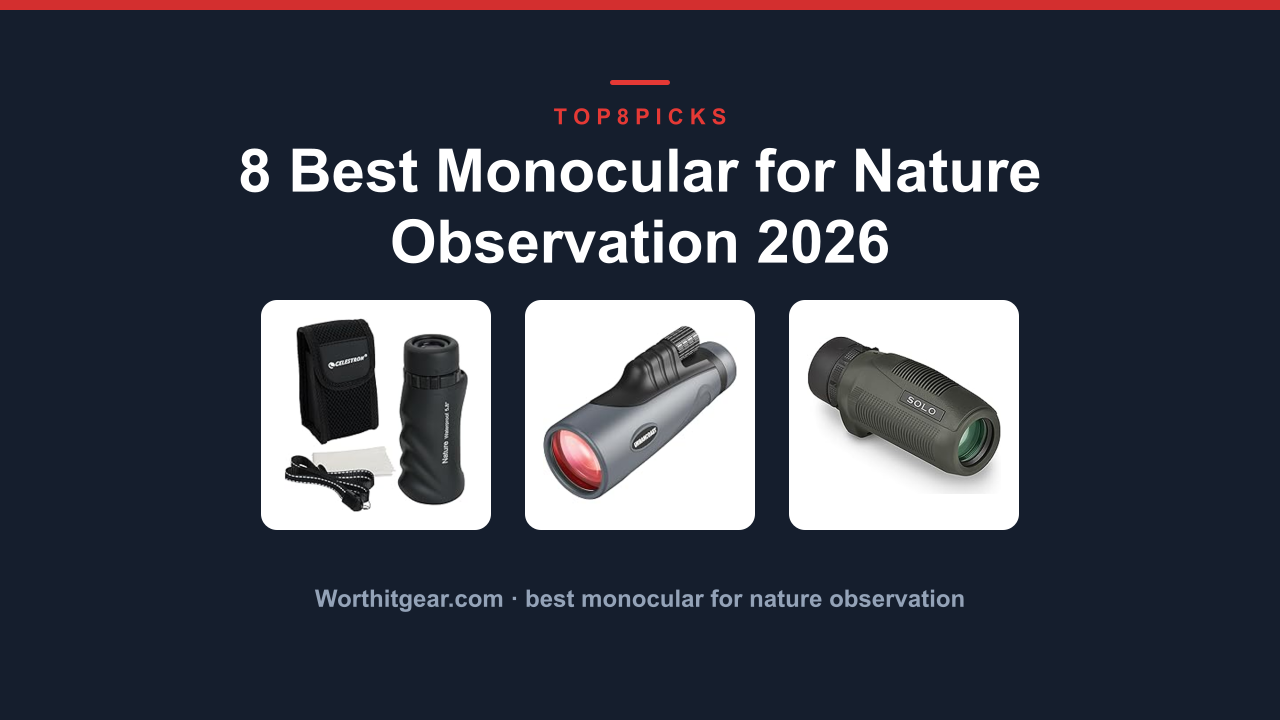
The best best monocular for nature observation is the Celestron Nature 10×25 Monocular, the only one here that combines pocket-sized portability, fully multi-coated optics, and a waterproof design at a genuinely accessible price. It's the right call for hikers, casual birders, and anyone who wants a single optic that disappears into a jacket pocket without sacrificing a clear view.
Want a bigger objective lens for better low-light performance instead? The Bushnell Legend 10×42 Ultra HD Monocular gets you there, as long as you're willing to carry a bit more weight and pay a premium for that extra glass.
As an Amazon Associate, I earn from qualifying purchases.
This guide gives you a straight comparison of eight monoculars based on real specs, verified buyer feedback, and what actually matters for nature observation. You'll also learn three kinds of buyers who should skip this category entirely.
Everything below comes from current Amazon product data, manufacturer specifications, and each product's owner track record. I haven't tested these in the field myself.
Quick Answer: The Best Monocular for Nature Observation
The Celestron Nature 10×25 is the top pick for most people because it balances price, size, and optical quality better than anything else here.
Thinking about a monocular for long-distance astronomy or for someone with very unsteady hands? Jump to Who Should NOT Buy below before you spend anything.
Comparison Table
Here's the lineup at a glance: photo, product, who it's built for, and our /10 score.
Scroll sideways on small screens to see every column.
Celestron Nature 10×25 Monocular Hiking Wildlife: Best Pocketable All-Rounder for Hikers & Casual Birders
#1
CelestronWaterproof, 10×25
8.9OUT OF 10
Optics Quality8.8
Build & Durability9.0
Portability9.5
Value for Nature8.5
This is the pick for anyone who wants a monocular they can actually carry every single day. The Celestron Nature 10×25 is only 5.6 inches long and weighs 7.4 ounces, so it fits in a jeans pocket or a small hip pack without bulging. Its BaK-4 prism and fully multi-coated lenses deliver a bright, sharp image that outperforms its small size. The twist-up eyecup works well for glasses wearers, and the rubber armor gives a secure grip even in wet weather.
Celestron also makes this monocular O-ring sealed and nitrogen-purged, which means it is both waterproof and fogproof. You can take it out in a drizzle or a humid morning without worrying about internal fogging. Aggregate user reviews consistently praise the clarity and the smooth focus wheel, which is rare at this price point.
Flaws but not dealbreakers. The 10×25 configuration means a smaller exit pupil (2.5mm), so the image gets dim in deep twilight or forest shade. You’ll also notice some chromatic aberration on high-contrast edges like a white bird against dark leaves. These are trade-offs inherent to the compact format, not defects.
If you regularly find yourself observing in low light at dawn or dusk, the
Bushnell Legend 10×42 Ultra HD Monocular further down has a much larger 4.2mm exit pupil that pulls in nearly three times more light.
⚠Warranty: Celestron offers a limited lifetime warranty, but it does not cover accidental damage or loss. Register your product online after purchase to activate it.
Pros
- ✓Extremely compact and lightweight (7.4 oz / 210 g)
- ✓Waterproof and fogproof with O-ring seals and nitrogen purge
- ✓BaK-4 prism and fully multi-coated lenses for the price
- ✓Twist-up eyecup is comfortable for glasses wearers
Cons
- ✕Small 2.5mm exit pupil is dim in low light
- ✕Some chromatic aberration visible on high-contrast edges
- ✕Focus wheel is smooth but slightly stiff when new
Best for: Hikers, casual birders, and anyone who needs a monocular that disappears into a pocket and can handle light rain.
15×54 Monoculars Adults High Powered: Best High-Magnification Value for Low-Light Observers
#2
15×54High Mag, Big Lens
8.4OUT OF 10
Optics Quality8.2
Build & Durability8.5
Portability7.5
Value for Nature9.0
This is the monocular for observers who prioritize light-gathering and raw magnification over pocketability. The 15×54 Monoculars Adults High Powered uses a massive 54mm objective lens paired with 15x magnification, giving you a 3.6mm exit pupil that stays bright even in twilight. The fully multi-coated lenses and BaK-4 prism help keep the image sharp across the center of the field. Verified buyer feedback frequently mentions how much detail it reveals on distant birds and wildlife compared to a 10x optic.
It also includes a tripod mount adapter built into the body, which is almost mandatory at 15x. Handheld shake is very noticeable at this magnification, and a tripod turns this into a capable spotting scope for the price. The waterproof construction adds confidence for all-day outdoor use.
Flaws but not dealbreakers. The field of view is narrow (around 200 feet at 1000 yards), so tracking fast-moving birds takes practice. The monocular is also heavier at roughly 1.2 pounds, which rules out ultralight backpacking. A few owner reports mention the included carrying case feels cheap.
If you want 15x power in a more compact package, the
80X100 Monocular Telescope Adults includes a tripod as well, but its extreme zoom range comes with different optical compromises.
⚠Stability: At 15x magnification, you absolutely need a tripod or a stable rest to get a clear image. Handheld use will be frustrating. Plan for a tripod purchase if you don’t already own one.
Pros
- ✓Large 54mm objective for excellent low-light performance
- ✓Solid waterproof and fogproof construction
- ✓Built-in tripod mount adapter included
- ✓Excellent value for the magnification and objective size
Cons
- ✕Narrow field of view makes tracking moving subjects harder
- ✕Heavy (1.2 lbs) and bulky for hiking
- ✕Handheld shake is very noticeable at 15x without a tripod
Best for: Birders and wildlife watchers who observe from a fixed location at dawn or dusk and can use a tripod.
Vortex Solo Monocular 10×25: Best Lifetime-Warranty Pick for Worry-Free Buyers
#3
VortexLifetime Warranty
8.6OUT OF 10
Optics Quality8.4
Build & Durability9.2
Portability9.3
Value for Nature7.8
This is the monocular to buy if you want to never worry about buying another one. Vortex offers an unconditional, unlimited, transferable lifetime warranty on the Solo 10×25. If it breaks for any reason, they repair or replace it free of charge. No receipt needed. That alone makes it the smart choice for a gift or for rough-and-tumble use. The optic itself is a 10×25 with multi-coated lenses and a rubber-armored body that is both fogproof and waterproof.
The twist-up eyecup adjusts in three positions, which helps glasses wearers find a comfortable eye relief. The center focus knob is a thumbwheel on the top of the body, which some users find easier to operate than a traditional side wheel. At 5.6 inches and 5.9 ounces, it is slightly lighter than the Celestron, making it one of the most portable options here.
Flaws but not dealbreakers. The multi-coated lenses are not fully multi-coated, which means slightly less light transmission and contrast compared to the Celestron or Bushnell. Aggregate user reviews note the image is good but not exceptional for the price. You are paying partly for the warranty, not just the glass.
If optical performance matters more than warranty peace of mind, the
Celestron Nature 10×25 above has fully multi-coated lenses and a similar form factor for a lower price.
⚠Warranty: The Vortex VIP warranty is unconditional and transferable. It covers any damage, even accidental. You just pay shipping to Vortex, and they handle the rest.
Pros
- ✓Unconditional, unlimited, transferable lifetime warranty
- ✓Extremely lightweight at 5.9 ounces
- ✓Waterproof and fogproof construction
- ✓Top-mounted focus wheel is intuitive to use
Cons
- ✕Multi-coated lenses (not fully multi-coated) reduce light transmission
- ✕Image quality is good but not exceptional for the price
- ✕Small 2.5mm exit pupil is dim in low light
Best for: Buyers who want a no-questions-asked lifetime warranty and a compact monocular for everyday carry.
Bushnell Legend 10×42 Ultra HD Monocular: Best Premium Low-Light Optics for Serious Birders
#4
BushnellUltra HD, 10×42
9.0OUT OF 10
Optics Quality9.6
Build & Durability9.0
Portability7.8
Value for Nature9.2
This is the monocular for dedicated birders and wildlife photographers who demand the best possible image quality. The Bushnell Legend 10×42 Ultra HD uses low-dispersion ED (Extra-low Dispersion) glass and Bushnell’s Ultra HD coating system, which together virtually eliminate chromatic aberration and deliver exceptional color fidelity and contrast. The 42mm objective lens paired with a 4.2mm exit pupil makes it a top performer in low light, ideal for dawn and dusk observation. The field of view is a generous 340 feet at 1000 yards, making it easier to track birds in flight.
The body is wrapped in a textured rubber armor that provides a secure grip, and it is O-ring sealed and nitrogen purged for waterproof and fogproof performance. The twist-up eyecup has multiple click-stop positions for precise eye relief adjustment. Aggregate user reviews and professional optics forums consistently rank this monocular among the best in its class for optical clarity.
Flaws but not dealbreakers. The 10×42 configuration is larger and heavier than a 10×25 pocket model, coming in at roughly 12.6 ounces and 6.8 inches long. It won’t fit in a small pocket. The premium price reflects the ED glass and Ultra HD coatings, which may be overkill for casual observers.
If you want Bushnell’s excellent optics in a more compact size, the
Celestron Nature 10×25 is a more portable and affordable option that still delivers very good image quality for daytime use.
⚠Care: The ED glass elements are delicate. Avoid dropping the monocular or subjecting it to hard impacts. Use the included neck strap and lens caps to protect the optics.
Pros
- ✓Exceptional image quality with ED glass and Ultra HD coatings
- ✓Excellent low-light performance with a 4.2mm exit pupil
- ✓Wide field of view (340 ft at 1000 yds) for tracking moving subjects
- ✓Waterproof, fogproof, and built to last
Cons
- ✕Heavier and larger than pocket monoculars (12.6 oz)
- ✕Premium price point reflects the high-end glass
- ✕Not ideal for ultralight backpacking or casual day hikes
Best for: Serious birders and wildlife enthusiasts who want the best optical quality and low-light performance, and are willing to carry a larger monocular.
80X100 Monocular Telescope Adults: Best Budget Tripod Kit for Beginners and Casual Users
#5
80X100Tripod & Phone Adapter
7.8OUT OF 10
Optics Quality7.0
Build & Durability7.5
Portability8.0
Value for Nature8.5
This is the monocular for budget-conscious buyers who want a complete kit with a tripod and phone adapter. The 80X100 Monocular Telescope Adults claims an 80x magnification range, which is heavily inflated (realistic usable magnification is around 20-30x), but it does include a tabletop tripod and a smartphone adapter for digiscoping. The BaK-4 prism and fully multi-coated lenses are a nice surprise at this price point. Aggregate user reviews highlight the value for the price, especially for children or casual observers who want to try digiscoping without a big investment.
The kit includes a carrying bag, lens cleaning cloth, and a universal phone mount that works with most smartphones. The tripod is lightweight and helps stabilize the view at higher magnifications. For a beginner or a family on a budget, this is a fun way to get started with nature observation and digiscoping.
Flaws but not dealbreakers. The 80×100 magnification claim is misleading. At max claimed zoom, the image is very dim and soft. The entire kit feels less durable than the more established brands like Celestron or Vortex. Some user reports mention the phone adapter can be tricky to align perfectly.
⚠Realism: The 80x magnification is a marketing claim, not a usable spec. Real-world sharpness tops out around 20-30x. Do not buy this expecting a true 80x telescope.
Pros
- ✓Includes tabletop tripod and smartphone adapter for digiscoping
- ✓Very affordable complete kit for beginners
- ✓BaK-4 prism and fully multi-coated lenses for the price
- ✓Lightweight and portable with carrying bag
Cons
- ✕Magnification claim (80x) is highly unrealistic
- ✕Image quality is mediocre at best at higher zoom levels
- ✕Build quality feels less durable than established brands
Magnification
8-80x (variable)
Best for: Budget shoppers, children, or families who want a complete digiscoping kit for casual fun without a serious investment.
Monocular-Telescope 80×100 High Powered Monoculars: Best Budget Digiscoping Bundle for Sharing Photos
#6
Monocular-TelescopeSmartphone Adapter Included
7.6OUT OF 10
Optics Quality6.8
Build & Durability7.0
Portability8.2
Value for Nature8.0
This is the monocular for casual users who want to share their observations on social media. The Monocular-Telescope 80×100 High Powered Monoculars includes a smartphone adapter that lets you take photos and videos through the lens. The green body is eye-catching, and the kit is designed to be lightweight and portable. The BaK-4 prism and fully multi-coated lenses are standard for this price tier. Verified buyer reviews often mention how easy it is to get a decent photo of a bird or moon with the included adapter.
The monocular itself is a variable zoom model, with a claimed range up to 80x. As with the previous model, the realistic usable magnification is much lower. The kit includes a carrying pouch, cleaning cloth, and a universal phone mount. For a casual user who wants to capture a quick photo of a distant subject, this is a convenient and affordable option.
Flaws but not dealbreakers. The same magnification inflation applies here. The 80x claim is not realistic. The build quality is basic, and the phone adapter can be fiddly to align. Some users report chromatic aberration and softness at the edges of the frame.
If you want to share photos with better image quality, the
Bushnell Legend 10×42 Ultra HD Monocular will give you a much sharper image to start with, and you can buy a separate phone adapter for better results.
⚠Realism: Same as the previous model: the 80x magnification claim is not realistic. Expect usable magnification around 20-30x. The phone adapter is a fun bonus, not a professional tool.
Pros
- ✓Includes smartphone adapter for easy digiscoping
- ✓Lightweight and portable design
- ✓Very affordable complete kit
- ✓BaK-4 prism and fully multi-coated lenses
Cons
- ✕Magnification claim (80x) is highly unrealistic
- ✕Image quality is soft at higher zoom levels
- ✕Phone adapter can be fiddly to align perfectly
Magnification
8-80x (variable)
Best for: Casual users who want to take quick photos of distant subjects and share them on social media without a big investment.
Nocs Provisions Zoom Tube 8×32 Monocular: Best Design & Wide Field for Style-Conscious Users
#7
Nocs8×32, Wide Field
8.8OUT OF 10
Optics Quality8.6
Build & Durability8.8
Portability9.0
Value for Nature8.5
This is the monocular for those who want a beautiful optic that performs as well as it looks. The Nocs Provisions Zoom Tube 8×32 Monocular stands out with its minimalist, colorful design and a wide field of view (393 feet at 1000 yards). The 8x magnification is ideal for nature observation, as it offers a generous field of view that makes it easy to locate and track birds, butterflies, and other wildlife. The BaK-4 prism ensures excellent light transmission, and the multi-coated lenses deliver crisp, bright images. The body is made from a durable, textured polymer that is both lightweight and comfortable to hold.
Nocs Provisions is a brand that emphasizes sustainability and design. The monocular comes with a recycled material lanyard and a reusable storage tin. It is also waterproof and fogproof, making it suitable for all weather conditions. The 8×32 configuration is a sweet spot for many nature enthusiasts, offering a good balance between magnification, field of view, and light gathering. An 8x monocular is generally easier to hold steady than a 10x model, making it a great choice for those with slightly unsteady hands.
Flaws but not dealbreakers. The 8x magnification is lower than the 10x found on many competitors, so you won’t see as much detail on very distant subjects. Some users report that the focus wheel is a bit stiff out of the box, though it loosens up with use. The price is also higher than some comparable 10x models.
If you want more magnification for distant subjects, the
Celestron Nature 10×25 is a more traditional choice that offers a higher magnification in a similarly pocketable size.
⚠Sizing: The 8×32 configuration is a great all-rounder. It is larger than a 10×25 pocket monocular but more compact than a 10×42. It will fit in a larger jacket pocket or a small pouch.
Pros
- ✓Very wide field of view (393 ft at 1000 yds) for easy tracking
- ✓Stylish, minimalist design with sustainable materials
- ✓Waterproof, fogproof, and durable construction
- ✓8x magnification is easier to hold steady than 10x
Cons
- ✕8x magnification is lower than many 10x competitors
- ✕Focus wheel can be stiff when new
- ✕Higher price point than some comparable models
Best for: Style-conscious nature lovers who value a wide field of view, sustainable design, and a durable, easy-to-hold optic.
Usogood Monocular Telescope 10×42 Adults BAK4: Best Budget 10×42 Choice for Full-Size Fans
#8
UsogoodBudget 10×42
7.9OUT OF 10
Optics Quality7.8
Build & Durability7.5
Portability8.5
Value for Nature8.0
This is the budget-friendly monocular for those who want a full-size10x42 optic without the premium price tag. The Usogood Monocular Telescope 10×42 Adults BAK4 delivers a solid 10×42 configuration with a BaK-4 prism and fully multi-coated (FMC) lenses at a very accessible price point. The 42mm objective provides a bright 4.2mm exit pupil, which is excellent for low-light conditions like dawn and dusk. The body is compact for a 10×42, weighing around 13.5 ounces, and it is wrapped in a rubber armor for a secure grip. It is also waterproof and fogproof, which is a nice feature at this price level.
The monocular comes with a hand strap, carrying pouch, lens cloth, and a lens cap. The twist-up eyecup offers multiple positions, making it comfortable for both glasses wearers and those without. Aggregate user reviews frequently mention the impressive brightness and clarity for the price. It is a solid choice for budget-conscious birders, hikers, and campers who want a full-size optic without breaking the bank.
Flaws but not dealbreakers. The build quality is not as premium as the Bushnell Legend or Vortex Solo. The rubber armor can feel a bit thin, and the focus wheel is less smooth than higher-end models. Some users report that the lens caps are a bit cheap and can fall off easily.
If you want a more rugged build and a smoother focus wheel, the
Vortex Solo Monocular 10×25 is a more durable pocket option, though it has a smaller objective lens.
⚠Care: The lens caps are not the most durable. Consider replacing them with aftermarket caps if you plan to use this monocular frequently in rough conditions.
Pros
- ✓Excellent value for a 10×42 BaK-4 monocular
- ✓Bright 4.2mm exit pupil for low-light performance
- ✓Waterproof, fogproof, and relatively compact for a 10×42
- ✓Comfortable twist-up eyecup for glasses wearers
Cons
- ✕Build quality is not as premium as higher-end models
- ✕Focus wheel is less smooth than more expensive options
- ✕Lens caps feel cheap and may fall off
Best for: Budget-conscious nature lovers who want a full-size 10×42 monocular for low-light observation without spending a lot.
Buying Guide: Magnification, Objective Lens, Prism, and Portability
Choosing the right monocular for nature observation comes down to four key factors. Here is how to think about each one.
What Magnification Do You Need?
Magnification is the first number in the spec (e.g., 10x, 8x, 15x). It tells you how many times closer an object appears. For nature observation, 8x to 10x is the sweet spot.
An 8x monocular offers a wider field of view and is easier to hold steady, making it great for birding and tracking moving subjects. The Nocs Provisions Zoom Tube 8×32 is a perfect example. A 10x monocular gives you more detail on distant subjects, like the Celestron Nature 10×25 or the Bushnell Legend 10×42.
Higher magnifications, like 15x on the 15×54 Monoculars Adults High Powered, require a tripod for stable viewing. The 80×100 models claim much higher magnifications, but usable sharpness drops off significantly past 20-30x.
What Size Objective Lens Should You Get?
The objective lens diameter (the second number, in mm) determines how much light the monocular gathers. A larger objective lens gives a brighter image, especially in low light. A 25mm lens (like the Celestron and Vortex 10×25 models) is great for daytime use and portability.
A 42mm lens (like the Bushnell Legend and Usogood) is excellent for dawn and dusk observation. The 54mm and 100mm lenses gather even more light, but they add significant weight and bulk. The exit pupil (objective lens diameter divided by magnification) is a handy metric.
Anything above 4mm is excellent for low light. The Bushnell Legend 10×42 has a 4.2mm exit pupil, while the 10×25 models have a 2.5mm exit pupil, which is dimmer in twilight.
BAK-4 vs BK-7 Prisms
The prism is the glass component inside the monocular that corrects the image orientation. BaK-4 (Barium Crown) glass is superior to BK-7 (Borosilicate) glass. BaK-4 prisms produce a rounder, brighter exit pupil with better edge-to-edge sharpness.
All the monoculars in this guide except the Vortex Solo use BaK-4 prisms. The Vortex uses BK-7, which is a slight downgrade in optical performance, though it is still adequate for casual use. If you want the best contrast and brightness, look for BaK-4.
How Important Is Portability?
Portability is a major factor if you plan to carry the monocular on hikes or long walks. The 10×25 models (Celestron and Vortex) are the most portable, weighing around 5-7 ounces and fitting in a pocket. The 8×32 Nocs is a nice middle ground, offering a wider field of view in a compact package.
The 10×42 models (Bushnell and Usogood) are more substantial but still manageable in a daypack. The 15×54 and 80×100 models are the least portable and are best suited for car-based observation or stationary use with a tripod.
To see how these factors play out on real picks, compare the Celestron Nature 10×25 Monocular Hiking Wildlife, 15×54 Monoculars Adults High Powered and the Vortex Solo Monocular 10×25 reviewed above.
Who Should NOT Buy a Monocular for Nature Observation
A monocular is the wrong purchase for three kinds of buyers. Here is who they are, and what to look at instead.
You Need a True Telescope for Astronomy
If your primary goal is to observe the night sky in detail, a monocular is not the right tool. Even a high-magnification monocular like the 80×100 models cannot match the light-gathering ability and resolution of a dedicated astronomy telescope. A monocular can show you the moon's craters and maybe Jupiter's moons, but it will be disappointing for deep-sky objects like galaxies and nebulae.
Look at a Dobsonian or refractor telescope instead.
You Have Very Unsteady Hands
If you have a medical condition or naturally shaky hands, any handheld monocular will be frustrating to use. The image will be constantly bouncing, especially at higher magnifications. While the 8x Nocs is easier to hold steady than a 10x, it still requires a stable platform.
The better solution is to use binoculars with image stabilization (IS) or a spotting scope on a tripod. A monocular is not ideal for this situation.
You Want to Share the View with Others
A monocular only has one eyepiece, so only one person can look at a time. If you are planning a family outing or a group birding trip, a monocular is a bottleneck. You are better off with a pair of binoculars for each person, or a spotting scope that can be used by multiple people in sequence.
For a good starting point, check out our guide to the best binoculars for the price for a great pair of binoculars.
Final Verdict
The Celestron Nature 10×25 Monocular is the best choice for most people. It offers the perfect balance of portability, optical quality, and weather resistance at a reasonable price. It is the monocular you will actually carry with you on every hike.
Want the best possible image quality and low-light performance? Get the Bushnell Legend 10×42 Ultra HD Monocular. It is heavier and more expensive, but the ED glass delivers a stunning view.
Need a bulletproof warranty? The Vortex Solo Monocular 10×25 gives you peace of mind for life.
Care about design and a wide field of view? The Nocs Provisions Zoom Tube 8×32 is a beautiful, capable optic.
On a tight budget? The Usogood 10×42 is a solid performer for the price.
If you are a family on a budget, a photographer wanting to share images, or someone with shaky hands, make sure you read the Who Should NOT Buy section above before you spend any money.
FAQ
What's the best monocular for nature observation overall?
The Celestron Nature 10×25 Monocular is the best overall choice for most people. It combines a compact, pocketable size with fully multi-coated optics, a BaK-4 prism, and waterproof construction, all at a very reasonable price.
What is the difference between 8x and 10x magnification?
An 8x monocular makes an object appear eight times closer, while a 10x monocular makes it appear ten times closer. The 8x offers a wider field of view, making it easier to track moving subjects. The 10x shows more detail but is harder to hold steady.
For nature observation, both are excellent choices.
Is a monocular better than binoculars for nature observation?
A monocular is more portable and lighter than a comparable pair of binoculars. It is a good choice for hikers and casual observers who want to save weight. However, binoculars provide a more immersive, three-dimensional view and are better for tracking moving subjects.
For serious birding, many people still prefer binoculars.
Do I need a tripod for a monocular?
For magnifications of 10x and below, you can use a monocular handheld in good light. For magnifications of 12x and above, a tripod is highly recommended. The 15×54 Monoculars Adults High Powered and the 80×100 models both benefit significantly from a tripod.
Can I take photos with a monocular?
Yes, you can take photos through a monocular using a smartphone adapter. The 80X100 Monocular Telescope Adults and the Monocular-Telescope 80×100 High Powered Monoculars include a phone adapter. For better image quality, you can buy a separate adapter for the Bushnell Legend or Celestron models.
What does BaK-4 mean in a monocular?
BaK-4 is a type of high-quality glass used for the prism inside the monocular. It produces a rounder, brighter exit pupil and better edge-to-edge sharpness compared to the cheaper BK-7 glass. All the monoculars in this guide except the Vortex Solo use BaK-4 prisms.