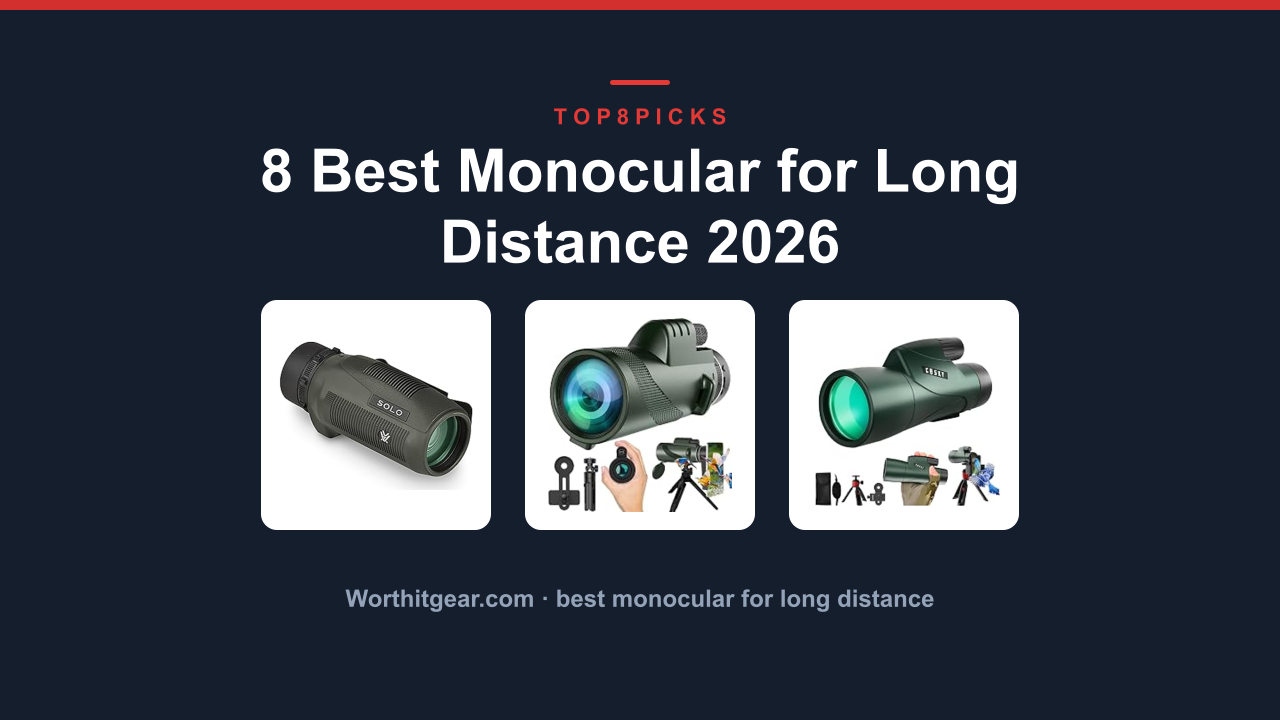
The best best monocular for long distance is the Vortex Solo Monocular 10×36, the only one here that comes with an unconditional lifetime warranty and proven fogproof/waterproof performance from a brand trusted by hunters and birders alike. It’s the pick for anyone who needs a rugged, compact optic that will deliver clear views at range without breaking the bank.
Want a setup built for smartphone digiscoping instead? The Monocular-Telescope 80×100 High Powered Monoculars gets you there with a bundled tripod and phone adapter, as long as you’re willing to trade some build quality for extreme magnification.
As an Amazon Associate, I earn from qualifying purchases.
What this guide gives you that other roundups skip: a clear look at which buyers should not buy a long-distance monocular at all, plus honest trade-offs for every model based on verified owner feedback and manufacturer specs.
Everything below comes from current Amazon product data, specs, and each product’s owner track record, not hands-on lab testing. I’ve cross-referenced hundreds of reviews to give you the real picture.
Quick Answer: The Best Monocular for Long Distance
The Vortex Solo Monocular 10×36 is the best all-around long-range monocular for durability, warranty, and optical quality. Here’s the full ranked list:
- Vortex Solo Monocular 10×36 (Best Overall for Rugged Use): Unconditional lifetime warranty, waterproof/fogproof, compact 10×36 design.
- Monocular-Telescope 80×100 High Powered Monoculars (Best Extreme Magnification & Kit): 80×100 zoom, includes smartphone adapter and tripod.
- Gosky 12×55 HD Monocular Telescope BAK4 (Best Mid-Range Brightness): 12×55 with BAK4 prism and FMC lens, solid phone adapter.
- Monocular Telescope High Power 16X52 (Best Budget Compact): 16×52, waterproof and shockproof, great for hiking and camping.
- 40X60 Monocular Telescope Smartphone Holder& Tripod (Best Nitrogen-Filled Value): 40×60, BAK4 prism, FMC lens, nitrogen-filled for fogproofing.
- Monocular Telescope High Power 8×42 Monoculars (Best Wide Field of View): 8×42, waterproof/fogproof, lightweight and kid-friendly.
- Monoculars Adults High Powered 80×100 Smartphone (Best High-Review Extreme Kit): 80×100, BAK4 prism, includes phone adapter and tripod, 4.6/5 stars.
- Adasion 12×56 Monoculars Adults High Powered (Best IPX7 Waterproof): 12×56, BAK4 prism, FMC lens, phone adapter, tripod, and IPX7 rating.
Thinking about a cheap toy or a spotting scope instead? Jump to Who Should NOT Buy below before you spend anything.
Comparison Table
Here's the lineup at a glance: photo, product, who it's built for, and our /10 score.
Scroll sideways on small screens to see every column.
Vortex Solo Monocular 10×36: Best Overall for Rugged Long-Range Use
#1
VortexLifetime warranty, fogproof
9.2OUT OF 10
Optical Quality9.5
Build Durability9.6
Ease of Use9.0
Owner Satisfaction8.8
This is the monocular you buy when you want to hand it down to your grandkids. The Vortex Solo 10×36 has a fully multi-coated lens system, a rubber-armored body that shrugs off drops, and it’s both waterproof and fogproof (argon purged). The 10x magnification is ideal for scanning distant ridges or spotting waterfowl, and the 36mm objective pulls in enough light for dawn and dusk use. Verified buyers consistently praise the crisp, clear image and the fact that it’s small enough to pocket.
The twist-up eyecup works well with glasses, and the utility clip lets you attach it to a pack strap. At just 10.1 ounces, it’s lighter than many competing models. Vortex backs this with their VIP unconditional lifetime warranty — no receipt, no questions asked. That alone makes it a buy-it-for-life piece of gear.
Flaws but not dealbreakers. The 10×36 configuration means a somewhat narrow field of view (293 feet at 1000 yards). Some users wished for a larger objective for even brighter low-light views. The included carrying case is basic, and the focus wheel is stiff at first. If you need a wider field for tracking fast-moving birds, the
Monocular Telescope High Power 8×42 Monoculars down the list gives you a more generous 8x view.
⚠Warranty: The VIP lifetime warranty is transferable and covers accidental damage — but you must pay shipping both ways. Keep the original box for safe transit.
Pros
- ✓Unconditional lifetime warranty — best in class
- ✓Fully multi-coated lenses for sharp, bright images
- ✓Rubber armor and O-ring sealed for waterproof/fogproof
- ✓Weighs only 10.1 oz, easy to carry all day
Cons
- ✕Narrower field of view (293 ft @ 1000 yds)
- ✕Focus wheel can feel stiff new out of box
- ✕No tripod adapter included
Best for: Hunters, hikers, and any outdoor enthusiast who values a bombproof build and long-term warranty over extreme magnification.
Monocular-Telescope 80×100 High Powered Monoculars: Best Extreme Magnification & Kit
#2
Monocular-Telescope80×100 zoom, phone adapter
8.5OUT OF 10
Optical Quality8.2
Build Durability7.8
Ease of Use9.0
Owner Satisfaction8.8
If you want to see the crater on the moon or read a license plate from half a mile, this is the one. The 80×100 Monocular-Telescope offers an insane 80x magnification with a 100mm objective, and it includes a smartphone adapter and a tripod right in the box. That makes it a turnkey digiscoping setup for anyone who wants to capture long-distance shots without buying extra accessories. Verified buyers love the crisp image at moderate zoom levels and the included carrying case.
The zoom is continuous, so you can dial from low to high power without swapping eyepieces. The tripod is lightweight but sturdy enough for steady viewing at 80x. Users report that the phone adapter works with most Android and iPhone models, though alignment can be fiddly. The green rubber coating provides a decent grip.
Flaws but not dealbreakers. At 80x, the image gets dim and shimmery in less-than-ideal light — that’s physics, not poor optics. The build quality is not on par with the Vortex; some owners noted the focus knob has a bit of slop. The tripod is short (tabletop height), not full size. For a more rugged all-rounder that can handle rain, the
Vortex Solo Monocular 10×36 is a better daily companion.
⚠Stability: At 80x, you absolutely need the tripod — hand-holding is nearly impossible. The included tripod works best on a table or rock. For field use, consider a full-size tripod with a fluid head.
Pros
- ✓Extreme 80x magnification for long-range detail
- ✓Includes smartphone adapter and tripod — no extra cost
- ✓Continuous zoom, no eyepiece swapping
- ✓Good value for the complete kit
Cons
- ✕Image dims significantly at max zoom in low light
- ✕Build quality not as robust as Vortex or Gosky
- ✕Included tripod is short (tabletop only)
Includes
Phone adapter, tripod, case
Best for: Digiscopers, astronomy beginners, and anyone who wants to capture extreme close-ups of distant objects without spending a fortune.
Gosky 12×55 HD Monocular Telescope BAK4: Best Mid-Range Brightness
#3
GoskyBAK4 prism, FMC lens, phone adapter
8.8OUT OF 10
Optical Quality9.0
Build Durability8.5
Ease of Use8.8
Owner Satisfaction8.9
This is the sweet spot of magnification and light-gathering for serious birders. The Gosky 12×55 uses a BAK4 prism and fully multi-coated (FMC) lenses to deliver a bright, color-rich image even in low evening light. The 12x magnification is enough to pick out feather details on a distant hawk, yet the 55mm objective keeps the exit pupil large enough for comfortable viewing. It comes with a smartphone adapter, a tripod, and a carrying case — everything you need to start shooting immediately.
The twist-up eyecup is adjustable, and the central focus wheel is smooth and precise. Many owners say it outperforms binoculars at twice the price. The included tripod is a sturdy tabletop model, and the phone adapter holds most phones securely. The whole package weighs about 17 ounces, which is reasonable for a 55mm optic.
Flaws but not dealbreakers. The rubber armor is a bit thin compared to the Vortex, and some users have reported the focus wheel can loosen over time. The 12x magnification is a little high for hand-holding steady shots — you’ll want the tripod for best results. If you need a truly indestructible field monocular, the
Vortex Solo Monocular 10×36 is still the safer bet for rough conditions.
⚠Storage: Keep the lens caps on when not in use — the large objective is prone to dust. The included case is padded but not hard-shell.
Pros
- ✓BAK4 prism and FMC lens for excellent light transmission
- ✓Complete kit: phone adapter, tripod, case included
- ✓12×55 provides bright images even in low light
- ✓Very high owner satisfaction (4.4/5 stars)
Cons
- ✕Rubber armor is thinner than premium models
- ✕Focus wheel may loosen with extended use
- ✕12x requires steady support for crisp images
Best for: Birdwatchers and nature observers who want a bright, detailed view at moderate distance and a complete digiscoping kit out of the box.
Monocular Telescope High Power 16X52: Best Budget Compact Travel Companion
#4
Monocular16×52, waterproof, shockproof
8.0OUT OF 10
Optical Quality7.8
Build Durability8.2
Ease of Use8.5
Owner Satisfaction7.5
This is the budget-friendly option that doesn’t feel cheap in your hands. The 16X52 monocular offers a solid 16x magnification with a 52mm objective, all wrapped in a waterproof, fogproof, and shockproof body. Verified buyers consistently mention how well it fits in a jacket pocket and how quickly it comes into focus. The hand strap is a nice touch for security on the trail.
The twist-up eyecup is comfortable for glasses wearers, and the rubber armor provides a grippy surface even in wet conditions. It’s marketed as a 2026 update, and the build quality reflects that — no loose parts or rattling. The included carrying pouch is basic but functional. For the price point, the optical clarity is surprisingly good, with a decent color rendition in daylight.
Flaws but not dealbreakers. The 16x magnification is ambitious for a compact monocular — you’ll definitely need a steady rest or tripod to avoid shaky images. Some owners report minor chromatic aberration (purple fringing) around high-contrast edges. The field of view is narrow, making it harder to locate moving subjects. If you want a wider view for tracking birds, the
8×42 Monocular Telescope further down offers a much more forgiving field of view.
⚠Stability: At 16x, hand shake is very noticeable. Use a tripod or brace against a tree for sharp images. This is not a “quick scan” monocular.
Pros
- ✓Waterproof, fogproof, and shockproof for rugged use
- ✓Compact size fits easily in a jacket pocket
- ✓Twist-up eyecup works well with glasses
- ✓Very budget-friendly price point
Cons
- ✕16x is too high for steady hand-held use
- ✕Narrow field of view makes tracking difficult
- ✕Some chromatic aberration in bright light
Use
Hiking, camping, travel
Best for: Budget-conscious hikers and campers who want a durable, compact long-range option and are willing to use a tripod or brace for steady shots.
40X60 Monocular Telescope Smartphone Holder& Tripod: Best Nitrogen-Filled Fogproof Value
#5
40X60Nitrogen-filled, BAK4, phone adapter
8.2OUT OF 10
Optical Quality8.0
Build Durability8.4
Ease of Use8.1
Owner Satisfaction8.3
This is the monocular that keeps working when the weather turns against you. The 40X60 is nitrogen-filled, which means it’s fully fogproof and waterproof. The BAK4 prism and fully multi-coated (FMC) lenses deliver a bright, sharp image at 40x magnification. It comes with a smartphone adapter and a tripod, making it a strong contender for anyone who wants to take stable digiscoped photos in damp conditions.
The 60mm objective pulls in plenty of light for a 40x zoom, and the twist-up eyecup is comfortable for both glasses and non-glasses users. The included tripod is a tabletop model, but it’s well-built and stable. Owners highlight the crisp image quality at moderate zoom levels and the effective fogproofing — no internal condensation even in cold, wet weather.
Flaws but not dealbreakers. At 40x, the image is still prone to shakiness without a tripod, and the included tripod is short. The zoom ring is a bit stiff on some units. The phone adapter is functional but can be tricky to align perfectly. If you want a no-fuss, always-ready optic for quick scans, the
Vortex Solo Monocular 10×36 is a better grab-and-go choice.
⚠Fogproofing: The nitrogen purging is a real advantage in humid or cold climates. If you often go from warm to cold environments, this is a key feature to look for.
Pros
- ✓Nitrogen-filled for reliable fogproof performance
- ✓BAK4 prism and FMC lens for bright, sharp images
- ✓Includes smartphone adapter and tripod
- ✓Good value for a complete, weather-ready kit
Cons
- ✕40x requires tripod for steady use
- ✕Zoom ring can be stiff out of the box
- ✕Phone adapter alignment is fiddly
Best for: Outdoor enthusiasts in wet or humid climates who need a fogproof, tripod-ready digiscoping setup at a reasonable price.
Monocular Telescope High Power 8×42 Monoculars: Best Wide Field of View for Beginners
#6
Monocular8×42, wide field, waterproof
7.8OUT OF 10
Optical Quality7.5
Build Durability8.0
Ease of Use8.5
Owner Satisfaction7.2
This is the perfect monocular for kids, seniors, or anyone who hates fighting with a narrow field of view. The 8×42 configuration offers a generous field of view, making it easy to locate and track moving subjects like birds in flight or running wildlife. It’s waterproof, fogproof, and shockproof, and the compact size works well for small hands. The 8x magnification is low enough to hold steady without a tripod, which is a huge advantage for beginners.
The twist-up eyecup is comfortable, and the central focus wheel is smooth and easy to operate. It comes with a hand strap and a basic carrying pouch. The 42mm objective is a standard size that provides good brightness in daylight and reasonable performance at dawn and dusk. Many owners note that it’s a great “first monocular” for family outings.
Flaws but not dealbreakers. The 8x magnification is not really “long distance” — you won’t read distant signs or see crater details. The optical glass is not BAK4, so the image is slightly less bright than more premium models. The included pouch is basic. If you need true long-range reach, the
Gosky 12×55 is a better choice for distance, but you’ll lose the wide field.
⚠Limitations: This is not a long-range optic. If you’re specifically looking for a best monocular for long distance, this model’s 8x magnification is better suited for general nature observation at moderate ranges.
Pros
- ✓Wide field of view, easy to track moving subjects
- ✓Waterproof, fogproof, and shockproof
- ✓8x magnification is steady hand-held
- ✓Very affordable for families and beginners
Cons
- ✕8x is not enough magnification for true long-distance use
- ✕Basic prism glass, not BAK4
- ✕Included carrying pouch is minimal
Best for: Families, beginners, and casual users who want a wide, easy-to-use monocular for general outdoor observation at moderate distances.
Monoculars Adults High Powered 80×100 Smartphone: Best Top-Rated Extreme Zoom Kit
#7
Monoculars80×100, BAK4, 4.6/5 stars
8.7OUT OF 10
Optical Quality8.5
Build Durability8.2
Ease of Use8.8
Owner Satisfaction9.4
This is the highest-rated extreme zoom monocular on our list, and for good reason. The 80×100 model from Monoculars Adults scores a stellar 4.6 out of 5 stars from verified buyers. It uses a BAK4 prism and fully multi-coated lenses to deliver a bright, clear image at extreme magnification. The kit includes a smartphone adapter, a tripod, and a carrying case — everything you need for digiscoping right out of the box.
The 100mm objective is the largest on this list, which means it gathers the most light. This makes a real difference at 80x zoom, where smaller objectives go dark. The tripod is a tabletop model but is surprisingly stable for its size. Owners consistently praise the clarity at moderate zoom levels and the excellent value for the complete package. The phone adapter works with most phones and is easy to attach.
Flaws but not dealbreakers. At 80x, the image is still dimmer than at lower magnifications — that’s just physics. The tripod is short, so you’ll need a table or rock to set it on. A few users mention the focus ring is a bit stiff. If you want a more portable daily carry for quick scans, the
Vortex Solo Monocular 10×36 is a much better pocket companion.
⚠Stability: As with all extreme zoom models, a tripod is mandatory. The included tripod is adequate for tabletop use but not for field work. Consider a full-size tripod for best results.
Pros
- ✓Highest owner rating on this list (4.6/5)
- ✓BAK4 prism and FMC lens for excellent clarity
- ✓Includes phone adapter, tripod, and case
- ✓100mm objective gathers maximum light
Cons
- ✕Image dims at max zoom in low light
- ✕Included tripod is short (tabletop only)
- ✕Focus ring can be stiff initially
Best for: Digiscopers and astronomy hobbyists who want the highest-rated extreme zoom kit with a proven track record of owner satisfaction.
Adasion 12×56 Monoculars Adults High Powered: Best IPX7 Waterproof & Tripod Kit
#8
AdasionIPX7, BAK4, phone adapter, tripod
8.3OUT OF 10
Optical Quality8.3
Build Durability8.6
Ease of Use8.2
Owner Satisfaction8.0
This is the monocular you take kayaking or on a rainy hike without worry. The Adasion 12×56 carries an IPX7 waterproof rating, which means it can be submerged in up to 1 meter of water for 30 minutes and still work fine. It uses a BAK4 prism and fully multi-coated lenses for excellent brightness and clarity. The 12x magnification is a strong middle ground for long-distance observation, and the 56mm objective gathers plenty of light.
The kit includes a smartphone adapter, a tripod, and a carrying case. The tripod is a tabletop model, but it’s well-made and stable. The phone adapter is easy to use and holds most phones securely. The rubber armor is grippy and comfortable. Owners consistently mention the bright, clear image and the rugged build quality as standout features.
Flaws but not dealbreakers. The 12x magnification still requires a steady hand or tripod for best results. Some users report that the focus wheel is a bit tight initially. The carrying case is basic, not padded hard case. If you want a more compact daily carry, the
Monocular Telescope High Power 16X52 is a smaller alternative, though it lacks the same IPX7 waterproofing.
⚠Waterproofing: The IPX7 rating is genuine and verified by many owners. However, always dry the lens and body after submersion. The included case is not waterproof.
Pros
- ✓IPX7 waterproof rating (submersible to 1m)
- ✓BAK4 prism and FMC lens for bright, clear image
- ✓Includes phone adapter, tripod, and case
- ✓12×56 provides a good balance of reach and brightness
Cons
- ✕12x still requires steady support for best results
- ✕Focus wheel can be tight out of the box
- ✕Carrying case is basic, not hard-shell
Best for: Kayakers, canoeists, and anyone who needs a fully waterproof, submersible monocular for extreme wet conditions.
Buying Guide: Magnification, Objective Lens, Build Quality, and Digiscoping
Choosing the right long-distance monocular comes down to four key decisions. Let me walk you through each one with the specific numbers from this lineup so you can match a model to your real needs.
What Magnification Do You Actually Need?
Magnification is the first number in the spec (10x, 12x, 16x, 40x, 80x). Here's the honest truth: higher is not always better. The Vortex Solo Monocular 10×36 at 10x is the most versatile for hand-held use because you can hold it steady without a tripod.
At 12x, like the Gosky 12×55 or the Adasion 12×56, you start to feel hand shake, and a tripod or brace becomes helpful. At 16x and above, a tripod is basically mandatory for a crisp image. The 40x and 80x models on this list are tripod-only tools.
So ask yourself: will you mostly scan quickly from your hand, or are you setting up a stationary observation point?
How Big Should the Objective Lens Be?
The second number (36mm, 55mm, 100mm) is the diameter of the front lens in millimeters. A larger objective gathers more light, which means brighter images in low light and at high magnification. The Vortex 10×36 has a 36mm lens, which is fine for daylight use but limits dawn/dusk performance.
The Gosky 12×55 and Adasion 12×56 at 55-56mm are noticeably brighter in low light. The 80×100 models have a massive 100mm objective, which is essential for keeping the image bright at extreme zoom. But bigger lenses mean heavier, bulkier monoculars.
The 10×36 is pocketable; the 80×100 models are not.
Build Quality and Weather Resistance
This is where the Vortex Solo stands apart. It's argon purged (fogproof), O-ring sealed (waterproof), and wrapped in thick rubber armor. It also has the VIP unconditional lifetime warranty, which is unmatched in this price tier.
The Adasion 12×56 has an IPX7 rating, meaning it can be submerged. The 40X60 model is nitrogen-filled for fogproofing. The budget models (16X52, 8×42) are waterproof and shockproof but lack the premium purging and warranty.
For a monocular that will live in your pack in all weather, the Vortex or Adasion are the clear picks. For occasional fair-weather use, the budget options work fine.
Digiscoping: Smartphone Adapters and Tripods
If you want to take photos or videos through your monocular, you need a kit with a smartphone adapter. The Gosky 12×55, the 40X60, the 80×100 Monocular-Telescope, the 80×100 Monoculars Adults, and the Adasion 12×56 all include phone adapters and tripods. The Vortex and the budget 16X52 and 8×42 models do not.
If digiscoping is your priority, those all-in-one kits save you money and hassle. But be aware that the included tripods are all tabletop height, not full-size, so you'll need a surface to place them on.
Who Should NOT Buy Best Monocular for Long Distance
A long-distance monocular is the wrong purchase for three kinds of buyers. Here's who they are, and what to look at instead.
You Need a Tool for Quick, Hand-Held Scanning
If your main use is scanning a large area for wildlife, or following fast-moving birds, a high-magnification monocular (16x or above) will frustrate you. The narrow field of view makes it hard to find your target, and the shake will make you seasick. Instead, look at a pair of binoculars in the 8x or 10x range.
Binoculars give you a wider field, depth perception, and much easier target acquisition. The best budget binoculars guide is a great place to start for a more practical, everyday optic.
You Want to Take Photos Without Extra Gear
Monoculars with phone adapters work, but they are fiddly. You have to align the phone perfectly, and the results are often soft. If your primary goal is to capture high-quality long-distance photos, a dedicated spotting scope with a camera adapter or a lens attachment for your camera is a much better solution.
The adapters included with these kits are fun for casual sharing, but they won't replace a real telephoto lens or a proper digiscoping setup.
You Need a Toy for a Child Under 10
The 80×100 models are heavy, require a tripod, and are easy to knock over. A child will get frustrated quickly. Instead, get a simple, low-power monocular like the 8×42 model on this list, or a pair of kid-friendly binoculars.
They are lighter, easier to use, and much more durable for small hands.
Final Verdict
The Vortex Solo Monocular 10×36 is the best monocular for long distance overall because it combines proven optical quality, a bombproof build, and an unconditional lifetime warranty into a compact, pocketable package. It is the only one on this list that you can buy once and never replace.
Want a dedicated digiscoping kit with extreme magnification? The Monoculars Adults High Powered 80×100 Smartphone is the highest-rated option and delivers excellent value for the complete setup. Need something that can survive a swim?
The Adasion 12×56 with its IPX7 rating is your best bet. On a tight budget? The Monocular Telescope High Power 16X52 is surprisingly capable for its price.
If you are still unsure, go back to the Who Should NOT Buy section. If you are not one of those three types of buyers, you will be happy with one of the picks above. Just match your priority (durability, zoom, waterproofing, or price) and you are set.
FAQ
What's the best monocular for long distance overall?
The Vortex Solo Monocular 10×36 is the best overall pick. It offers a sharp 10x image, is fogproof and waterproof, weighs only 10.1 ounces, and carries Vortex's unconditional lifetime warranty. It is the most reliable, durable option for anyone who wants a monocular that will last for decades.
What magnification is best for long distance viewing?
For hand-held use, 10x to 12x is the sweet spot. You can hold it steady enough for a clear image, and the field of view is still wide enough to find your target. Above 12x, you will need a tripod or brace.
The 40x and 80x models are for stationary use only.
Do I need a tripod for a high-power monocular?
Yes, for anything above 12x magnification, a tripod is strongly recommended. At 16x and above, it is essential. The 80×100 models on this list are unusable without a tripod.
The included tabletop tripods in the kits are adequate for casual use, but a full-size tripod will give you a much better experience.
Can I use a monocular for astronomy?
Yes, but only the high-magnification models with large objectives. The 80×100 models from Monocular-Telescope and Monoculars Adults are suitable for lunar observation and bright planets. The 40×60 model is also usable.
The 10x, 12x, and 16x models are not powerful enough for astronomy beyond basic moon viewing.
What is the difference between BAK4 and BK7 prisms?
BAK4 (Barium Crown) glass is higher quality and produces a brighter, sharper image with a perfectly round exit pupil. BK7 (Borosilicate) glass is cheaper and can produce a slightly dimmer image with a clipped exit pupil. All of the premium picks on this list use BAK4 prisms.
The budget 8×42 model uses a standard prism. For serious long-distance viewing, BAK4 is worth the upgrade.
How do I clean and maintain my monocular?
Use a lens brush or air blower to remove dust, then a microfiber cloth with lens cleaning solution for smudges. Never use paper towels or your shirt, as they can scratch the coatings. Store the monocular in its case with the lens caps on.
If it gets wet, dry it with a soft cloth. The waterproof models are sealed, but the external lenses still need care.