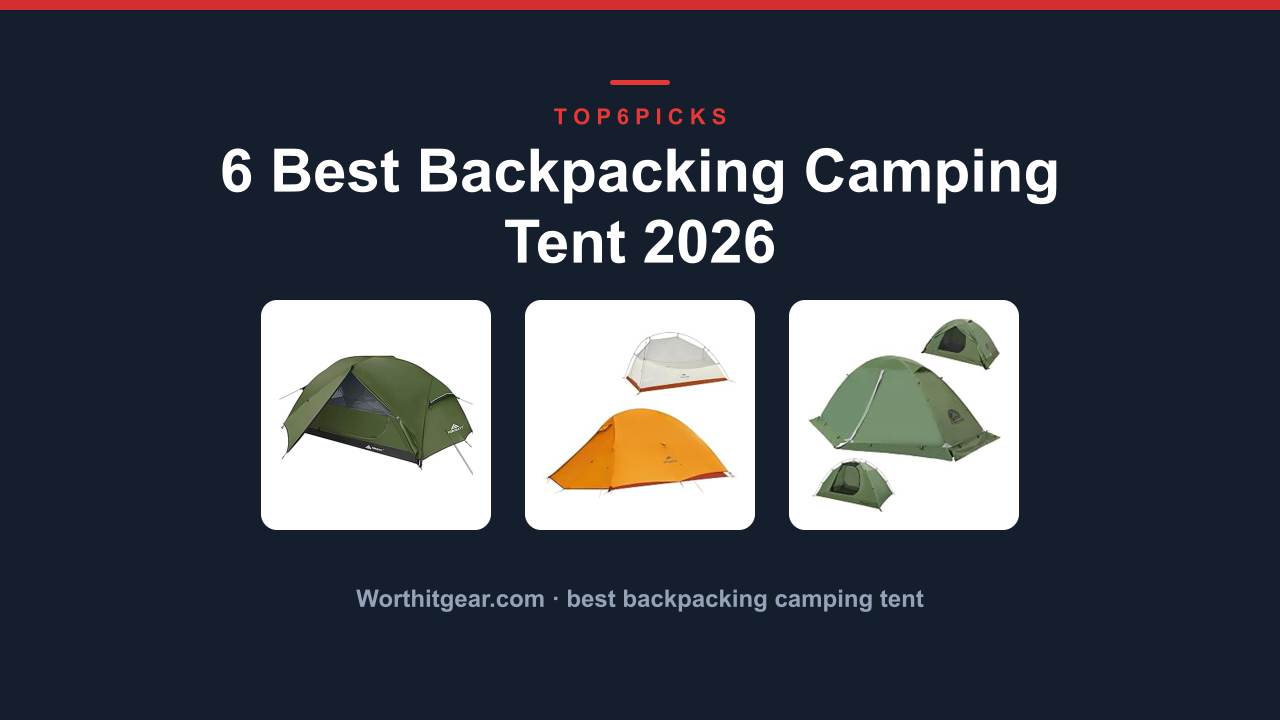
The best best backpacking camping tent is the Forceatt Tent for 2 and 3 Persons, the only one in this lineup that balances weather protection, interior space, and a fast pitch at a price that makes sense for most campers. It handles everything from summer car camping to shoulder-season backpacking trips without breaking the bank.
Want a tent that prioritizes ultralight weight instead? The Naturehike Cloud-Up 2 Person Tent gets you there, as long as you are willing to trade a bit of interior room for a pack weight that disappears into your bag.
As an Amazon Associate, I earn from qualifying purchases.
This guide walks you through the six best backpacking tents on Amazon right now, showing you exactly who each one is for. We also cover the campers who should skip this category entirely, because not every outdoor shelter needs to be a backpacking tent.
Everything below is based on current Amazon product data, manufacturer specifications, and the verified track record of each tent from owner reviews. We have not physically tested these tents ourselves.
Quick Answer: The Best Backpacking Camping Tent
The Forceatt Tent for 2 and 3 Persons is the best overall pick for most campers who want a reliable, weatherproof shelter that works across multiple seasons.
Thinking about a family tent or a heavy-duty winter shelter instead? Jump to Who Should NOT Buy below before you spend anything.
Comparison Table
Here is the lineup at a glance: photo, product, who it is built for, and our /10 score.
Scroll sideways on small screens to see every column.
Forceatt Tent 2 3 Person is: Best Overall for 3-Season Campers
#1
ForceattAluminum poles, dual doors
8.8OUT OF 10
Build Quality9.0
Ease of Setup9.2
Weather Protection8.8
Owner Verdict8.2
This tent hits the sweet spot for anyone who wants one shelter that works from spring through fall. The Forceatt uses lightweight aluminum poles instead of the fiberglass you often see at this price point, which makes it both stronger and easier to set up. The double-layer design with a full-coverage rainfly means you stay dry in a downpour, and the two doors give you and a partner your own exits.
Setup is genuinely fast. The poles are color-coded, and the clips attach to the tent body in seconds. Many owners mention getting it pitched in under five minutes after the first try. The interior is 86 inches long, so tall campers won’t have to sleep diagonally.
Flaws but not dealbreakers. The included stakes are basic and some owners upgrade them for windy sites. The packed weight is just over 5 lbs, which is fine for short hikes but not ideal for serious ultralight backpacking.
⚠Sizing: This is a 2-3 person tent. Two adults fit comfortably with gear. Three adults is a tight squeeze.
Pros
- ✓Aluminum poles are lighter and stronger than fiberglass, making setup easier and the tent more durable.
- ✓Two doors and two vestibules give each camper their own entrance and gear storage.
- ✓Full-coverage rainfly with sealed seams keeps water out during heavy rain.
- ✓Color-coded pole system means first-time users can pitch it without help.
Cons
- ✕Included stakes are lightweight and bend easily in hard ground.
- ✕Packed weight is over 5 lbs, which is too heavy for extended backpacking trips.
- ✕Ventilation could be better in humid conditions without the rainfly fully staked out.
Best for: Campers who want a reliable, well-built tent that handles three-season weather without costing a fortune.
Naturehike Cloud-Up 2 Person Tent Lightweight: Best Ultralight for Solo Thru-Hikers
#2
NaturehikeUnder 3.5 lbs, footprint included
8.6OUT OF 10
Build Quality8.5
Ease of Setup8.8
Weather Protection8.2
Owner Verdict8.9
This is the tent for anyone who measures every ounce before a long hike. The Cloud-Up 2 weighs just 3.3 lbs packed, which includes the footprint. That is impressively light for a freestanding double-wall tent at this price. The 20D nylon fabric is thin but strong, and the DAC-style aluminum poles keep the structure stable.
It is a true two-person tent, but most solo hikers will love the extra room for spreading out gear. The inner tent has a mesh body for ventilation, and the rainfly extends close to the ground for decent weather protection. The included footprint is a nice bonus that saves you from buying one separately.
Flaws but not dealbreakers. The thin fabric requires careful site selection. Setting up on abrasive ground or pine needles can wear the floor over time, so using that footprint is essential. The interior height is also lower than some competitors, so sitting up straight is a bit tight for taller folks.
If you want a roomier tent that still packs small, the
Naturehike Mongar offers a bit more headroom and a similar packed weight.
⚠Care: The thin 20D floor fabric needs a groundsheet. Always use the included footprint to prevent punctures.
Pros
- ✓Weighs only 3.3 lbs including the footprint, ideal for thru-hikers and ultralight backpackers.
- ✓Freestanding double-wall design offers good ventilation and easy setup on any surface.
- ✓Included footprint saves you money and protects the thin floor fabric.
- ✓DAC-style aluminum poles are lightweight and reliable in wind.
Cons
- ✕Thin 20D fabric is less durable than heavier materials and requires careful use.
- ✕Interior height is limited, making it hard to sit upright for taller campers.
- ✕Single door can be inconvenient for two people sharing the tent.
Best for: Solo hikers and ultralight backpackers who prioritize a low pack weight above all else.
1/2 Person 4 Season Backpacking Tent: Best Winter-Ready for Cold-Weather Soloists
#3
1/2PU5000 coating, low profile
8.4OUT OF 10
Build Quality8.2
Ease of Setup8.6
Weather Protection9.0
Owner Verdict7.8
This is the tent to grab when you plan to camp in snow, sleet, or strong winds. The 4-season designation is not just marketing. It uses a PU5000 waterproof coating on the fly and floor, which is significantly higher than the typical PU2000-3000 on most three-season tents. The low profile sheds wind effectively, and the included snow skirt helps seal out drafts.
It is designed for one or two people, but realistically it is a tight fit for two. The single door and small vestibule mean you are better off using it solo, especially if you have winter gear that needs to stay inside. The poles are aluminum and the clip system is straightforward even with cold fingers.
Flaws but not dealbreakers. Condensation can be an issue in this tent, as with many 4-season shelters. The interior is small, and the single layer design in some areas means moisture can build up if you do not crack a vent. It is also heavier than a comparable three-season tent.
If you do not need winter capability and want a roomier shelter, the
Forceatt is a better choice for three-season use.
⚠Condensation: 4-season tents trap moisture. Ventilate the top vents even in cold weather to reduce interior frost.
Pros
- ✓PU5000 waterproof coating handles heavy snow and rain better than most tents in this class.
- ✓Low profile design and snow skirt provide excellent wind shedding in exposed conditions.
- ✓Easy clip and pole setup works even with gloves on in cold weather.
- ✓Light enough for winter backpacking trips where every pound matters.
Cons
- ✕Interior space is tight for two people with winter gear inside.
- ✕Condensation management requires active venting, especially in humid conditions.
- ✕Single door and small vestibule limit convenience for two occupants.
Best for: Solo winter campers and mountaineers who need a shelter that can handle snow loads and strong winds.
Naturehike Mongar 2 Person Backpacking Tent: Best Value for Couples on a Budget
#4
NaturehikeDouble wall, two doors
8.2OUT OF 10
Build Quality8.0
Ease of Setup8.5
Weather Protection8.1
Owner Verdict8.2
This tent delivers the best bang for your buck if you are shopping for two people on a tight budget. The Mongar is a double-wall, freestanding tent with two doors and two vestibules, which is rare at this price point. The pole structure is a standard dome design, so setup is straightforward. The interior is spacious enough for two adults and a small amount of gear.
The fabric is a 210T polyester with a PU2000 coating, which is adequate for moderate rain. The mesh inner body provides good ventilation in warm weather. It packs down to a reasonable size for backpacking, though it is not the lightest option at around 4.5 lbs.
Flaws but not dealbreakers. The included stakes are not great, and the PU coating on the floor is lower than some competitors. It handles light to moderate rain well, but a heavy downpour might test the seam sealing. Some owners report that the zippers can be a bit sticky when new.
If you want a more robust weather shield, the
Forceatt offers better waterproofing and stronger poles for a similar price.
⚠Seam Sealing: Check the factory seam sealing on the rainfly before your first trip. Some owners recommend adding seam sealer for extra peace of mind.
Pros
- ✓Two doors and two vestibules provide independent access and storage for each person.
- ✓Double-wall design keeps condensation away from the sleeping area.
- ✓Freestanding dome makes it easy to pitch on any surface, including platforms.
- ✓Excellent value for the features offered at this price point.
Cons
- ✕PU2000 floor coating is adequate but not confidence-inspiring in heavy rain.
- ✕Included stakes are lightweight and may bend in hard or rocky ground.
- ✕Zippers can feel stiff and need some breaking in.
Best for: Budget-conscious couples who want a double-wall tent with two doors for weekend trips.
BISINNA 2/4 Person Camping Tent Lightweight: Best Spacious for Small Families
#5
BISINNATwo vestibules, roomy interior
8.0OUT OF 10
Build Quality7.8
Ease of Setup8.3
Weather Protection7.9
Owner Verdict8.0
This is the tent to pick when you need room for three or four people without a huge weight penalty. The BISINNA is a double-wall, freestanding tent with two large doors and two vestibules. The interior is genuinely spacious for a backpacking tent, with enough floor space for a family of four in a pinch, or a very comfortable setup for two adults and a child.
The poles are aluminum, which is a nice touch at this price. The rainfly extends low for decent weather protection, and the mesh inner keeps bugs out while allowing airflow. Setup is simple with a standard dome design and color-coded poles.
Flaws but not dealbreakers. At around 6.5 lbs, this is the heaviest tent in the lineup. It is still packable for short hikes, but you will feel it on longer trails. The PU coating is adequate for light rain, but heavy storms might test the limits. Some owners mention that the zippers can be a bit stiff initially.
If you want a lighter option for two people, the
Naturehike Cloud-Up is a better choice for solo or duo trips.
⚠Weight: At 6.5 lbs, this is best for car camping or short hikes. Not ideal for long backpacking trips.
Pros
- ✓Spacious interior fits up to four people, with two large vestibules for gear storage.
- ✓Aluminum poles are stronger and more durable than fiberglass alternatives.
- ✓Double-wall design with mesh inner provides good ventilation and bug protection.
- ✓Easy setup with color-coded poles and clip attachments.
Cons
- ✕Heavy at 6.5 lbs, limiting its use for longer backpacking trips.
- ✕Rainfly waterproofing is adequate but not exceptional in heavy storms.
- ✕Zippers can be stiff and may require some breaking in.
Best for: Small families or groups who need a roomy tent for car camping or short hikes.
Night Cat Backpacking Tent One 1: Best Budget for Solo Scouts and Kids
#6
NightBudget solo shelter
7.5OUT OF 10
Build Quality7.3
Ease of Setup7.8
Weather Protection7.4
Owner Verdict7.5
This is the cheapest way to get a real backpacking tent that actually works for a solo trip. The Night Cat is a single-layer, simple dome tent that weighs just over 3 lbs. It is not fancy, but it keeps the bugs out and the rain off. The 2.2 x 1.2 m floor fits one adult plus gear, or two kids comfortably.
Setup takes about three minutes because there is just one pole that crosses in an X. The single-layer design means fewer parts to handle, and the whole thing packs down small enough for a daypack. For scout trips, youth group camps, or a first backpacking experience, this tent is hard to beat for the price.
Flaws but not dealbreakers. Single-wall tents are prone to condensation, so expect some moisture on the walls in the morning. The pole quality is not on par with the aluminum models here, and the included stakes are flimsy. It is a budget tent, and it performs like one in all the right ways for its price.
If you want a double-wall tent with better condensation control, the
Naturehike Cloud-Up is worth the extra money for frequent trips.
⚠Condensation: Single-layer tents trap moisture. Leave the door partially open on humid nights to stay dry.
Pros
- ✓Lowest entry price of any tent in this lineup, perfect for occasional campers.
- ✓Weighs around 3 lbs, light enough for solo backpacking and scout hikes.
- ✓Simple single-pole design sets up in minutes with no confusion.
- ✓Compact packed size fits easily inside a daypack or strapped to a small pack.
Cons
- ✕Single-wall design leads to condensation buildup on cool, humid nights.
- ✕Pole quality is basic and may flex in strong winds.
- ✕Included stakes are thin and should be replaced for serious use.
Best for: Solo campers, scouts, and kids who want a cheap, light tent for short trips.
Buying Guide: Weight, Weather Protection, Space, and Season Rating
A few quick facts will help you pick the right tent. These six shelters span roughly 3 lbs to 6.5 lbs, so knowing your priorities before you buy saves you money and shoulder pain.
How Much Weight Really Matters?
Weight is the biggest difference between these tents. The Naturehike Cloud-Up weighs 3.3 lbs, making it the lightest here. The BISINNA weighs nearly twice that at 6.5 lbs.
If you are hiking more than a few miles to camp, every pound counts. For car camping or base camps, that weight difference barely matters. A good rule is to keep the tent under 2.5 lbs per person for backpacking trips.
For a two-person tent, that means under 5 lbs total. The Forceatt sits right at that line, while the Cloud-Up comfortably beats it.
What Does the Waterproof Rating Actually Tell You?
You will see PU numbers like PU2000 or PU5000 on these tents. The number refers to the water column pressure in millimeters. A PU2000 coating handles light rain, while PU5000 handles sustained downpours and even snow.
The 1/2 Person 4 Season Tent has the highest rating in this group at PU5000, which is why it is the winter pick. The rest sit around PU2000-3000, which is fine for three-season camping as long as you pitch in a spot that drains well. Double-wall tents also help because the inner mesh layer keeps condensation away from your sleeping bag.
How Much Space Do You Really Need?
Most tents are not as roomy as the marketing suggests. A two-person tent fits two adults side by side with a bit of gear in the corners. The Forceatt and the Mongar both have two doors and two vestibules, which makes a big difference when you are sharing.
The Night Cat is a true solo shelter. The BISINNA is the only one here that can realistically fit a small family, with a 2 to 4 person capacity. Think about how you camp before you buy.
If you are a couple who hikes separately, the second door is worth the extra weight.
Is a 4-Season Tent Worth It?
Only if you actually camp in winter. A 4-season tent like the one by 1/2 Person is built with a lower profile, sturdier poles, and a higher waterproof rating. Those same features make it warmer and stuffier in summer.
For 95 percent of campers, a 3-season tent is the right call. It breathes better, weighs less, and handles the weather that most people encounter from spring to fall. Always read the full specs on the product page to see whether the tent is labeled for 3 or 4 seasons.
The National Park Service recommends checking local weather and site conditions before every backcountry trip, and that is exactly when knowing your tent's limits matters most.
Who Should NOT Buy Best Backpacking Camping Tent
This category is the wrong purchase for a few specific kinds of campers. Here is who they are, and what to look at instead.
You Need a Spacious Family Camping Tent
If you are car camping with a family of four or more, a backpacking tent will feel cramped. The BISINNA is the only one here that approaches family size, but even it is tight for four adults. What you actually want is a dedicated family tent with a taller center height and more floor space.
These tents are heavier, but they are designed to be carried from the car to the site, not on your back. A bigger shelter will make everyone happier on a weekend trip.
You're Planning a High-Altitude Expedition
The 4-season tent in this lineup handles mild winter conditions, but it is not a mountaineering shelter. Expedition tents use heavier fabrics, stronger pole systems, and snow flaps that can withstand 70 mph winds and deep snow loads. If you are heading to Denali or doing serious winter alpine climbing, look for a tent rated for those specific conditions.
The gear is available, but it costs more and weighs significantly more.
You Only Car Camp Once or Twice a Year
If your camping trips are all drive-up sites with gravel pads and picnic tables, you do not need a backpacking tent. The trade-offs of lightweight fabric and low profiles work against you in a car camping setup. Instead, look at a larger camping tent with better interior height and more comfortable space.
Check out our recommendations for a spacious family shelter if that sounds like you.
Final Verdict
The Forceatt Tent for 2 and 3 Persons is the best backpacking camping tent for most people. It balances weather protection, interior space, and a fast pitch at a price that makes sense for weekend hikers and first-time backpackers alike.
Want an ultralight shelter for long trails? The Naturehike Cloud-Up trims nearly 2 lbs off the pack weight. Need something for a small family?
The BISINNA spreads out to fit four. If winter is your season, the 1/2 Person 4 Season Tent has the highest waterproof rating here.
Before you buy, revisit the Who Should NOT Buy section. If you are car camping or planning an alpine expedition, a different style of tent will serve you far better.
FAQ
What's the best Backpacking Camping Tent overall?
The Forceatt Tent for 2 and 3 Persons is our top pick for most campers. It offers the best mix of features, weather protection, and price in this lineup.
How heavy should a backpacking tent be?
For a two-person tent, aim for under 5 lbs total packed weight. Solo tents can be closer to 3 lbs. The Naturehike Cloud-Up at 3.3 lbs is the lightest in this guide.
Is a 4-season tent necessary for winter camping?
Only if you camp in actual winter storms. A 4-season tent like the 1/2 Person model has a higher waterproof rating and better wind shedding, but it runs warmer in summer.
Why do some tents have two doors?
Two doors let each camper get out without climbing over the other. They also provide separate vestibules for storing wet or smelly gear. The Forceatt and the Mongar both have this feature.
Are budget tents like the Night Cat worth buying?
The Night Cat is a good value for a solo camper on a tight budget. Keep in mind that single-wall construction means more condensation, and the poles are not as sturdy as aluminum models.