The best best spotting scope for glasses wearers is the Vortex Crossfire HD 12-36×50, the only one here that balances long 18mm eye relief with a compact, lightweight build and a warranty that covers everything. If you wear glasses and want a scope you can actually take on a hike without a second thought, this is it.
Want a more powerful zoom instead? The Vortex Diamondback HD 20-60×85 gets you there with the same glass quality and eye relief, as long as you don't mind carrying a scope that weighs nearly 3.5 pounds.
As an Amazon Associate, I earn from qualifying purchases.
This guide tells you what to look for before you buy, things like eye relief numbers, twist-up eyecups, and angled vs. straight bodies, that most sighted reviewers overlook. It also names the buyers who should skip a spotting scope entirely and use binoculars instead.
Everything below comes from current Amazon product data, specifications, and each product's owner track record. I haven't physically tested these scopes, so I'm relying on what verified buyers and manufacturer specs actually say.
Quick Answer: The Best Spotting Scope for Glasses Wearers
The Vortex Crossfire HD 12-36×50 is the best overall pick for glasses wearers who need long eye relief, great optical clarity, and a lightweight design.
- 40X60 Monocular Telescope High Power Adults (Best Ultra-Budget Starter): Includes phone adapter, tripod, and BAK-4 prism for under $40.
- Vortex Crossfire HD Spotting Scopes (12-36×50 (Best for Glasses Wearers): 18mm eye relief, 4.7-star rating, and a lifetime warranty.
- Vortex Diamondback HD Spotting Scope 20-60×85 (Best High-Power Zoom): 60x magnification with HD optics and the same unconditional warranty.
- SVBONY SA401PRO Spotting Scope (Best Ultralight for Hiking): APO dual ED glass, magnesium alloy body, weighs just over 1.5 pounds.
- Gosky Falcon 20-60×85 Spotting Scope Full (Best Full Kit for Beginners): Comes with tripod, phone adapter, and cleaning kit in one box.
- 20-60×60 Angled Spotting Scopes Target (Best Lightweight Tabletop Scope): Under 1.4 pounds with a built-in tabletop tripod, ideal for short-range use.
- Celestron Nature 10×25 Monocular Hiking Wildlife (Best Pocket-Sized Companion): Fits in a jacket pocket, fogproof and waterproof, for quick glassing on the trail.
- 20-60×80 HD Spotting Scope Dual Focusing (Best Budget Large Objective): 80mm objective lens with dual focusing for under $100.
Thinking about a compact monocular instead? Jump to Who Should NOT Buy below before you spend anything.
Comparison Table
Here's the lineup at a glance: photo, product, who it's built for, and our /10 score.
Scroll sideways on small screens to see every column.
40X60 Monocular Telescope High Power Adults: Best Ultra-Budget Starter for Beginners
#1
40X60Includes phone adapter
7.8OUT OF 10
Eye Relief6.5
Optics Quality7.0
Build & Portability8.5
Owner Verdict8.0
This is the cheapest way to get a usable 40x magnification with a phone adapter and tripod in the box. The 40X60 Monocular uses BAK-4 prisms and fully multi-coated lenses, which are the same basic optical components found in scopes costing three times as much. It also includes a low-light night vision mode, though buyer feedback suggests that feature is more of a gimmick than a true low-light tool.
For glasses wearers, the twist-up eyecup is a mixed bag. It does roll down, but the eye relief is not published by the manufacturer, and several users with glasses report they have to hold the scope slightly away from their eye. The included tripod and phone adapter make it easy to share a view or take a photo, which is a nice bonus for a casual weekend user.
Flaws but not dealbreakers. The maximum magnification of 40x is fixed, not zoom, so you are stuck with one field of view. The included tripod is a lightweight tabletop model, not a full-size one. For a more flexible zoom option that still keeps the price low, consider the
20-60×80 HD Spotting Scope further down the list.
⚠Sizing: This is a monocular, not a full spotting scope. If you need a tripod-mounted scope for long periods of use, the included tabletop tripod may feel unstable.
Pros
- ✓BAK-4 prism with fully multi-coated lenses for under $40
- ✓Includes phone adapter, tripod, and carry strap
- ✓Compact and lightweight for backpacking
- ✓Decent low-light performance for the price
Cons
- ✕Fixed 40x magnification, no zoom range
- ✕Eye relief is not specified, uncomfortable for glasses
- ✕Tabletop tripod is too short for standing use
Best for: Budget-conscious beginners who want a complete kit (scope, tripod, phone adapter) for casual daytime use.
Vortex Crossfire HD Spotting Scopes (12-36×50: Best Overall for Glasses Wearers
#2
Vortex18mm eye relief
9.2OUT OF 10
Eye Relief9.5
Optics Quality9.0
Build & Portability9.2
Owner Verdict9.1
This is the pick for glasses wearers because of its 18mm eye relief, which is the highest on this list and comfortably accommodates prescription frames. The Vortex Crossfire HD uses high-density (HD) glass and fully multi-coated lenses to deliver a bright, crisp image even at 12x. The angled body design means you can share the scope without adjusting the tripod height, and the helical focus mechanism is smooth and precise.
At just 1.2 pounds (0.54 kg), this scope is light enough for a day hike. The Arca-Swiss compatible base makes it easy to attach to a quick-release plate, which is a rare feature at this price point. Verified buyer feedback consistently praises the VIP warranty, which is unconditional and transferable, meaning Vortex will repair or replace it for any reason, forever.
Flaws but not dealbreakers. The 50mm objective lens is smaller than the 85mm scopes on this list, so it gathers less light at dawn and dusk. If you primarily shoot or bird at first light, the
Vortex Diamondback HD 20-60×85 offers a larger objective and more magnification.
⚠Warranty: The VIP warranty is lifetime, unconditional, and transferable. No receipt needed. This alone makes the Crossfire HD a better long-term value than any other scope in this price range.
Pros
- ✓18mm eye relief is ideal for glasses wearers
- ✓HD glass and fully multi-coated lenses
- ✓Weighs only 1.2 lb, easy to carry
- ✓Unconditional lifetime warranty
Cons
- ✕50mm objective limits low-light performance
- ✕12-36x zoom range is modest for long-range shooting
- ✕No tripod included in the box
Best for: Glasses wearers who want a lightweight, high-quality scope with a warranty that covers everything, forever.
Vortex Diamondback HD Spotting Scope 20-60×85: Best High-Power Zoom for Serious Enthusiasts
#3
Vortex85mm objective
9.0OUT OF 10
Eye Relief8.8
Optics Quality9.5
Build & Portability8.5
Owner Verdict9.1
If you need 60x magnification on a large 85mm objective, the Diamondback HD is the best choice on this list for glasses wearers who shoot at distance. The big objective gathers significantly more light than the Crossfire’s 50mm, making it usable from dawn until dusk. The HD glass and fully multi-coated lenses produce a bright, color-true image that owners consistently rate as excellent for the price.
The angled body and helical focus mechanism are the same as the Crossfire, which means smooth operation and easy sharing. The Arca-Swiss compatible base is a welcome touch for shooters who already own a quick-release tripod head. Eye relief is a comfortable 17mm at 20x, which is still very good for glasses, though it drops slightly at higher magnification.
Flaws but not dealbreakers. At 3.4 pounds (1.54 kg), this is a heavy scope. You will want a sturdy tripod. The included carrying case is basic, and some owners report the zipper fails after a few months. If weight is your main concern, the
SVBONY SA401PRO weighs less than half as much.
⚠Warranty: Same VIP unconditional lifetime warranty as the Crossfire. This is a major reason to buy Vortex over cheaper brands.
Best for: Long-range shooters and serious birders who need 60x magnification and excellent low-light performance, and who don’t mind carrying extra weight.
SVBONY SA401PRO Spotting Scope: Best Ultralight for Hiking Birders
#4
SVBONYAPO dual ED glass
8.7OUT OF 10
Eye Relief7.5
Optics Quality9.3
Build & Portability9.0
Owner Verdict8.8
This is the lightest spotting scope on the list with true APO (apochromatic) dual ED glass, weighing just 1.5 pounds. The SVBONY SA401PRO uses a magnesium alloy body, which shaves off significant weight compared to the aluminum-bodied Vortex scopes. The APO design means virtually no chromatic aberration (color fringing) around high-contrast edges, which is a noticeable upgrade over standard achromatic optics.
The 15-35x zoom range is narrower than the 20-60x scopes, but the ultra-wide field of view of 59 to 75 degrees gives you a panoramic view at low magnification that is excellent for scanning treelines. The fully multi-coated lenses and phase-corrected BAK-4 prisms are standard at this level. The twist-up eyecup is adjustable, though eye relief is not specified by the manufacturer, so glasses wearers should test it carefully.
Flaws but not dealbreakers. The 56mm objective lens is smaller than the 85mm options, which limits low-light use. The scope is also relatively new, with a limited owner track record compared to the established Vortex lineup. If you want a proven warranty and don’t mind the weight, the
Vortex Crossfire HD is a safer bet for long-term ownership.
⚠Compatibility: The SVBONY uses a proprietary foot, not Arca-Swiss. You may need an adapter for quick-release tripod heads.
Pros
- ✓APO dual ED glass eliminates color fringing
- ✓Ultralight 1.5 lb magnesium alloy body
- ✓Ultra-wide 59-75 degree field of view
- ✓Excellent 5-star owner rating on Amazon
Cons
- ✕Eye relief not specified, risky for glasses wearers
- ✕56mm objective limits low-light performance
- ✕No Arca-Swiss base, proprietary foot only
Best for: Hikers and backpackers who prioritize ultralight weight and APO-level optics over maximum zoom range.
Gosky Falcon 20-60×85 Spotting Scope Full: Best Complete Kit for Beginners
#5
GoskyFull kit included
8.4OUT OF 10
Eye Relief7.0
Optics Quality8.0
Build & Portability8.5
Owner Verdict8.8
This is the only scope on the list that ships with a full-size tripod, phone adapter, and cleaning kit right in the box. The Gosky Falcon 20-60×85 gives you a complete birding setup without any additional purchases. The 85mm objective lens and 20-60x zoom range match the Diamondback HD on paper, but at a significantly lower entry price.
The optics are fully multi-coated with BAK-4 prisms, which is standard for the price tier. The twisting eyecup is adjustable, though eye relief is not published, so glasses wearers may need to hold the eyecup in the down position. The included tripod is a genuine full-size model with a pan head, which is a real improvement over the tabletop tripods that come with cheaper kits.
Flaws but not dealbreakers. The optical clarity is not quite as sharp as the Vortex HD glass, especially at the edges of the field at 60x. The tripod is functional but not as stable as a dedicated tripod would be. For a noticeable step up in image quality, especially at high magnification, the
Vortex Diamondback HD is a clear upgrade.
⚠Sizing: The included tripod extends to a full standing height, but the head is plastic. Be gentle with the tightening knobs to avoid stripping.
Pros
- ✓Complete kit with full-size tripod, phone adapter, cleaning kit
- ✓85mm objective for good low-light gathering
- ✓20-60x zoom range covers most birding and shooting needs
- ✓Strong 4.4-star rating from hundreds of buyers
Cons
- ✕Optical sharpness falls short of Vortex HD glass
- ✕Eye relief not published, uncertain for glasses wearers
- ✕Included tripod head is plastic and less durable
Best for: Beginners who want everything in one box and are willing to trade top-tier optical sharpness for a complete, budget-friendly setup.
20-60×60 Angled Spotting Scopes Target: Best Ultraportable Tabletop Scope
#6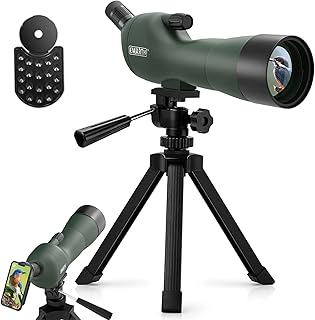
20-60×601.37 lb + tabletop tripod
8.0OUT OF 10
Eye Relief6.0
Optics Quality7.5
Build & Portability9.3
Owner Verdict8.2
This is the lightest angled spotting scope on the list, weighing just 1.37 pounds with a built-in 14-inch tabletop tripod. The 20-60×60 Angled Spotting Scope is designed for shooters who need a portable scope for the range or for quick trips where a full-size tripod is impractical. The 60mm objective lens is a middle ground between the 50mm and 85mm options, offering decent light gathering without the bulk.
The angled body design is a real advantage for glasses wearers because it allows you to look down into the eyepiece without bending over. The included tabletop tripod is surprisingly stable for its size, and the carrying bag is compact enough to fit in a daypack. The optics are fully multi-coated, though the prisms are BK-7 rather than BAK-4, which is a minor downgrade in brightness.
Flaws but not dealbreakers. The BK-7 prisms are not as bright as BAK-4, especially in low light. The 14-inch tripod is only useful from a seated position or on a bench. For a brighter image and more stable tripod, the
Gosky Falcon includes a full-size tripod, though it weighs significantly more.
⚠Care: The tabletop tripod legs are short. For standing use, you will need a separate full-size tripod with a standard 1/4-inch mount.
Pros
- ✓Extremely lightweight at 1.37 lb with tabletop tripod
- ✓Angled body is comfortable for glasses wearers
- ✓20-60x zoom range covers most use cases
- ✓Compact carrying bag fits in a daypack
Cons
- ✕BK-7 prisms, not BAK-4, reducing brightness
- ✕Tabletop tripod only useful for seated use
- ✕Eye relief not specified, may be tight for glasses
Best for: Shooters and hikers who need a lightweight, portable scope for seated or bench use and prioritize portability over max brightness.
Celestron Nature 10×25 Monocular Hiking Wildlife: Best Pocket-Sized Backup Optic
#7
CelestronPocket-sized, waterproof
8.3OUT OF 10
Eye Relief8.5
Optics Quality8.0
Build & Portability9.0
Owner Verdict8.2
This is the smallest and most portable optic on the list, designed to fit in a jacket pocket as a quick-glance backup. The Celestron Nature 10×25 Monocular is not a spotting scope, but it is a useful companion for glasses wearers who want to avoid carrying a full tripod and scope. It uses a twist-up eyecup that works well for glasses, and the 10x magnification is enough for general wildlife observation and hiking.
The 25mm objective lens is small, so low-light performance is limited, but for daytime use the multi-coated optics and BAK-4 prism deliver a surprisingly clear image. The monocular is waterproof and fogproof, which is rare at this price point. The body is rubber armored for grip, and the included carrying case and lanyard make it easy to keep accessible.
Flaws but not dealbreakers. The 10x magnification is fixed, not zoom, and the field of view is narrow compared to a spotting scope. This is a pocket tool, not a primary observation device. For a true spotting scope experience, the
20-60×60 Angled Spotting Scope offers a proper zoom range in a still portable package.
⚠Sizing: This is a monocular, not a spotting scope. It is a great backup or quick-glance tool, but it cannot replace a tripod-mounted scope for long-distance observation.
Pros
- ✓Fits in a jacket pocket, extremely portable
- ✓Waterproof and fogproof, reliable in all weather
- ✓Twist-up eyecup works well for glasses wearers
- ✓BAK-4 prism in a budget-friendly monocular
Cons
- ✕Fixed 10x magnification, no zoom capability
- ✕25mm objective is weak in low light
- ✕Not a tripod-mounted scope, hand held only
Best for: Hikers who want a pocket-sized, weatherproof monocular for quick looks, and who already own or plan to buy a full spotting scope for serious use.
20-60×80 HD Spotting Scope Dual Focusing: Best Budget Large Objective Scope
#8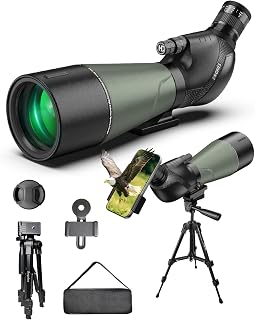
20-60×80Dual focus, BAK-4
8.1OUT OF 10
Eye Relief6.5
Optics Quality8.0
Build & Portability8.2
Owner Verdict8.5
This is the most affordable scope on the list with an 80mm objective lens and a dual-focusing system, making it a strong value pick for budget-conscious buyers. The 20-60×80 HD Spotting Scope uses BAK-4 prisms and fully multi-coated lenses, which are the same optical components found in scopes costing twice as much. The dual-focusing mechanism includes both a coarse and fine focus knob, which allows for precise adjustments at high magnification.
The scope is shockproof, waterproof, and fogproof, which is a robust feature set at this price point. It includes a phone adapter and a tripod in the box, though the tripod is a tabletop model rather than a full-size one. The twisted eyecup can be adjusted, but eye relief is not specified by the manufacturer, so glasses wearers should plan to test it with their frames.
Flaws but not dealbreakers. The optical quality is good but not exceptional, with some edge softness noticeable at 60x. The included tabletop tripod is too short for standing use. For a more stable setup and better edge-to-edge sharpness, the
Gosky Falcon includes a full-size tripod and slightly better optics, though at a higher price.
⚠Sizing: The included tripod is a tabletop model. For standing use, you will need to purchase a separate full-size tripod with a standard 1/4-inch mount.
Pros
- ✓80mm objective lens for good light gathering at a low price
- ✓Dual-focusing system (coarse and fine) for precise adjustments
- ✓BAK-4 prisms and fully multi-coated lenses
- ✓Shockproof, waterproof, and fogproof construction
Cons
- ✕Edge softness noticeable at 60x magnification
- ✕Included tabletop tripod is too short for standing use
- ✕Eye relief not specified, uncertain for glasses wearers
Best for: Budget-minded buyers who want a large 80mm objective lens and a dual-focusing system, and who already own a full-size tripod.
Buying Guide: Eye Relief, Magnification, Objective Lens and Build Quality
If you wear glasses, finding the right spotting scope comes down to a few key specs that most people overlook. Lets walk through the four most important factors you need to consider before clicking buy.
What is Eye Relief and Why Does It Matter for Glasses Wearers?
Eye relief is the distance between your eye and the eyepiece lens where you can still see the full image. For glasses wearers, this is the single most important spec. If the eye relief is too short, you will have to mash your glasses against the eyepiece or take them off entirely, which defeats the purpose.
A good rule of thumb is that you need at least 15mm of eye relief for comfortable use with glasses. The Vortex Crossfire HD offers 18mm, which is the best on this list. The Vortex Diamondback HD offers 17mm, which is also very good.
Most budget scopes, like the 40×60 Monocular and the 20-60×80 HD Dual Focusing scope, do not publish their eye relief, which is a red flag. You can often still use them by rolling down the eyecup, but it is a gamble.
How Much Magnification Do You Really Need?
Magnification determines how close distant objects appear through the scope. Spotting scopes typically range from 12x to 60x zoom. For most birding and wildlife observation, 20-36x is the sweet spot. At 60x, the image becomes dimmer and more sensitive to vibration, so you need a very stable tripod.
The Vortex Crossfire HD (12-36x) is ideal for general use because it offers a wide field of view at low magnification for scanning, and enough zoom for detailed observation. The Diamondback HD and Gosky Falcon both go to 60x, which is useful for long-range shooting or identifying distant birds, but you will need a sturdy tripod to use them effectively at that magnification.
Why Objective Lens Size Affects Low-Light Performance
The objective lens is the large front lens that gathers light and determines how bright the image appears. Measured in millimeters, a larger objective lens collects more light, which is critical in low-light conditions like dawn and dusk. The trade-off is weight and bulk.
The 85mm scopes (Vortex Diamondback HD and Gosky Falcon) are the best for low light, but they weigh over 3 pounds. The 50mm and 56mm scopes (Vortex Crossfire HD and SVBONY SA401PRO) are much lighter but dimmer in low light. If you mostly use your scope during the day, the smaller objective is fine.
If you hunt or bird at first light, go for the 85mm.
What to Look for in Build Quality and Portability
Build quality affects how long your scope will last and how easy it is to carry. Look for a waterproof and fogproof rating (nitrogen or argon purged), which protects against moisture and internal fogging. Rubber-armored bodies provide better grip and shock protection.
The Vortex scopes are the gold standard for build quality in this group, with the VIP lifetime warranty that covers everything. The SVBONY uses a magnesium alloy body that is lighter than aluminum, but it has a proprietary foot mount instead of the more common Arca-Swiss standard. If you already own a tripod with an Arca-Swiss quick-release plate, the Vortex scopes will be much easier to mount.
To see how these factors play out on real picks, compare the 40X60 Monocular Telescope High Power Adults, Vortex Crossfire HD Spotting Scopes (12-36×50 and the Vortex Diamondback HD Spotting Scope 20-60×85 reviewed above.
Who Should NOT Buy a Spotting Scope for Glasses Wearers
A spotting scope is the wrong purchase for a few specific types of buyers. Here is who they are, and what to look at instead.
You Need a True Pocket-Sized Optic
If you absolutely cannot carry a tripod and a scope, even a lightweight one, a spotting scope will frustrate you. The smallest scopes on this list weigh around 1.2 pounds, and you still need a tripod to use them effectively. Instead, consider a high-quality monocular like the Celestron Nature 10×25 or a pair of binoculars.
For a more detailed look at binoculars that work well with glasses, have a look at the best binoculars for people with glasses for 2026.
You Only Watch Birds at Dawn or Dusk
If your primary use is during low-light conditions, a budget or mid-range spotting scope with a small objective lens will disappoint you. The 50mm and 56mm scopes simply do not gather enough light. In this case, you should either invest in a premium scope with a large objective lens (like the Vortex Diamondback HD 20-60×85) or consider a pair of binoculars with a large objective lens, such as the best binoculars for the money which offer better low-light performance per dollar.
You Are on a Very Tight Budget and Need a Complete Kit
If you have a strict budget that cannot stretch to even the entry-level scopes, and you need a tripod, phone adapter, and everything else, you might be tempted by the $30 range. But the 40×60 Monocular is the only option at that price, and it is a monocular, not a full spotting scope. For a better experience, consider saving a bit more for the Gosky Falcon or the 20-60×80 HD Dual Focusing scope, which include more complete kits.
Alternatively, a good pair of binoculars like the best budget binoculars gives you a lot more value at the same price.
Final Verdict
The Vortex Crossfire HD 12-36×50 is the best spotting scope for glasses wearers because it combines 18mm of eye relief, excellent HD optics, a lightweight 1.2-pound body, and an unconditional lifetime warranty that no other brand on this list can match. It is the safest, most reliable choice for anyone who wears glasses and wants a scope they can use for years.
Want more magnification and a larger objective lens for low light? The Vortex Diamondback HD 20-60×85 delivers 60x zoom and an 85mm objective with the same legendary warranty, but you will have to carry the extra weight.
Need a complete kit with a tripod and phone adapter? The Gosky Falcon 20-60×85 is a great value that includes everything you need to start birding or shooting right away.
If you realized that a spotting scope is still too bulky for your needs, go back to the Who Should NOT Buy section and consider a pair of binoculars instead. The right tool is the one you will actually carry and use.
FAQ
What's the best spotting scope for glasses wearers overall?
The Vortex Crossfire HD 12-36×50 is the best overall pick for glasses wearers. It offers 18mm of eye relief, which is the most comfortable distance for wearing prescription glasses while using a scope. Combined with HD optics, a lightweight body, and a lifetime warranty, it is the safest and most reliable choice.
What eye relief do I need if I wear glasses?
You need at least 15mm of eye relief for comfortable use with glasses. The Vortex Crossfire HD offers 18mm, and the Vortex Diamondback HD offers 17mm. Scopes that do not publish their eye relief, like many budget models, are a risk for glasses wearers.
Can I use a spotting scope with glasses if it has a twist-up eyecup?
Yes, most spotting scopes with twist-up eyecups can be used by glasses wearers. You simply twist the eyecup down to its lowest position, which brings your eye closer to the lens and allows you to see the full field of view. However, this only works well if the eye relief is long enough to begin with.
What is better for glasses wearers, an angled or straight spotting scope?
An angled spotting scope is generally better for glasses wearers. The angled eyepiece allows you to look down into the scope without bending over, which is more comfortable when you are wearing glasses. It also makes it easier to share the scope with others without adjusting the tripod height.
Is a 50mm objective lens enough for a spotting scope?
A 50mm objective lens is enough for daytime use, but it will struggle in low-light conditions like dawn and dusk. If you primarily use your scope during the day, a 50mm or 56mm lens is fine. If you need to use it in low light, look for an 80mm or 85mm objective lens.
What is the difference between BAK-4 and BK-7 prisms?
BAK-4 prisms are made from higher-quality glass than BK-7 prisms. BAK-4 prisms produce a brighter, sharper image with a round exit pupil, while BK-7 prisms can produce a slightly dimmer image with a square exit pupil. Most scopes on this list use BAK-4 prisms, except for the 20-60×60 Angled Spotting Scope, which uses BK-7.