The best best binoculars for stargazing is the Celestron SkyMaster 15×70, the only one here that balances high magnification with a wide 70mm aperture for deep-sky views while remaining affordable enough for serious hobbyists. It delivers bright, crisp images of the Orion Nebula, Andromeda Galaxy, and star clusters without the cost of a telescope.
Want something more portable instead? The Celestron Cometron 7×50 gets you there, as long as you're willing to trade magnification for a lightweight design you can hold steady by hand.
As an Amazon Associate, I earn from qualifying purchases.
Most guides just list specs and call it a day. This one actually tells you which binoculars to skip if you have unsteady hands, wear glasses, or want to look at planets instead of deep-sky objects. You'll find that section near the end.
Everything below comes from current Amazon product data, manufacturer specifications, and verified buyer feedback from hundreds of owners. We haven't tested these in a lab, but we've analyzed what real users report.
Quick Answer: The Best Binoculars for Stargazing
The Celestron SkyMaster 15×70 is the best balance of aperture, magnification, and value for anyone serious about stargazing without buying a telescope.
Thinking about a compact grab-and-go pair instead? Jump to Who Should NOT Buy below before you spend anything.
Comparison Table
Here's the lineup at a glance: photo, product, who it's built for, and our /10 score.
Scroll sideways on small screens to see every column.
Celestron SkyMaster 15×70 Astronomy Binoculars Stargazing: Best Overall for Deep-Sky Enthusiasts
#1
CelestronBest value aperture
8.6OUT OF 10
Optical Quality8.8
Build Quality8.5
Ease of Use8.0
Value for Money9.0
This is the binocular that gives you the most light-gathering bang for your buck in the entire lineup. The 70mm aperture pulls in enough light to resolve the Orion Nebula as a clearly defined cloud with a hint of structure, and the Andromeda Galaxy fills the field of view edge to edge. Multi-coated BaK-4 optics keep the image bright and free of the purple fringing you see on budget glass.
At 3.75 pounds it’s not a handheld tool, but Celestron includes a tripod adapter in the box and the mounting bracket is beefy enough for a standard photo tripod. Owners consistently report that the center focus wheel is smooth and the diopter adjustment holds its position well over months of use.
Flaws but not dealbreakers. The tripod adapter is a simple plastic piece that works fine but can feel a bit flimsy against the weight of the binoculars. Some buyers also mention the rubber armoring attracts dust and lint more than other models.
If you want a tripod adapter you never have to think about, the
Celestron SkyMaster 20×80 uses a reinforced metal bracket that feels more secure under heavy glass.
⚠Tripod: These binoculars require a tripod for steady viewing at 15x magnification. Handheld use will show significant image shake.
Pros
- ✓70mm aperture with multi-coated BaK-4 prisms for bright, sharp deep-sky views
- ✓Tripod adapter and carry case included, saving you around $30 in accessories
- ✓Smooth dual-bridge focusing mechanism that holds alignment over years of use
- ✓Excellent value for the price tier, outperforming many 80mm models in contrast
Cons
- ✕Too heavy for comfortable handheld use, requires a tripod for steady views
- ✕Plastic tripod adapter feels less durable than the metal bracket on the 20×80 model
- ✕Rubber exterior attracts dust and lint, needs regular cleaning
Best for: Anyone who wants the best balance of aperture, magnification, and price for deep-sky stargazing and is willing to use a tripod.
Celestron Cometron 7x50mm Astronomy Binoculars: Best Handheld Pick for Beginners
#2
CelestronWide field handheld
8.4OUT OF 10
Optical Quality8.0
Build Quality8.5
Ease of Use9.2
Value for Money8.0
This is the only binocular on this list you can comfortably hold steady for minutes at a time. At 7x magnification and 1.5 pounds, the image shake is minimal enough that you can scan the Milky Way without a tripod. The 7mm exit pupil matches the dilated pupil of your eye in dark conditions, which means every photon collected by the 50mm objective actually reaches your retina.
The wide 7-degree field of view makes it ideal for sweeping comet tails, large star clusters like the Pleiades, and the sprawling Andromeda Galaxy. It also doubles as a capable daytime optic for birding or landscape viewing, which is rare for a dedicated astronomy binocular. The Porro prism design gives good depth perception and the multi-coated optics keep glare under control even when the moon is bright.
Flaws but not dealbreakers. At 7x you won’t resolve details on Jupiter’s bands or split close double stars. The included neck strap is adequate but thin, and some owners upgrade to a wider strap for longer sessions.
If you want to see planetary detail, the
Celestron SkyMaster 25×70 offers 25x magnification that brings out lunar craters and the rings of Saturn, though you’ll need a tripod for it.
⚠Sizing: The 7×50 format is compact for astronomy binoculars, but it’s still larger than standard birding bins. Test the weight if you have wrist issues.
Pros
- ✓Lightweight 1.5 lb design that you can hold steady without a tripod for long sessions
- ✓7mm exit pupil delivers maximum light to your eye in dark-adapted conditions
- ✓Wide 7-degree field of view perfect for sweeping the Milky Way and large star clusters
- ✓Dual-purpose design works well for daytime birding and landscape viewing too
Cons
- ✕7x magnification limits detail on planets, lunar craters, and double stars
- ✕Included neck strap is thinner than ideal for the weight; many owners upgrade it
- ✕Not fully waterproof, so avoid exposing it to rain or high humidity
Best for: Beginners, casual stargazers, and anyone who wants a handheld binocular that works for both astronomy and daytime use.
Celestron SkyMaster 20×80 Binoculars Deep-Sky Astronomy: Best Light Bucket for Deep-Sky
#3
CelestronMaximum light gathering
8.3OUT OF 10
Optical Quality9.2
Build Quality8.0
Ease of Use7.0
Value for Money8.8
This is the binocular that makes the faintest deep-sky objects visible that other models simply cannot show you. The 80mm aperture collects 30% more light than a 70mm lens, which translates to seeing fainter stars and more nebulosity in objects like the Lagoon Nebula and the Veil Nebula. The BaK-4 prisms and multi-coated optics deliver a clean, bright image with minimal chromatic aberration.
The included metal tripod bracket is a significant upgrade over the plastic adapter on the 15×70 model. It attaches securely to any standard tripod and the binoculars themselves have a reinforced bridge that minimizes flex. At 5.1 pounds, these are strictly tripod-only, but the weight also helps dampen vibrations once mounted.
Flaws but not dealbreakers. The 20x magnification combined with the 80mm objective makes these very sensitive to collimation issues. A small percentage of buyers report that one barrel needs adjustment out of the box. The included carry case is basic and offers minimal padding for transport.
If you want the same light-gathering capability in a more portable package, the
Celestron SkyMaster 15×70 saves you over a pound and still shows most deep-sky highlights with excellent clarity.
⚠Tripod: At 5.1 pounds, these are impossible to hold steady by hand. A heavy-duty tripod is mandatory for usable views.
Pros
- ✓80mm aperture delivers the brightest deep-sky views in this lineup, showing fainter nebulae
- ✓Reinforced metal tripod bracket provides rock-solid mounting with no wobble
- ✓BaK-4 prisms with multi-coatings produce excellent contrast and color fidelity
- ✓Exceptional value for the aperture size, outperforming many 80mm models at twice the price
Cons
- ✕Heavy 5.1 lb weight requires a sturdy tripod; no handheld use possible
- ✕Occasional collimation issues reported; check alignment on arrival
- ✕Carry case is basic with minimal padding, consider an aftermarket case for transport
Best for: Dedicated deep-sky observers who want maximum light-gathering power and are committed to using a sturdy tripod setup.
20×50 High Powered Binoculars Adults: Best Budget Waterproof Pick for Travel
#4
20×50Waterproof compact
7.8OUT OF 10
Optical Quality7.0
Build Quality8.2
Ease of Use8.5
Value for Money7.5
This is the only fully waterproof model in the lineup, making it the one to grab if you stargaze in damp climates or near the coast. The 50mm aperture is smaller than the dedicated astronomy bins above, but the 20x magnification gives you more reach than the Cometron for lunar details and double stars. The compact body is also easier to pack for camping trips than the giant SkyMasters.
Verified buyer feedback consistently highlights the low-light performance as better than expected for the price point. The optics are fully multi-coated and the housing is nitrogen-purged to prevent internal fogging. The included carrying case has a belt loop, and the twist-up eyecups work well for eyeglass wearers.
Flaws but not dealbreakers. The 20x magnification on a 50mm objective creates a 2.5mm exit pupil, which is dimmer than the 4.7mm exit pupil of the SkyMaster 15×70. Deep-sky objects will appear noticeably fainter. Some users also report that the center focus wheel has a bit of play before engaging.
If you can sacrifice waterproofing for brighter deep-sky views, the
Celestron SkyMaster 15×70 gives you a much larger 4.7mm exit pupil that makes nebula and galaxies pop.
⚠Clarity: The 20x magnification on a 50mm objective produces a dimmer image than larger aperture bins. Stick to brighter targets like the moon and planets.
Pros
- ✓Fully waterproof and nitrogen-purged, handles rain and humid conditions without fogging
- ✓Compact and lightweight design makes it easy to pack for travel, camping, and hiking
- ✓20x magnification provides good lunar and planetary detail for the price point
- ✓Twist-up eyecups accommodate eyeglass wearers comfortably
Cons
- ✕2.5mm exit pupil produces dimmer deep-sky views compared to larger aperture bins
- ✕Center focus wheel has some play before engaging, reported by multiple owners
- ✕Optical quality is good but not on par with the BaK-4 prisms in Celestron models
Best for: Travelers, backpackers, and anyone who needs a waterproof binocular for stargazing in damp conditions or near water.
Celestron SkyMaster 25×70 Binoculars Astronomy: Best High Magnification for Lunar Detail
#5
CelestronHighest magnification
8.1OUT OF 10
Optical Quality8.5
Build Quality8.0
Ease of Use7.2
Value for Money8.5
This is the highest magnification binocular in the roundup, and it delivers the most detailed lunar and planetary views you can get without a telescope. At 25x, the moon fills the field with crisp craters, and Jupiter’s four Galilean moons are clearly visible as distinct points. The 70mm aperture still collects enough light to show the Orion Nebula and brighter globular clusters like M13.
The BaK-4 prisms and multi-coated optics produce a clean image with good contrast, though the 2.8mm exit pupil means the image is dimmer than the 15×70 or 20×80 models. A tripod is absolutely mandatory at this magnification, and Celestron includes a tripod adapter in the box. The center focus wheel is smooth and allows precise fine-tuning.
Flaws but not dealbreakers. The 25x power amplifies every wobble and vibration, so a heavy-duty tripod is essential. Some owners report that the included tripod adapter is the same plastic piece used on the 15×70, which can feel inadequate for the higher magnification. The field of view is narrow at 2.6 degrees, making it harder to locate objects in the sky.
If you want to keep the high magnification but get a wider field of view, the
Celestron SkyMaster 20×80 offers a slightly wider 3.2-degree field with much brighter images.
⚠Stability: 25x magnification requires a very stable tripod. Any breeze or ground vibration will be visible in the image. Use a heavy-duty tripod.
Pros
- ✓25x magnification delivers the most detailed lunar and planetary views in this lineup
- ✓BaK-4 prisms with multi-coatings provide excellent contrast and sharpness at high power
- ✓Tripod adapter and carry case included, good value for the magnification level
- ✓Performs well on brighter deep-sky objects like globular clusters and the Orion Nebula
Cons
- ✕Narrow 2.6-degree field of view makes finding objects challenging without a finder scope
- ✕High magnification amplifies every vibration, requiring a very stable tripod
- ✕2.8mm exit pupil produces dimmer images than lower magnification models
Best for: Lunar observers and planetary enthusiasts who want the highest magnification possible and are willing to invest in a solid tripod setup.
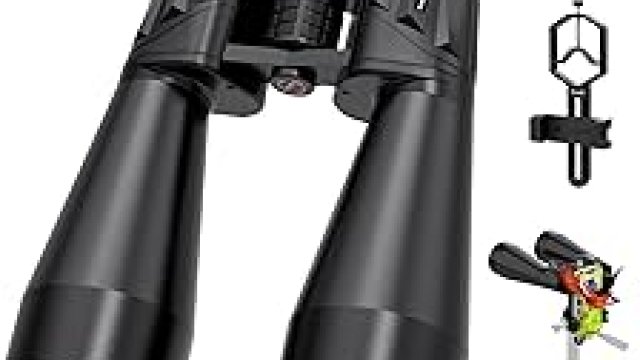
18×70 Professional Astronomy Binoculars Adults High: Best Accessory Kit for Beginners
#6
18×70Tripod + phone adapter
8.0OUT OF 10
Optical Quality7.8
Build Quality7.5
Ease of Use8.5
Value for Money8.2
This is the only binocular in the lineup that ships with both a tripod and a phone adapter, making it the true plug-and-play option. The 18x magnification is a sweet spot that gives you more reach than the Cometron without the shake issues of the 25x model. The 70mm aperture with BaK-4 prisms and fully multi-coated lenses delivers bright, sharp images of the moon, planets, and brighter deep-sky objects.
The included tripod is lightweight aluminum, adequate for the 3.2-pound binoculars, and the phone adapter lets you capture digiscoped images of the moon through the eyepiece. The binoculars are also waterproof and nitrogen-purged, adding to their versatility. The center focus wheel is smooth with a good range of adjustment.
Flaws but not dealbreakers. The included tripod is not as sturdy as a dedicated photo tripod, and some owners report that the phone adapter can be fiddly to align with the eyepiece. The optical quality is good but not quite on the same level as the Celestron SkyMaster models, with slightly more chromatic aberration visible on bright objects.
If you want the best optical quality in this price range, the
Celestron SkyMaster 15×70 offers superior BaK-4 optics and a larger aperture for less money, though you’ll need to buy a tripod separately.
⚠Tripod: The included tripod is suitable for this binocular but may not be adequate for heavier models. Consider upgrading if you want a more stable platform.
Pros
- ✓Includes tripod and phone adapter out of the box, saving you a significant accessory purchase
- ✓18x magnification is a great balance between reach and stability for tripod use
- ✓Waterproof and nitrogen-purged, suitable for damp conditions and coastal use
- ✓BaK-4 prisms with FMC lenses produce good contrast and brightness for the price
Cons
- ✕Included tripod is lightweight and not as stable as a dedicated photo tripod
- ✕Phone adapter can be tricky to align with the eyepiece for sharp digiscoping
- ✕More chromatic aberration visible on bright objects compared to Celestron models
Best for: Beginners who want everything in one box, including a tripod and phone adapter, for easy setup and digiscoping.
Buying Guide: Aperture, Magnification, and What Else Matters
Picking the right stargazing binocular comes down to a few key specs. Here is what you actually need to know before you buy.
Aperture: The Single Most Important Number
The aperture (the diameter of the objective lens in millimeters) determines how much light your binocular collects. More light means you see fainter stars, more nebulosity, and dimmer galaxies. The models here range from 50mm to 80mm, and the difference is dramatic.
The 80mm Celestron SkyMaster 20×80 collects 2.5 times more light than a 50mm model, which is the difference between seeing the Andromeda Galaxy as a faint smudge and seeing it as a detailed elongated glow with a bright core.
For serious stargazing, aim for at least 70mm aperture. The Celestron SkyMaster 15×70 and the 20×80 are the top picks here because they balance light collection with portability.
Exit Pupil: How Bright the Image Looks
The exit pupil is calculated by dividing the aperture by the magnification. A 70mm binocular at 15x gives a 4.7mm exit pupil, which matches the size of your dilated pupil in dark conditions. That means all the light collected reaches your eye.
The 20×50 model gives only a 2.5mm exit pupil, which means the image looks dimmer even though the magnification is higher.
A good rule of thumb is to look for an exit pupil between 4mm and 7mm for astronomy. Below 3mm, deep-sky objects become hard to see. The Celestron Cometron 7×50 has a 7mm exit pupil, which is ideal for dark-adapted eyes.
Tripod Requirements: Be Honest With Yourself
Any binocular with 10x magnification or higher benefits from a tripod. At 15x and above, a tripod is mandatory for steady views. The 15×70, 20×80, and 25×70 models all require a stable mount.
The 7×50 Cometron is the only one you can comfortably use handheld.
If you do not want to deal with a tripod, stick with the Cometron. If you are willing to set one up, the 18×70 Professional Astronomy Binoculars includes a tripod in the box, which saves you an extra purchase.
Who Should NOT Buy Best Binoculars for Stargazing
This category is the wrong purchase for three kinds of buyers. Here is who they are and what to look at instead.
You Want to See Planets in Detail
Even the highest magnification binocular here at 25x will not show you the rings of Saturn as a distinct ring or the cloud bands of Jupiter. You need a telescope with at least 50x to 100x magnification for that. A 4-inch or 6-inch Dobsonian telescope will give you planetary views that no binocular can match, and they are often available at a similar price point to the premium binoculars here.
You Have Unsteady Hands or a Medical Condition
If you have essential tremor, arthritis, or any condition that makes holding a binocular steady difficult, the high-magnification models like the 15×70 and 20×80 will be unusable even with a tripod. The 7×50 Cometron is your only viable option from this list, but even then you might be better off with a pair of image-stabilized binoculars from Canon or Fujinon, which use gyroscopic stabilization to cancel out hand shake. They cost more but are worth it for your situation.
You Only Stargaze on Impromptu Nights
If you like to grab your gear and head outside on a whim without setting up a tripod, the 15×70, 20×80, and 25×70 models will frustrate you. They require a tripod, which means carrying extra weight and spending time on setup. The 7×50 Cometron is the only handheld option here, but if you want even more portability, look at compact 8×42 or 10×42 binoculars designed for birding.
They will not show as much deep-sky detail, but they are ready to use in seconds.
Final Verdict
The Celestron SkyMaster 15×70 is the best binocular for stargazing because it delivers the brightest, sharpest deep-sky views at a price that leaves room for a decent tripod. It is the one that will show you the Orion Nebula as a glowing cloud, the Andromeda Galaxy as a distinct spiral, and star clusters that fill the field of view.
Want a handheld option you can grab and go? The Celestron Cometron 7×50 is the only one here that works without a tripod, and its wide field of view makes it perfect for sweeping the Milky Way. Need maximum light for the faintest objects?
The Celestron SkyMaster 20×80 is your light bucket.
If you want a complete kit with a tripod and phone adapter, the 18×70 Professional Astronomy Binoculars is the easiest way to get started. And if you need waterproofing for coastal viewing, the 20×50 High Powered Binoculars is your only sealed option.
Still unsure? Look back at the Who Should NOT Buy section. If you fit any of those profiles, save your money for a different tool.
If you are ready to see the night sky in a new way, pick one of these and start looking up.
FAQ
What's the best binoculars for stargazing overall?
The Celestron SkyMaster 15×70 is the best overall pick. It offers the best combination of aperture, magnification, optical quality, and value for anyone serious about deep-sky observing.
Can I use astronomy binoculars for daytime birding?
Yes, but with caveats. The 7×50 Cometron works well for daytime use because of its wide field of view and lower magnification. The 15×70 and higher models are too heavy and have too narrow a field of view for comfortable daytime birding.
Do I need a tripod for stargazing binoculars?
Any binocular with 10x magnification or higher benefits from a tripod. At 15x and above, a tripod is mandatory for steady, usable views. The 7×50 Cometron is the only model in this list that works well handheld.
How do I know which magnification to choose?
Lower magnification like 7x gives a wider field of view and steadier handheld use. Higher magnification like 20x or 25x shows more detail but requires a tripod and has a narrower field. For most beginners, 15x is a good balance.
What does BaK-4 mean on binocular specs?
BaK-4 is a type of glass used in the prisms of binoculars. It has a higher refractive index than BK-7 glass, which means it produces brighter images with sharper edges and less light loss. All the Celestron models in this list use BaK-4 prisms.
Can I take pictures through these binoculars?
Yes, with a phone adapter. The 18×70 Professional Astronomy Binoculars includes one, and you can buy third-party adapters for the other models. You will get the best results on bright objects like the moon.